

Press Brake Tooling FAQ: Quick Answers on Fit, Lead Times & Custom Specs
Welcome to the CAMT Technical FAQ Center. Access clear, practical guidance on press brake tooling compatibility, lead times, custom OEM/ODM solutions, and quality standards to streamline your procurement and engineering decisions.
Built for global procurement managers, sheet metal fabricators, distributors, and engineering teams seeking dependable, high-precision bending tools.
Guaranteed Compatibility
Verified fits across major press brake styles and clamping systems
Custom OEM / ODM
Engineered punches, dies, and special profiles from your drawings
Rapid Global Dispatch
Stocked standard items and accelerated custom production
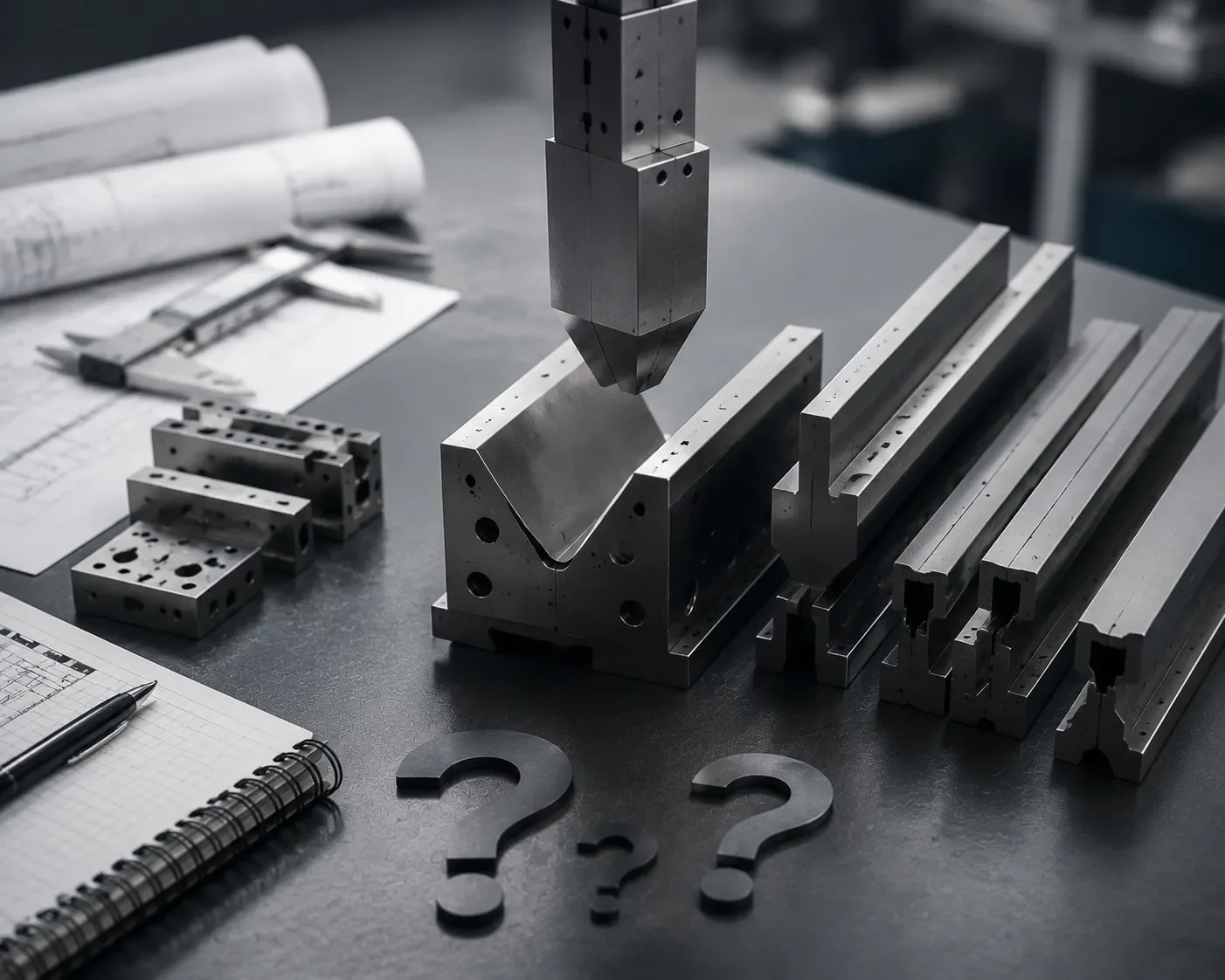
Quick Answer Directory for Tooling & Manufacturing
CAMT structures this FAQ guide around the real decision-making steps of procurement and engineering teams, helping you verify machine compatibility, confirm delivery timelines, and resolve technical specifications.
Tooling Compatibility
Confirm press brake machine fitment, punch and die matching, V-opening selection and clearance requirements.
Lead Time & Stock Inventory
Review standard tooling availability, custom production cycles and global delivery support.
Customization & OEM Specs
Submit drawings, request special profiles, and develop customized tooling solutions.
Quality & Heat Treatment
Understand CNC grinding, hardness control, dimensional accuracy and wear resistance.
Purchasing & After-Sales
Get support for MOQ, packaging, shipping options and technical communication.
Need Custom Technical Support?
Send your drawings directly to CAMT engineers for tooling evaluation and technical recommendations.
Press Brake Tooling Compatibility FAQ
Get precise answers on machine fitment, die selection, and part interference to eliminate purchasing errors before you order.
Which press brake brands and tonnage ranges is CAMT tooling compatible with?
CAMT precision press brake tooling is engineered for seamless integration with all major press brake brands, including Amada, Trumpf, Bystronic, LVD, Durma, Accurl, and Cincinnati, handling tonnage ratings from 40 to over 1,000 tons.
Share your machine make, model, and clamping system with us to receive a guaranteed compatibility verification before placing your order.
How do I confirm fit between upper punches, lower dies, gooseneck, radius, and offset tools?
Matching depends on your machine’s tang style (European Precision, American Traditional, Wila/TRUMPF Standard, or custom) and clamp receiver dimensions, especially when using gooseneck punches or offset punches.
Send us your upper ram and lower bed clamping specifications. CAMT’s application engineers will evaluate profile heights, shut height, and load limits to recommend the ideal punch and die pairing.
How do I choose the correct V-die opening for my application?
For air bending, the standard rule of thumb is V-opening = 6 to 8× sheet thickness for gauge materials, extending to 10–12× for high-tensile alloys or heavy plate.
- Mild Steel (1.0–3.0 mm): V = 8–16 mm
- Stainless Steel / High-Strength Alloys: V = 10–20 mm
- Aluminum (Soft/Medium grades): V = 8–14 mm
Provide your material specification, thickness, and required inner radius for a precise V-width recommendation tailored to your press capacity.
How do I verify whether tooling will interfere with the workpiece or machine frame?
Collision risks increase on deep channels, narrow return flanges, and complex multi-bend profiles. Key clearance checks include:
- Punch relief depth vs. return flange length
- Backgauge finger clearance during secondary bend sequences
- Available open height, stroke length, and throat depth
Upload your part CAD file (2D or 3D). CAMT will run a 2D/3D bending simulation to flag potential collisions before manufacturing your tooling.
What technical data does CAMT require to confirm compatibility?
To provide a 100% verified tooling layout, our engineering team asks for:
- Part drawings (DXF, STEP, or detailed PDF)
- Press brake model, total tonnage, and working length
- Material type, tensile strength, and sheet thickness
- Target bend angles, internal radii, and critical dimensions
- Existing clamping setup or adapter system details
Submitting complete drawings allows CAMT to optimize tooling geometry and prevent costly production downtime.
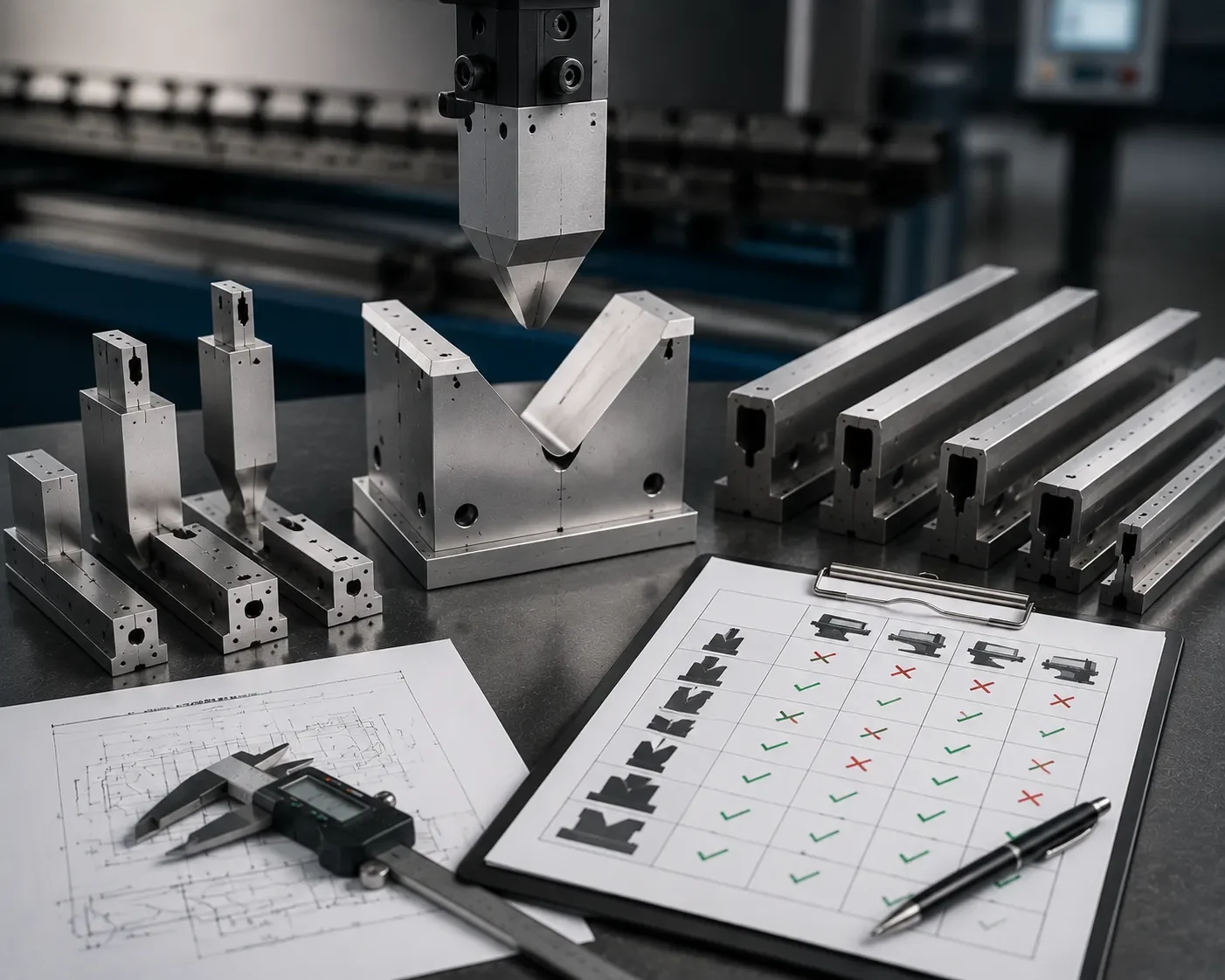
Selection Checklist
- 1 Confirm press brake make, model, and tonnage
- 2 Identify clamping mechanism and tang profile
- 3 Specify sheet material, thickness, and bend angle
- 4 Submit part drawing for collision check
- 5 Receive verified tooling layout & quotation
Need Help Verifying Tooling Fit?
Send your part drawings and machine specs to CAMT. Our engineers will verify compatibility, model the bend sequence, and confirm fitment—free of charge.
Request Fit ConfirmationCustom Manufacturing & OEM/ODM Services FAQ
Clear answers on custom press brake tooling, drawing evaluations, trial sampling, and private-label manufacturing capabilities at CAMT.
Q1 Can you manufacture non-standard sizes, custom angles, special materials, or coatings?
Yes. CAMT produces custom press brake tooling tailored to your machine specs and metal forming requirements. For demanding bends, we also recommend gooseneck punches to improve clearance. We support non-standard heights, custom V-openings, specific radii, acute angles, high-wear alloy steels, and specialized surface treatments to maximize tool life.
Q2 How does pre-quotation drawing optimization help prevent bending issues?
Our engineering team reviews your part drawings before issuing a quote. We analyze bending sequences, tonnage limits, and clearance profiles to identify collision risks early, refine tool geometry, and ensure seamless compatibility on your press brake. We also verify tooling selection, including offset punches, when access or clearance is tight.
Q3 What options are available for OEM branding, custom packaging, and laser marking?
We offer end-to-end OEM and ODM support for distributors and equipment builders. This includes precision laser marking for part numbers or logos, custom paint finishes, anti-rust protective wraps, and customized export-grade wooden packaging tailored to your brand standards.
Q4 Can we verify a trial sample piece before committing to a full production order?
Yes. We offer prototype development and trial sample verification for complex or large-volume projects. Samples undergo rigorous dimensional and hardness testing, complete with inspection reports, to guarantee accuracy before mass production begins.
5-Step Custom Tooling Process
A structured workflow ensuring precision, speed, and reliability.
Requirement Submission
Provide your part drawings, machine model, tonnage, and target sheet thickness.
Engineering & Drawing Optimization
CAMT engineers evaluate clearances, stress points, and bending geometry.
Proposal & Cost Approval
Review finalized 2D/3D tooling specs, material grades, lead times, and pricing.
Prototyping & Quality Checks
Manufacture test samples and perform full CMM and hardness inspections.
Batch Production & Export Delivery
Execute precision grinding, heat treatment, custom marking, and global shipping.
Engineering Support
Get drawing reviews before committing to custom press brake tooling production.
Need Support for a Custom Bending Application?
Share your part drawings, material details, and machine specifications. CAMT engineers will review your requirements and recommend the right tooling solution.
Lead Times, MOQ, and Global Shipping FAQ
CAMT supports fast delivery and export-ready packaging for global customers with cross-border procurement needs. Find direct answers regarding production cycles, order minimums, and international freight options below. If your order includes express press-brake tooling or press-brake punches, we can align packaging and dispatch around your schedule.
Streamlined Order Fulfillment Workflow
4-Step ProcessSpecification Confirmation
Send completed CAD/3D drawings and material specs for immediate quotation and feasibility review.
Production Planning
Standard components enter immediate stock dispatch; custom orders enter automated CNC scheduling.
Export Packaging
Heavy-duty, ocean-grade reinforced packaging with moisture barriers and custom shockproofing.
Global Shipping
Fast dispatch via air express, sea freight, or multimodal options with real-time tracking support.
What are the standard vs. custom item lead times?
Lead time directly depends on component complexity, material availability, and required surface treatments:
- Standard Stock Items: Dispatched within 3 to 5 business days.
- Custom Precision Parts: Typically 15 to 25 business days based on tooling and CNC machining cycles.
To accelerate your order, submit fully dimensioned engineering drawings early.
Is the Minimum Order Quantity (MOQ) flexible for trial orders?
Yes, CAMT offers flexible MOQ terms to support low-volume prototyping and small-batch production trials:
- Standard Parts: Low or zero MOQ requirements for off-the-shelf inventory.
- Custom Projects: Prototype runs starting as low as 1 to 10 units before scaled production.
Flexible MOQ options help verify design accuracy while lowering early-stage financial commitment.
Is packaging suitable for long-distance export and sea freight?
All shipments utilize export-grade packaging engineered to withstand cross-border logistics and ocean transit:
- Heavy-duty ISPM 15 compliant fumigated wooden crates.
- VCI anti-corrosion film and vacuum-sealed desiccant protection against sea moisture.
- Custom shock-absorbing foam inserts to eliminate internal component movement.
Specialty items such as offset punches can also be packed for sea freight with the same export-grade protection.
What global shipping methods are available?
We provide comprehensive international logistics solutions tailored to your schedule and budget:
- Air Freight & Express: DHL, FedEx, UPS (3–7 days) for urgent or high-value orders.
- Sea Freight: FCL and LCL options (20–40 days) for large-volume cost optimization.
- DDP / DAP Delivery: Full door-to-door customs clearing services available globally.
How can buyers accelerate overall order progress and fast delivery?
Order speed is directly influenced by communication speed and technical readiness. Buyers can prevent production delays by executing three key actions:
1. Complete Drawings
Provide complete 2D (STEP/IGS) and 3D files with explicit tolerances and surface finish specs.
2. Fast Design Sign-off
Confirm Engineering Change Orders (ECO) and DFM suggestions promptly during pre-production.
3. Standard Material Selection
Opt for readily available standard stock metals/polymers to eliminate raw material lead times.
Streamline Your Industrial Sourcing with CAMT
Get transparent delivery schedules, flexible trial order quantities, and reliable global shipping solutions tailored to your commercial requirements.
Materials, Heat Treatment & Quality Control FAQ
Discover how CAMT's products combine high-hardness tool steel, vacuum heat treatment, and precision grinding to deliver long-term wear resistance, strict dimensional tolerances, and reliable batch-to-batch bending accuracy.
High-Hardness Tool Steel Selection
We utilize premium alloy tool steels like 42CrMo and Cr12MoV, optimized for heavy mechanical loads, high tonnage, and abrasive sheet metal forming.
- Balanced core toughness & surface hardness
- Extended service life under continuous production
CNC Machining & Heat Treatment
Computer-controlled vacuum quenching and deep tempering eliminate internal stress, maintaining microstructural stability and preventing tool warping.
- Uniform 47–60 HRC depth hardening (per alloy)
- Stress-relieved for high-tonnage stability
Precision Grinding & Tolerances
Multi-axis precision CNC grinding ensures micron-level accuracy across working radii and V-opening contact surfaces to guarantee part repeatability.
- Dimensional tolerances up to ±0.01 mm
- Fine surface finish to minimize sheet marking
Precision QA Verification
Micron-level dimensional checks & structural integrity auditing
Rigorous Inspection Checkpoints Across Production
CAMT enforces strict quality verification at every stage of manufacturing. Our closed-loop testing protocol prevents dimensional drift and guarantees tooling longevity in high-duty bending operations.
1. Raw Material Spectrometry
Chemical composition analysis and ultrasonic flaw detection before machining begins.
2. In-Process CNC Verification
Real-time dimensional tracking during roughing and finishing to preserve exact profile geometry.
3. Hardness Profile Auditing
Multi-point Rockwell (HRC) testing along tool working surfaces to confirm uniform depth hardness.
4. CMM & Surface Inspection
3D Coordinate Measuring Machine (CMM) and surface roughness testing prior to final coating and dispatch.
Frequently Asked Questions
Technical details on material selection, heat treatment standards, and quality management.
Which high-hardness tool steels are best for press brake tooling?
How does heat treatment affect press brake tool life and dimensional accuracy?
How are hardness consistency, tolerances, and surface quality controlled?
Why is long-term tooling stability vital for high-volume batch bending?
Support That Goes Beyond the Sale
CAMT delivers end-to-end technical support — from pre-order evaluation to long-term after-sales assistance across our products — so your projects launch faster and run reliably.
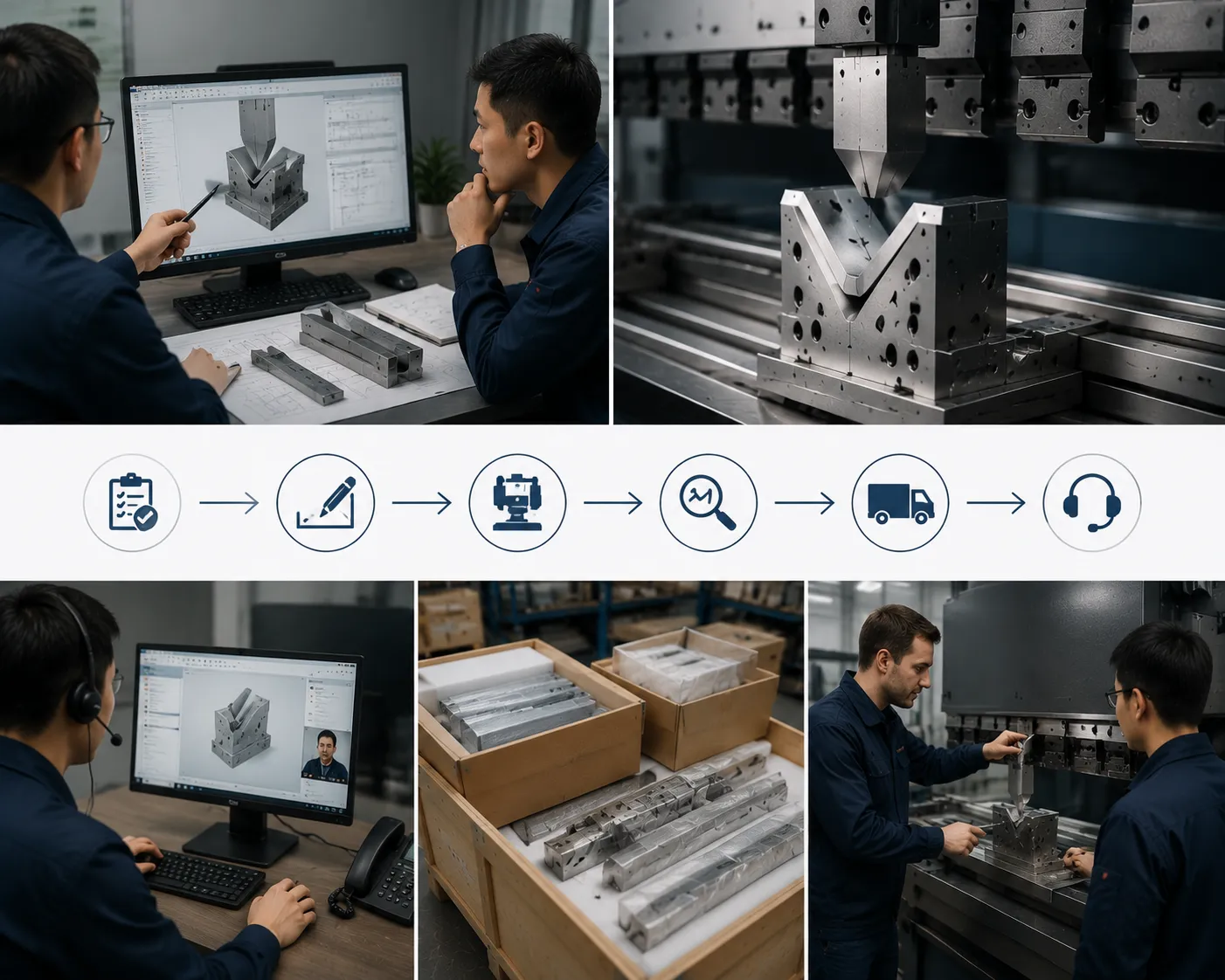
Full-Cycle Service Coverage
-
Pre-Order Selection Guidance
Our engineers help you choose the right press brake tooling before you commit — reducing costly trial-and-error.
-
Drawing Optimization & Process Advice
We review your drawings and suggest process improvements to maximize bend accuracy and tool life.
-
After-Sales Troubleshooting
Bending defects or dimensional issues? Our team diagnoses root causes and delivers actionable fixes fast.
-
Alternative Solutions & Upgrade Options
When requirements evolve, we propose compatible alternatives like press brake punches or upgraded tooling without disrupting your workflow.
-
Long-Term Specification Consistency
We maintain your project specs on file, ensuring repeat orders match original tolerances — every time.
Frequently Asked Questions
Can I get tooling selection advice before placing an order?
Does CAMT support drawing optimization and process improvement?
What happens if I encounter bending problems after delivery?
Can CAMT suggest alternative or upgraded tooling solutions?
Can the same project specifications be maintained for repeat orders?
Need Technical Assistance?
Submit your tooling requirements and receive professional guidance from CAMT engineers within one business day.
Need Help Selecting the Right Tooling or Custom Dies?
If your bending application requires additional guidance, send your part drawings or machine specifications to CAMT. Our application engineers will review your requirements, verify compatibility, and recommend the right press brake tooling solution.
Start Your Tooling Evaluation
Share your project requirements and receive professional recommendations from CAMT engineering specialists.
Supporting procurement teams, OEM manufacturers, and custom bending projects worldwide.