
Technical Anatomy: What Is a 4-Way Press Brake Die?
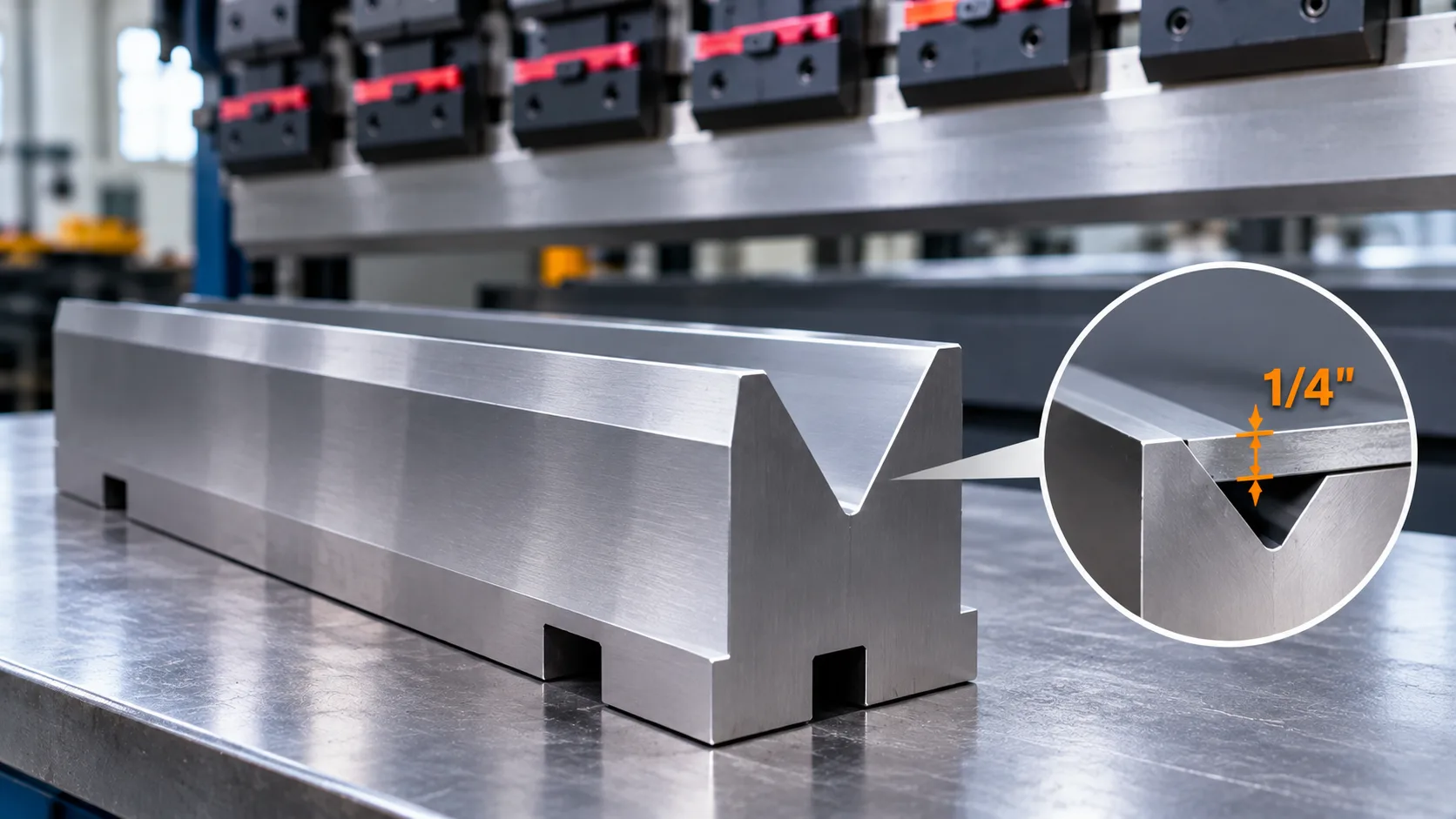
A monoblock 4-way die (also known as a cross die or four-way bottom block) is a traditional press brake bottom tooling solution machined from a single solid billet of high-tensile alloy steel (typically 42CrMo or equivalent induction-hardened tool steel).
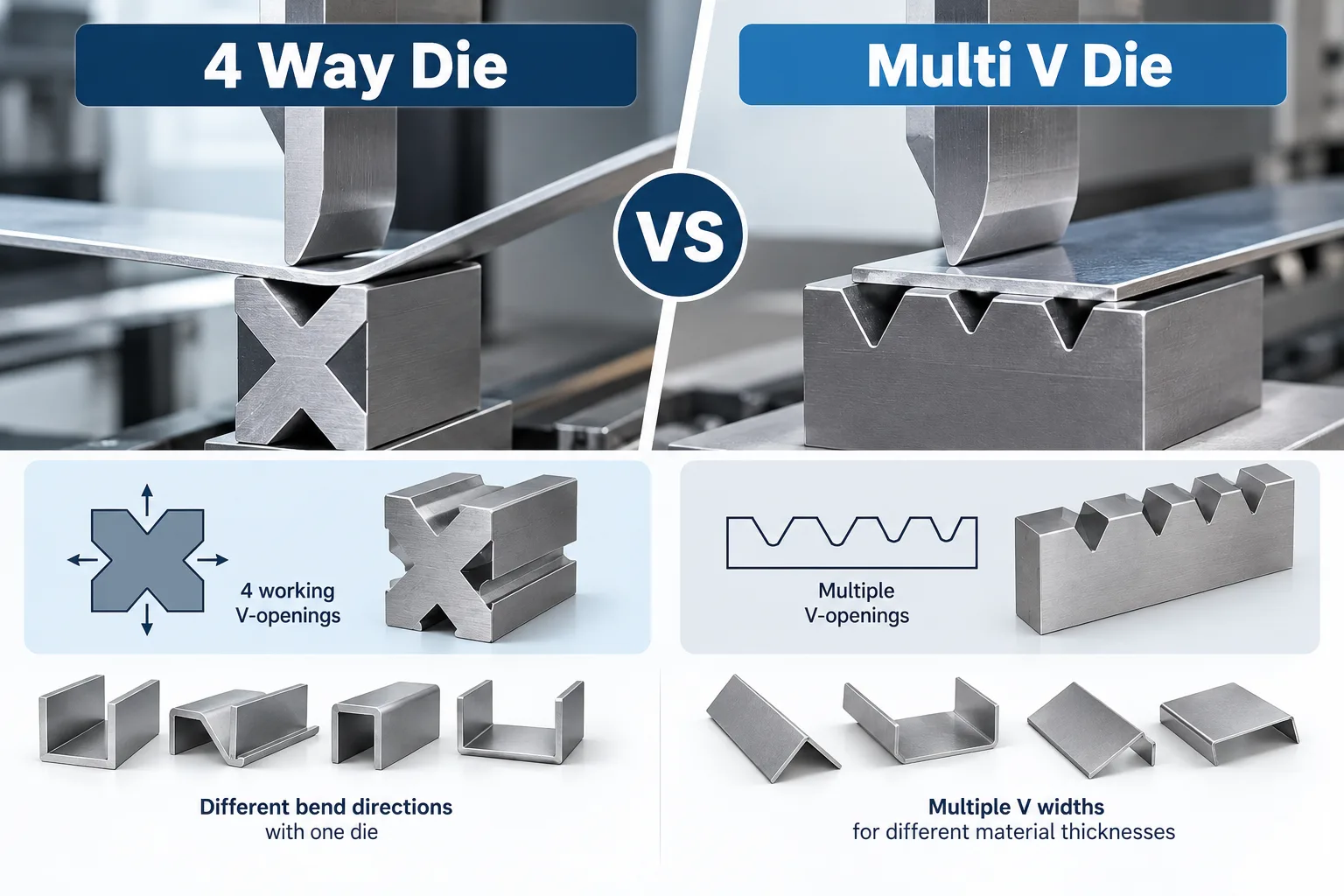
Its cross-shaped profile features four distinct V-groove openings machined into each of its four faces at 90-degree intervals. This geometry allows fabricators to handle multiple sheet metal thicknesses without purchasing separate single-V blocks.
[ V-Groove 1 ]
|
[ V-Groove 4 ]-[ Core ]-[ V-Groove 2 ]
|
[ V-Groove 3 ]
Monoblock Cross Die Mechanical Specifications
| Specification Parameter | Standard Configuration | Engineering Note |
|---|---|---|
| Material Grade | 42CrMo / 4140 Steel | Quenched & tempered; working shoulders induction hardened (50–55 HRC) |
| V-Opening Combinations | 12 mm, 16 mm, 22 mm, 35 mm (or custom) | Steps scaled to support 1.0 mm up to 6.0 mm plate bending |
| Included V-Angles | 85°, 88°, or 90° | Optimized for standard air bending tooling and bottoming |
| Bed Mounting | Flat bottom with central alignment tang | Secures via mechanical side set-screws or standard bed holders |
| Standard Lengths | 500 mm, 835 mm, to full-length single bars (3000 mm+) | Sectionalized or single-piece monoblock construction |
Operational Workflow: Indexing and Rotation
Switching between V-groove openings on a traditional monoblock 4-way die requires physical intervention:
- Unclamping: Loosen all mechanical set-screws along the lower bed holder.
- Lifting and Rigging: For lengths over 1 meter, hook overhead crane straps or use a forklift to hoist the die clear of the bed.
- Manual Rotation: Rotate the heavy bar 90° or 180° to bring the target V-opening to the top position.
- Reseating and Centerline Alignment: Lower the die into the holder, manually verify punch-to-die centerline alignment under light clamping pressure, and retighten all locking bolts.
Key Engineering Advantages
- Low Initial Investment: Delivers four distinct V-openings in a single purchase, drastically lowering upfront tooling acquisition costs.
- Maximum Static Rigidity: The solid monoblock construction contains zero moving parts, providing reliable structural resistance against deformation under high bending tonnage.
- Broad Machine Compatibility: Installs directly onto flat press brake beds and standard mechanical clamping rails without requiring specialized hydraulic adapters.
Operational Limitations and Shop-Floor Drawbacks
- Setup Bottlenecks: Manual rotation and re-centering can consume 15 to 45 minutes per changeover, bottlenecking high-mix low-volume (HMLV) production.
- Safety and Ergonomic Risks: Flipping solid steel blocks weighing hundreds of kilograms creates significant crush hazards and heavy-lifting fatigue for operators.
- Crane Dependency: Large monoblock dies require overhead crane availability, causing idle machine time while operators wait for rigging equipment.
- Non-Uniform Wear: Frequent use of a single popular V-groove wears down specific shoulders over time, requiring full-die regrinding even if the other three grooves remain intact.
Technical Anatomy: What Is a Multi-V Die (Fixed & Adjustable)?
Fixed Multi-V Blocks vs. Adjustable Modular Systems
Understanding the mechanical split between these two designs helps determine the right fit for your bed length and plate requirements:
| Tooling Feature | Fixed Multi-V Block | Adjustable Multi-V Die System |
|---|---|---|
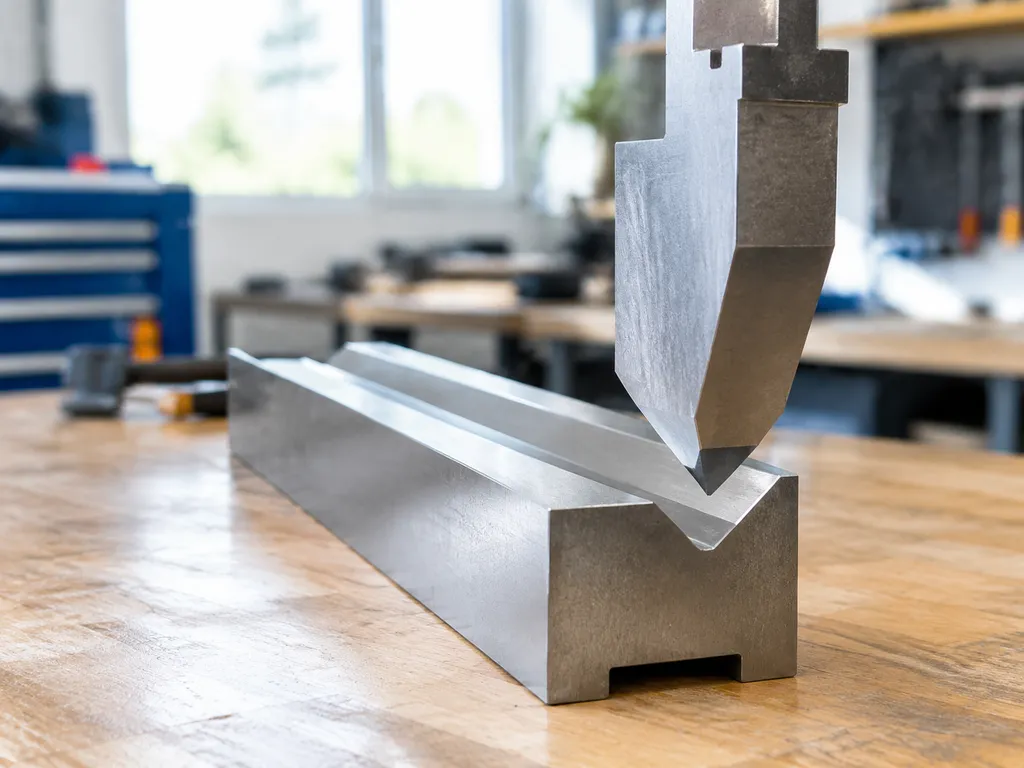
| Structure | Solid, machined block with several parallel V-grooves | Two split, sliding tooling jaws on a shared base bed |
| Adjustment Method | Repositioning punch along the bed to align with the chosen pocket | Manual shims, precision spacer bars, or CNC servomotors |
| V-Opening Range | Fixed set (e.g., V6, V10, V16, V25) | Infinitely variable or step-adjustable (e.g., V25 to V400+) |
| Typical Use Case | Sheet metal and light gauge forming | Medium to heavy plate bending and high-mix fabrication |
Mechanical Features of Modern Multi-V Tooling
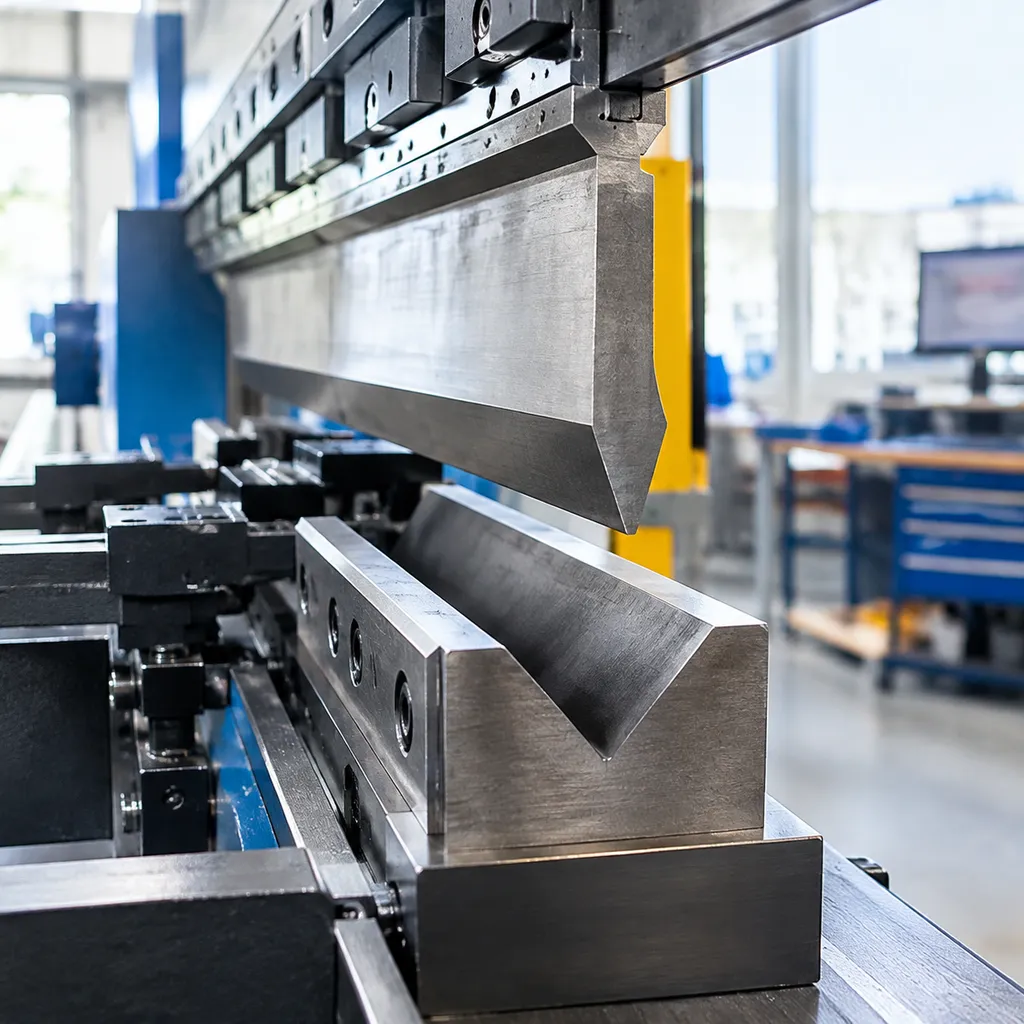
Modern adjustable multi-V die systems incorporate dedicated engineering elements to handle extreme loads while protecting both the workpiece and the machine:
- Hardened Shoulder Rollers: Replace static edges with rotating, case-hardened alloy rollers (typically 58–62 HRC) to cut friction, prevent sheet galling, and reduce tonnage demand by up to 30%.
- Precision Spacer Bars & Shims: Drop-in gauge bars lock the jaw opening to exact widths in minutes, maintaining centerline repeatability under heavy tonnage.
- CNC Motorized Integration: Advanced systems connect directly to the press brake controller, automatically opening and closing the V-jaws via drive screws to match job parameters referenced in a standardized press brake V die chart and tonnage guide.
[ Punch Force ]
│ │
▼ ▼
┌───┐ ┌───┐ <-- Replaceable Hardened Rollers
( O ) ( O )
│ │◄───►│ │ <-- Variable V-Opening (Spacer/CNC Controlled)
└─────┘ └─────┘
═════════════════════ <-- Heavy-Duty Base Bed & Guide Rails
Key Engineering Advantages
- Stationary Safety: The tool stays bolted to the bed. Operators never need an overhead crane or forklift to flip heavy steel blocks between sheet gauge changes.
- Broad Plate Range: A single modular unit handles everything from 4 mm mild steel to 25 mm high-strength plate simply by changing the spacer blocks or running the motor.
- Drastic Setup Reduction: Swapping V-widths takes under two minutes with spacers and seconds with CNC drives, keeping cycle times low and machines running.
Maintenance Considerations for Moving Tooling Systems
Adjustable modular systems have moving parts that require regular upkeep to ensure accurate bend angles:
- Shoulder Roller Inspection: Inspect roller pins and needle bearings for debris and flat spots; replace worn inserts immediately to avoid localized marking.
- Guide Rail and Lead Screw Upkeep: Clear scale, rust, and plate dust from sliding surfaces daily, followed by automated or manual lubrication.
- Debris Evacuation: Heavy forming generates mill scale that drops between the jaws. Ensure scrap chutes and base pockets are vacuumed regularly to prevent jaw misalignment.
Head-to-Head Comparison: 4-Way Die vs. Multi-V Die
Evaluating a 4-way die vs multi-V die comes down to balancing initial tooling spend against daily production speed, operator safety, and part surface requirements.
| Feature / Metric | Traditional Monoblock 4-Way Die | Adjustable / Modular Multi-V Die |
|---|---|---|
| Typical Changeover Time | 15–45 minutes (crane/rigging required) | 1–5 minutes (shim plates or CNC drives) |
| Operator Safety Risk | High (flipping heavy solid steel blocks) | Low (tool stays bolted to the bed) |
| V-Opening Range | Fixed to 4 pre-machined profiles | Continuously variable or modular increments |
| Surface Finish Quality | High friction; prone to sheet galling | Low friction; optional hardened roller shoulders |
| Bed Tonnage & Deflection | Solid continuous baseline support | Segmented load transfer requiring precise shimming |
| Upfront Cost | Budget-friendly initial purchase | Higher initial capital expenditure |
Setup Speed and Changeover Efficiency
Rotating a solid 4-way press brake die requires unbolting bottom clamps, slinging the tool to an overhead crane or forklift, hoisting it, rotating the block 90 degrees, and realigning the center groove. This process easily takes 20 to 45 minutes of non-productive machine downtime.
In contrast, an adjustable press brake die stays locked on the machine bed. We change the V-groove opening in minutes by swapping precision spacer bars or letting automated CNC drive shafts reposition the saddle jaws.
Operator Safety and Ergonomics
Handling a solid 4-way block weighing hundreds of kilograms presents serious pinch, crush, and strain hazards. Eliminating physical die rotation removes high-risk rigging maneuvers from the shop floor entirely. Multi-V systems remain stationary, isolating the operator from heavy lifting and significantly reducing fatigue during multi-thickness shifts.
Tonnage Distribution and Bed Deflection
- 4-Way Monoblock Dies: Offer continuous, solid-mass rigidity directly over the press brake bed. They handle heavy localized impact well, though uneven wear on individual grooves over time can complicate CNC crowning compensation.
- Multi-V Systems: Feature segmented or adjustable load paths. High-tonnage operations must ensure correct shoulder engagement and bed seating to prevent localized deflection during heavy air bending.
Surface Protection and Galling Prevention
Standard 4-way dies feature fixed, machined shoulder radii. When forming aluminum, stainless steel, or pre-painted sheet metal, sliding friction across static tool shoulders causes tool pick-up and sheet galling.
Modern multi-V designs often integrate hardened, roll-in shoulder inserts or rotating rollers. These components convert sliding friction into rolling contact, minimizing drag marks and maintaining clean part aesthetics.
Thickness Versatility and Long-Term Labor ROI
While a 4-way cross die delivers an economical entry point for standard structural bending, it limits your flexibility to four fixed openings. When job mixes expand to varying gauges and high-strength steels (like Hardox or Weldox), fixed geometries force additional tooling purchases.
Although an adjustable multi-V setup requires a larger initial capital investment, shops running high-mix, low-volume (HMLV) batches routinely recoup that cost within 6 to 12 months through reclaimed changeover hours and reduced scrap rates.
Application Matrix: Choosing the Right Bottom Tooling for Your Shop
Selecting the right press brake bottom tooling directly impacts your daily throughput, operator safety, and bend accuracy. When evaluating a 4-way die vs multi-V die, the choice comes down to your shop’s mix of sheet thicknesses, batch sizes, and plate materials.
| Production Factor | Monoblock 4-Way Die | Adjustable Multi-V Die |
|---|---|---|
| Primary Batch Type | High-volume, low-mix (dedicated setups) | High-mix, low-volume (HMLV) |
| Material Thickness Range | 1.0 mm to 6.0 mm standard sheet | 6.0 mm to 30.0+ mm heavy plate |
| High-Strength Alloys (Hardox/Weldox) | Limited suitability (high shoulder wear) | Ideal (hardened rollers absorb extreme loads) |
| Average Changeover Time | 15–45 minutes (crane/manual flip) | Under 2 minutes (spacer adjustment or CNC) |
| Upfront Capital Cost | Low | Moderate to high |
| Shop Footprint Impact | Single-block storage per machine | Replaces dozens of dedicated single V-blocks |
When to Choose a 4-Way Die: High-Volume, Low-Tonnage Runs
We recommend a traditional 4-way press brake die when your manufacturing floor runs consistent, repetitive parts on standard gauges:
- Single-Thickness Production Runs: If your press brake runs 10-gauge to 16-gauge mild steel all week, a 4-way monoblock provides excellent static rigidity and stable alignment without ongoing adjustments.
- Tight Tooling Budgets: For standard job shops operating on modest capital budgets, 4-way dies offer four standard V-grooves in a single profile at a fraction of the cost of modular tooling.
- Light-to-Medium Air Bending: When forming parts below 6 mm thickness, the tonnage remains low enough that shoulder wear and manual indexing remain manageable.
When to Choose an Adjustable Multi-V Die: HMLV Jobs and Heavy Plate
For custom job shops, heavy structural fabricators, and facilities running high-strength steel, an adjustable multi-V die eliminates common setup bottlenecks:
- High-Mix, Low-Volume (HMLV) Contracts: When you switch between 4 mm, 8 mm, 12 mm, and 20 mm plates several times per shift, swapping shim spacers takes seconds and eliminates crane-assisted tool flips.
- Heavy Plate and High-Yield Materials: Bending wear-resistant alloys like Hardox and Weldox requires large V-openings and massive tonnage. Adjustable systems with hardened, replaceable roller shoulders reduce forming tonnage by up to 30% and prevent material galling.
- Workplace Ergonomics and Safety: Eliminating overhead crane rigging to rotate 300 kg bottom dies protects operators and prevents costly drop-induced damage to machine beds.
The Hybrid Tooling Strategy: Balancing Modular Systems with Dedicated Dies
Most productive fabrication floors do not rely entirely on a single tooling style. We frequently deploy a hybrid setup strategy:
- Base Load on Multi-V Systems: Mount an adjustable multi-V die on large-tonnage press brakes to cover everything from 8 mm structural parts to 25 mm plate with zero physical tool swaps.
- Dedicated High-Speed Precision Stations: Keep specialized single-V or 4-way dies on smaller, fast-cycling press brakes for light sheet enclosures, small brackets, and thin stainless components requiring tight radii.
- Maximized Machine Uptime: This setup keeps high-tonnage machines running continuously while reserving nimble machines for rapid, light-gauge part runs.
Best Practices for Maximizing Die Life and Bending Accuracy
V-Opening Calculation Rules: Standard vs. High-Strength Steel
Choosing the correct V-groove opening directly dictates bending tonnage calculations, springback behavior, and tool longevity:
- The Standard 8×T Rule (Mild Steel & Aluminum): For standard structural steel and soft alloys, set the V-opening to 8 times the sheet thickness (V = 8 × T). This maintains a balanced inside bend radius approximately equal to material thickness while keeping forming tonnage within nominal limits.
- The 10×T to 12×T Rule (High-Strength & Abrasion-Resistant Steel): When bending high-yield materials like Hardox or Strenx, increase the V-opening to 10 × T or 12 × T. High-tensile plate generates severe localized pressure; expanding the opening reduces required tonnage and prevents cracking along the bend line.
- The Danger of Undersized Openings: Forcing thick plate into a narrow V-groove causes massive tonnage spikes, deep tool markings, and permanent shoulder deformation on bottom tooling.
Shoulder Radius Maintenance and Wear Detection Protocols
The die shoulder radius absorbs the highest friction and compressive load during air bending. Maintaining this surface is vital for consistent workpiece angle accuracy.
- Visual and Dimensional Inspection: Check die shoulders weekly for pitting, galling, or flat spots using radius gauges and optical profile comparators. A worn shoulder creates uneven friction, dragging the sheet off-center.
- Surface Conditioning: On standard 4-way dies, remove mild sheet galling using fine abrasive stones, always polishing parallel to the sheet feed direction. Never use aggressive grinding wheels that alter the factory radius profile.
- Roller and Insert Servicing: For adjustable multi-V dies, ensure hardened shoulder rollers spin freely and clear out packed scale. Implementing structured press brake die maintenance protocols ensures moving inserts remain lubricated and free of abrasive grit.
Centerline Alignment, Clamping Integrity, and Side-Load Prevention
Even the highest-grade bottom die will fail if subjected to off-center loading or improper bed seating:
- Precision Centerline Alignment: Always align the top punch tip to the exact center of the bottom V-groove under minimal clamping pressure before applying full seating tonnage. Misalignment produces asymmetric angles and heavy lateral forces.
- Side-Load Prevention: Ensure the workpiece is supported squarely against the backgauge. Angled or off-center feeding drives the punch into the side wall of the V-die, risking fractured tool shoulders or blown guide rails on modular multi-V bases.
- Uniform Clamping Pressure: Verify that hydraulic tool clamping pins or mechanical wedge bars deliver equal seating force across the entire die length to eliminate tool lift and bed deflection under high load.
Frequently Asked Questions About 4-Way and Multi-V Dies
Can I use a traditional 4-way die with modern hydraulic clamping systems?
Yes, but it requires specific adapters or mechanical die holders. Standard monoblock 4-way die profiles feature square or rectangular cross-sections that do not natively seat into standard European or Wila-style upper/lower clamping channels.
- Direct Mounting Limitations: Modern hydraulic tool clamping systems rely on precision tangs and shoulder seating pins. A 4-way block lacks these standard tang profiles.
- Adapter Bases: To run a 4-way block on hydraulic rails, we use specialized universal die holders equipped with standard tangs. Keep in mind that stack height increases, which reduces your total open height and stroke length.
How does an adjustable multi-V die help eliminate tool markings on stainless and aluminum?
Traditional 4-way blocks feature fixed, ground shoulders where sheet friction generates severe drag lines, leading to galling and cosmetic defects on sensitive metals.
An adjustable multi-V die solves this using replaceable, hardened roll-in shoulder inserts:
Rotational Action: The hardened rollers rotate with the material as it is drawn into the V-groove opening.
Friction Reduction: Converting sliding friction to rolling contact reduces surface shear, virtually eliminating bottom tooling drag marks on polished stainless, architectural aluminum, and prepainted sheets without requiring single-use urethane protection film.
What is the typical payback period when upgrading to an adjustable multi-V die?
For fabricators managing high-mix, low-volume (HMLV) orders or processing plate over 6 mm (1/4 in), the typical return on investment (ROI) spans 3 to 6 months.
| Cost Factor | Monoblock 4-Way Die | Adjustable Multi-V System |
|---|---|---|
| Average Setup Time | 20–45 minutes (crane/rigging needed) | Under 3 minutes (spacer bar or CNC shift) |
| Daily Changeovers (4x/day) | ~2 to 3 hours lost uptime | Under 15 minutes total setup |
| Annual Labor Savings | Baseline | $18,000 – $35,000+ per press brake |
| Safety & Crane Bottlenecks | High overhead crane reliance | Eliminated (die stays permanently on the bed) |
The primary financial return comes from eliminating sheet metal changeover time and keeping the press brake running parts instead of waiting on overhead cranes.
How do V-opening adjustments impact bending tonnage and springback compensation?
V-opening width dictates both the required forming force and the resulting inside bend radius:
- Bending Tonnage Calculation: Bending force is inversely proportional to the V-opening width ($Tonnage \propto 1/V$). Doubling the V-width cuts the required tonnage roughly in half, protecting your press brake bed and tooling from over-tonnage damage on high-strength alloys.
- Inside Radius Control: In air bending tooling setups, the naturally formed inside radius ($I_r$) equals roughly 15% to 17% of the V-groove opening for mild steel. Selecting larger V-widths yields a broader radius and increases springback.
- Springback Compensation: Adjustable systems allow micro-step adjustments in V-width to fine-tune punch penetration depth, providing tighter workpiece angle accuracy and predictable springback recovery on heavy plate and high-yield materials like Hardox. For shops seeking multi-opening versatility on lighter gauges, a dedicated 10-way multi-V die provides immediate manual indexing across several fixed sizes without complex mechanical disassembly.