
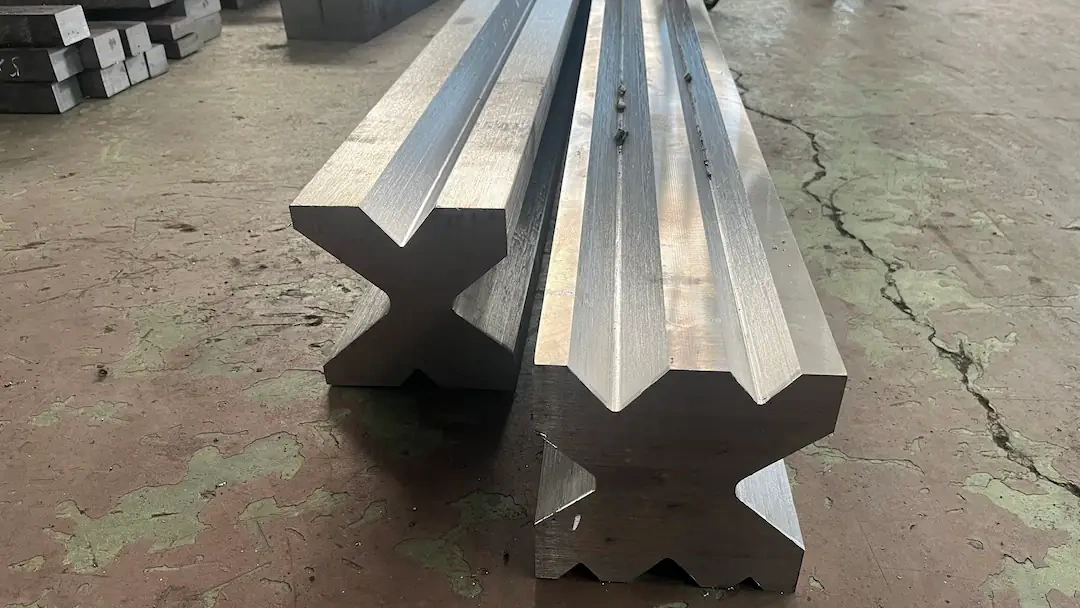
Formula details
Product Details
Overview
Are you dealing with rapid tooling wear, inconsistent bend angles, or constant setup delays when switching sheet metal thicknesses? We engineer our 10 way press brake die line to meet strict global metallurgical and manufacturing standards, delivering dependable performance for high-tonnage precision bending operations.
Technical Specifications & Metallurgical Standards
Technical Data Summary
| Technical Parameter | Specification Standard | Operational Benefit |
|---|---|---|
| Base Material | Premium 42CrMo / 4140 Chrome-Moly Steel | High tensile strength; prevents structural fatigue under heavy loads |
| Surface Hardness | 55–60 HRC (Induction Hardened) | Superior wear resistance along critical V-opening contact zones |
| Core Toughness | 47–52 HRC | Shock-absorbing core prevents die fracturing during high-tonnage cycles |
| Profile Tolerance | ±0.01 mm | Maintains strict centerline concentricity across all ten V-grooves |
| Surface Finish | Ra < 0.8 µm | Reduces friction, galling, and cosmetic scoring on sheet metal |
| Standard Lengths | 415 mm, 835 mm, 10-inch, 10-foot | Available in easy-to-handle sectionals or continuous full-bed lengths |
Alloy Steel Composition & Core Toughness
We utilize high-grade 42CrMo (AISI 4140) chromium-molybdenum alloy steel as our material standard. This formulation provides the ideal balance of core toughness and hardifiability required for heavy-duty multi-V press brake die applications.
- Dual-Stage Heat Treatment: The entire die body is quenched and tempered to 47–52 HRC, giving the core the structural resilience needed to absorb shock without deformation.
- Deep Induction Hardening: Critical working surfaces on each V-groove receive targeted induction hardening reaching 55–60 HRC, extending wear life up to three times longer than standard untreated tooling.
Precision Tolerances & Surface Quality
Achieving consistent bend lines on a 10 opening press brake die requires strict manufacturing tolerances:
±0.01 mm Profile Tolerance: Precise grinding guarantees that every V-groove aligns accurately relative to the central rotation baseline.
Ra < 0.8 µm Surface Finish: Precision-ground surfaces ensure smooth material flow during air bending, improving angle repeatability and protecting soft metals like aluminum and stainless steel.
V-Opening Sizes & OEM Machine Fitment
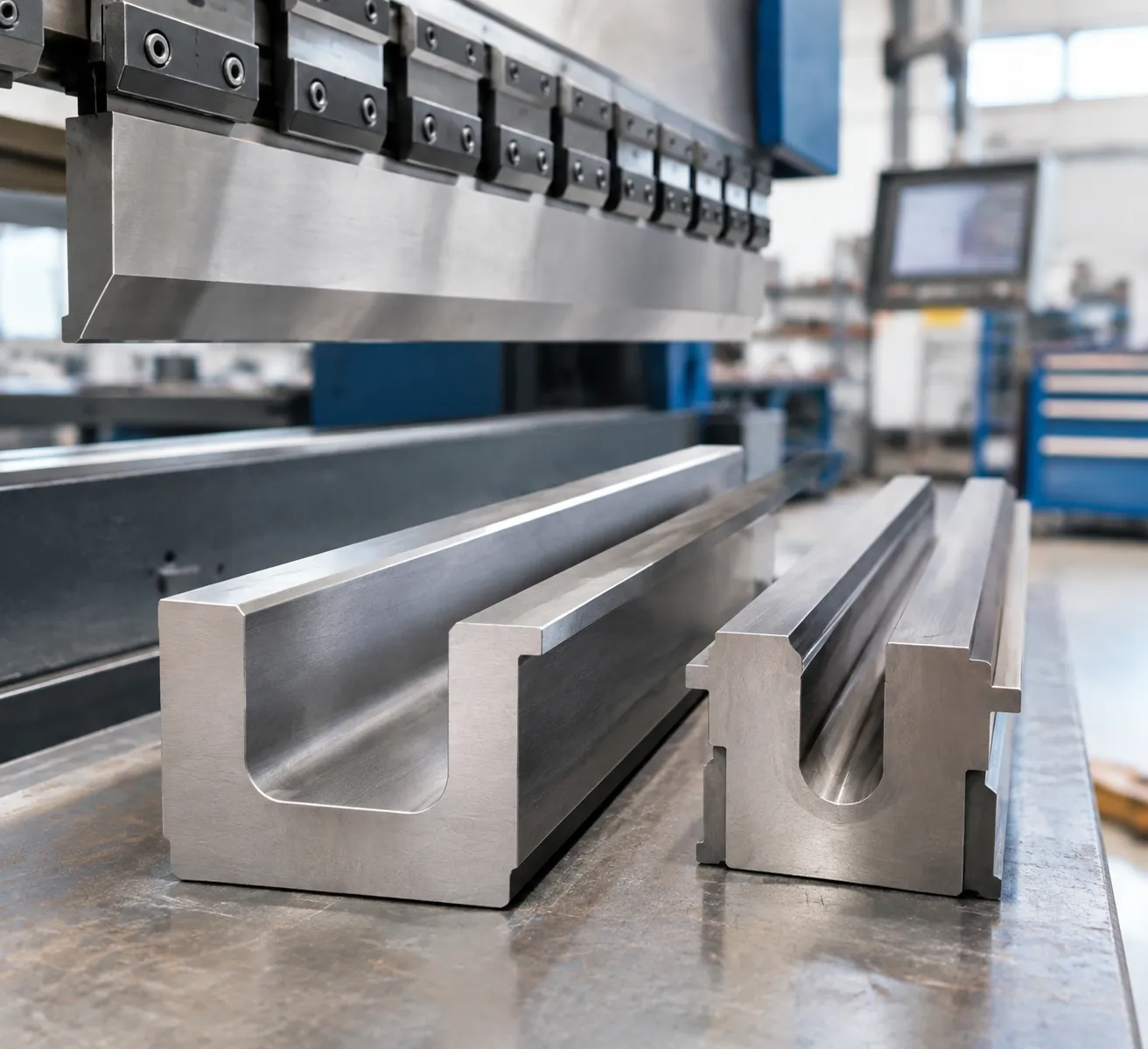
Our 10 way lower press brake tooling accommodates a wide range of material gauges on a single block, eliminating the need to swap individual dies. Standard sectional lengths (415 mm and 835 mm) allow fast rotational handling by a single operator, while 10-inch and 10-foot configurations handle continuous long-sheet fabrication.
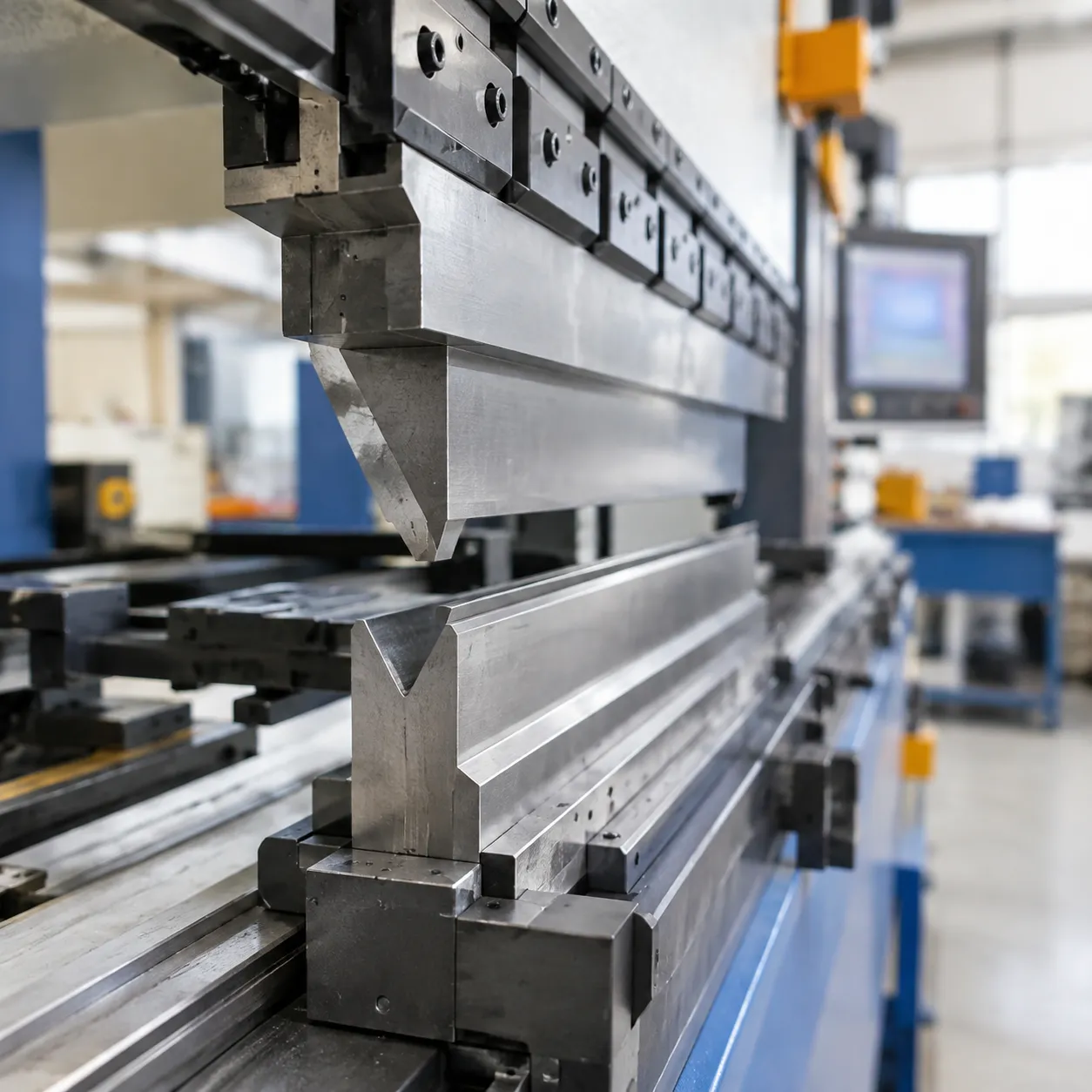
These rotational press brake lower dies mount seamlessly into standard adapter rails, lower die block holders, and multi-vee bases across major machine brands, including Amada, TRUMPF, Bystronic, Cincinnati, Accurpress, LVD, and Durma systems.
Key Benefits of CAMT 10-Way Press Brake Die Tooling
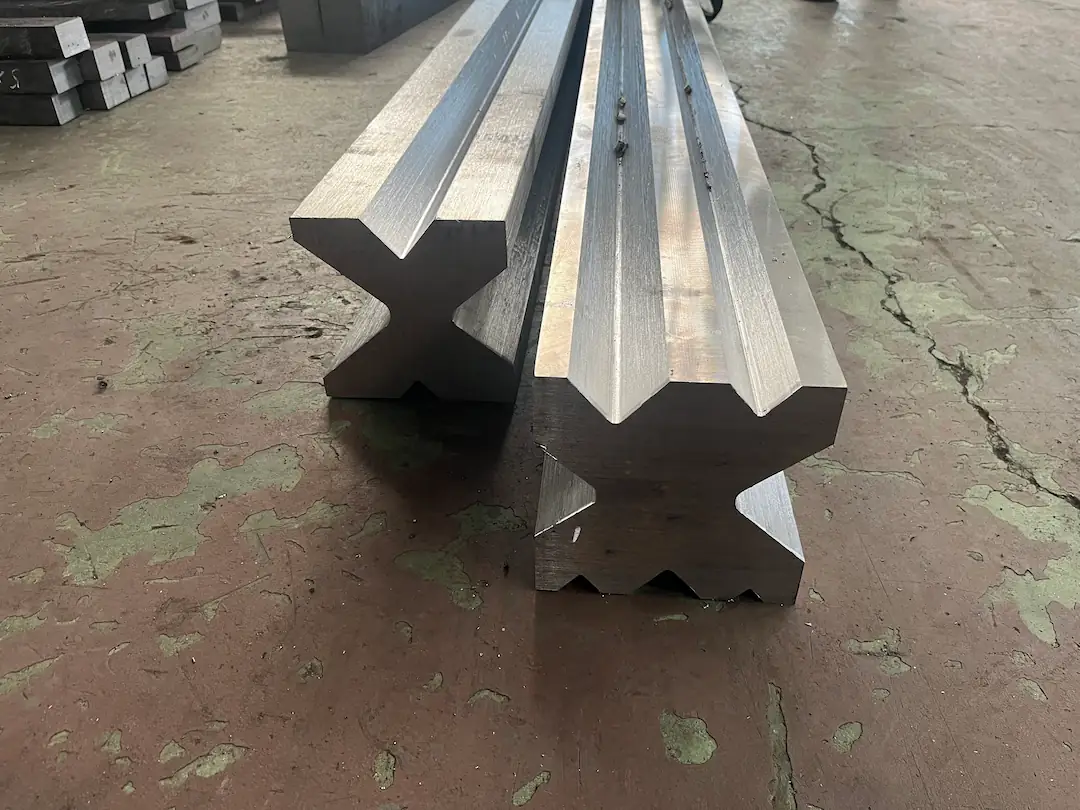
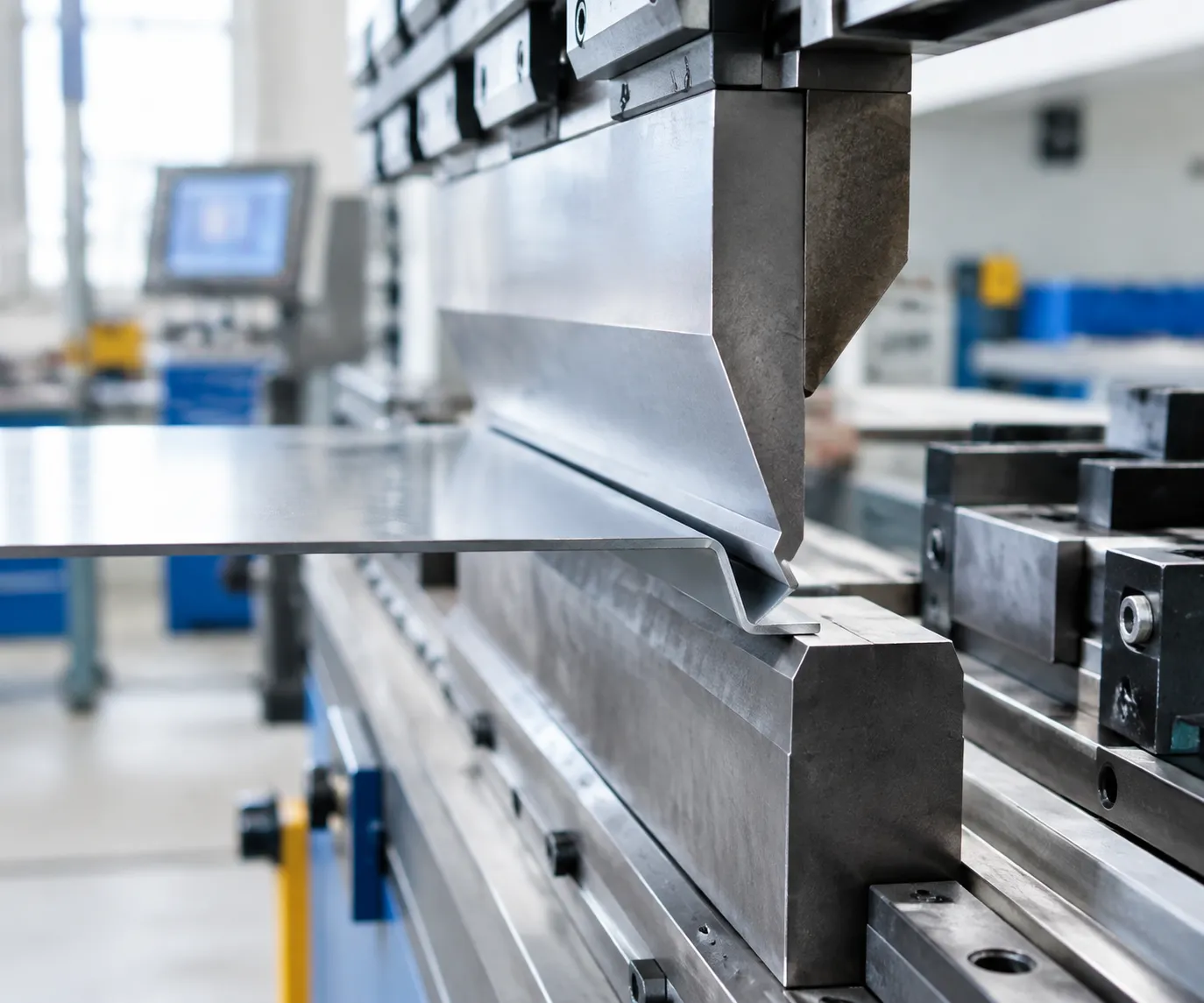
We design our 10 opening press brake die solutions to solve the biggest headaches on the shop floor: excessive setup downtime, rapid wear, and inconsistent bending accuracy. By integrating ten distinct V-openings into a single rotational block, we eliminate the hassle of swapping heavy lower dies between jobs.
1. Rapid Setup & Production Efficiency
- Zero-Tool-Changeover Downtime: Instead of unbolting and lifting heavy single-V dies, operators rotate the 10 way press brake die to the required V-opening in seconds.
- Streamlined Multi-Gauge Runs: Handle job runs requiring different sheet metal thicknesses on the same machine without resetting the lower setup.
- Streamline your production floor with our high-efficiency multi-V press brake dies designed for seamless rotation.
2. Deep Induction Hardening & Core Toughness
- Extended Tool Life: We subject all wear zones to targeted induction hardening (55–60 HRC), giving our dies up to 3x the wear life of conventional tooling.
- Shock Absorption: The inner core retains a tough 47–52 HRC hardness, preventing catastrophic cracking under high tonnage.
- Learn more about alloy selections and heat treatments in our comprehensive press brake tooling material guide.
3. Precision Concentricity & Alignment
- Central Baseline Precision: Every V-groove is ground relative to a shared central axis.
- Consistent Bending Angles: Rotating the die preserves exact centerline positioning, protecting your press brake ram and ensuring uniform bend angles across all openings.
Performance Comparison: Single-V vs. CAMT 10-Way Multi-V Die Block
| Feature | Standard Single / Double V Die | CAMT 10 Way Press Brake Die |
|---|---|---|
| Setup Time | High (5–15 min tool swaps) | Instant (rotates in seconds) |
| Wear Life | Standard surface hardness | 3x extended life (55–60 HRC wear zone) |
| Core Structure | Uniform hardness (crack risk) | High-toughness core (47–52 HRC) |
| Storage Footprint | Requires large rack space | 10 profiles in 1 compact die block |
| Alignment Accuracy | Requires manual re-centering | Precision-ground relative to central axis |
V-Die Selection Guide: The 10x Thickness Rule for Heavy Plate
Air Bending V-Opening Selection Rules
To maintain high accuracy and prevent structural overload, we follow established ratio rules based on material thickness ($t$):
- Mild Steel & Thin Gauge ($t$ < 3 mm): Use 8x material thickness ($V = 8t$) as the standard V-groove baseline.
- Stainless Steel & High-Strength Alloys: Use 10x to 12x material thickness ($V = 10t$ to $12t$) to compensate for higher tensile strength and springback.
- Heavy Plate ($t$ > 6 mm): Use the 10x to 12x Thickness Rule ($V = 10t$ to $12t$). Selecting a wider V-opening lowers the required tonnage significantly while reducing friction cracking along the outer bend radius.
| Material Type | Sheet Thickness ($t$) | Recommended V-Opening |
|---|---|---|
| Thin Mild Steel | 1.0 mm – 2.5 mm | 8x Thickness ($8t$) |
| Heavy Mild Steel | 3.0 mm – 8.0 mm | 10x Thickness ($10t$) |
| Stainless Steel | 2.0 mm – 6.0 mm | 10x – 12x Thickness ($10t - 12t$) |
| Structural / Heavy Plate | 8.0 mm+ | 12x Thickness ($12t$) |
Tonnage Calculation Formula for Bending Force
Calculating required tonnage before forming prevents tool damage and machine overload. We calculate air bending force ($P$) using the standard formula:
P = (C * t^2 * L) / V
- P: Bending force in Metric Tons
- C: Material strength coefficient (approx. 1.33 for standard mild steel; up to 2.0 for stainless steel)
- t: Sheet metal thickness (mm)
- L: Bending length (meters)
- V: V-die opening width (mm)
Notice that the V-opening ($V$) sits in the denominator: increasing your V-opening width reduces the total required bending force proportionally. Proper V-opening selection not only guarantees precise angles but also extends overall press brake die lifespan by eliminating excessive force spikes.
Lowering Load to Protect Hydraulics and Tooling
Using an under-sized V-groove spikes the ton-per-meter load dramatically. Overloading causes point-load stress on the bottom die block, leading to micro-cracking, galling, and central beam deflection on your machine.
By rotating your 10 way press brake die to a larger V-opening, you directly lower the ton-per-meter load. This simple adjustment yields key operational benefits:
- Hydraulic System Protection: Reduces peak working pressure on valves, pumps, and cylinders.
- Die Block Preservation: Prevents crushing or permanent deformation on the shoulder radii of the multi-groove V die block.
- Energy Efficiency: Cuts electrical consumption during heavy plate forming cycles.
For heavy-duty forming setups, exploring our full range of precision-ground press brake V-dies helps ensure optimal tonnage distribution across all bending operations.
Machine Compatibility & Adapter Systems
Clamping Style Compatibility
- European Standard Style: Fits Promecam, Amada, and Euro-style press brakes using standard multi-V block support bases and center-location pins.
- American Precision Style: Built for standard 1/2-inch tang slots and lower adapter rails. Our tooling fits seamlessly with traditional setups, including heavy-duty Cincinnati press brake die set compatible T-style dies for thick plate bending.
- New Standard / Wila / TRUMPF Style: We supply precision adapter bases designed for fast setup on modern hydraulic clamping beds. If your shop utilizes automated or high-precision systems, check our options for Wila tooling compatibility to maintain tight tolerances when rotating the die block.
Broad OEM Support
We design our rotational multi-groove V die blocks to mount on all leading press brake brands:
| Machine Manufacturer | Compatibility & Mount Type |
|---|---|
| Cincinnati & Accurpress | American traditional rail & T-slot adapters |
| Bystronic & LVD | European and specialized multi-V shoe holders |
| TRUMPF & Durma | New Standard adapter plates & hydraulic clamping bases |
| Haco & Amada | Standard Euro-style lower die holders |
6-Step Manufacturing & Quality Control for 10-Way Dies
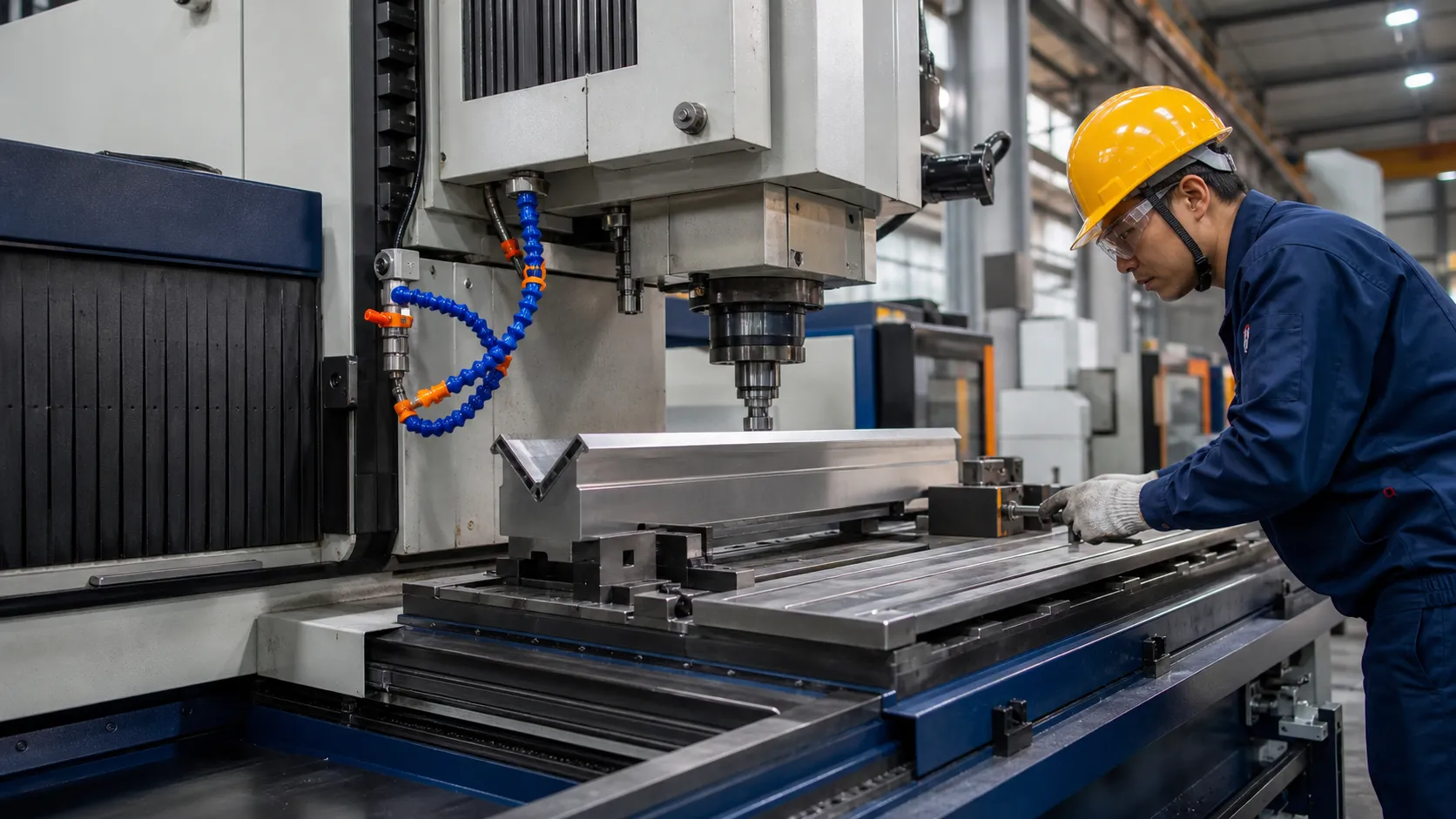
We build every 10 opening press brake die to withstand extreme bending forces while maintaining strict dimensional accuracy.
Here is our exact 6-step production and inspection protocol:
- 1. Material Verification & Chemical Analysis: We start exclusively with certified 42CrMo / 4140 alloy steel stock. Every raw billet undergoes spectrographic chemical analysis to verify material composition and guarantee structural integrity before machining begins.
- 2. Multi-Axis CNC Roughing: Using high-torque CNC machining centers, we rough-cut all 10 distinct V-groove profiles into the solid block. This precise rough-milling phase establishes concentric geometry while preventing stress concentration zones across the tool body.
- 3. Vacuum Heat Treatment: The roughed block undergoes full-vacuum heat treatment to achieve uniform core toughness (47–52 HRC). Check out our specialized manufacturing processes to see how deep thermal processing prevents tool fracturing under severe bending loads.
- 4. Deep Induction Hardening: We apply targeted induction hardening directly to the high-wear V-groove working radiuses. This process boosts localized surface hardness to 55–60 HRC, giving the tool up to three times the service life when forming abrasive metals.
- 5. Precision CNC Surface Grinding: To maintain accurate bend angles and zero baseline deflection, every working face and V-opening is precision ground. We hold a tight ±0.01 mm profile tolerance and a fine surface finish (Ra < 0.8 µm) across the full length of the sheet metal bending die block.
- 6. CMM Inspection & Rockwell Hardness Testing: Before any tool leaves our floor, it must pass our rigorous quality control testing protocol. We utilize CMM (Coordinate Measuring Machine) laser scanning to verify baseline alignment and multi-point Rockwell hardness testing to confirm localized surface strength.
Typical Applications & Industry Solutions
Structural Steel Fabrication
Heavy structural components require rugged heavy duty press brake tooling that handles high-tonnage forming without structural deflection.
Heavy Plate & Channels: Form thick structural steel plates and custom channels efficiently using the larger V-groove options on our 10 way press brake die.
High-Yield Strength Alloys: Absorb high bending force reliably while maintaining tight profile tolerances across long workpieces.
Electrical Cabinets & Switchgear
Precision and flexibility are vital when manufacturing heavy-duty enclosures for electrical cabinets and power distribution switchgear.
Varied Material Gauges: Transition seamlessly from forming light gauge outer panels to bending thick internal mounting plates.
Consistent Flange Accuracy: Maintain uniform bend angles and sharp radii across production runs with precision-ground V-grooves.
HVAC & Ductwork Forming
Streamline complex ducting and channel geometries with rapid die indexing.
Multi-Radius Channel Bending: Execute multi-bend profiles and varied bend radii on a single lower die setup without removing the block from the machine bed.
Clean Surface Finish: Smooth, ground V-groove shoulders minimize surface marring on galvanized and aluminum sheets.
Custom Metal Job Shops
For high-mix, low-volume job shops, our 10 opening press brake die is the ultimate efficiency upgrade for everyday sheet metal fabrication.
Instant Setup Adjustments: Simply rotate the multi-groove V die block to match the target sheet thickness in seconds.
Lower Tooling Overhead: Replace a rack full of single V-dies with one heavy-duty rotational die, reducing floor space requirements and tooling investment.
Frequently Asked Questions
What is the main advantage of a 10 opening die over a standard double-V die?
The primary advantage of a 10 opening press brake die is the drastic reduction in setup and tool changeover time. Instead of swapping out lower tooling every time you change sheet metal thickness, you simply rotate the block to select from 10 distinct V-grooves. This multi-V design boosts machine uptime and optimizes workflow in high-mix production environments. Explore our complete range of specialized press brake dies built for demanding bending setups.
How do I ensure correct centerline alignment when rotating a 10-way press brake die?
We precision-ground all 10 V-grooves relative to a single central baseline. When mounted with proper centering adapter rails or alignment pins, each rotation maintains exact concentricity with the upper punch. This eliminates the need for manual recalibration or ram readjustments whenever you switch to a new opening.
Can CAMT manufacture custom V-opening sizes or custom lengths for 10-way dies?
Yes. While standard lengths (415 mm, 835 mm, 10-inch, or 10-foot sectionalized dies) are readily available, we regularly manufacture tailored die configurations. Through our custom press brake tooling program, we design non-standard V-groove combinations, specialized angles, and custom block dimensions to fit your specific OEM press brake.
Which V-opening selection rule should be used for stainless steel?
For stainless steel, use a 10x to 12x material thickness rule instead of the traditional 8x rule used for mild steel. Stainless steel has higher tensile strength and increased springback. Selecting a wider opening lowers the tonnage per meter required to form the bend, protecting your 10 way press brake die from excessive wear while safeguarding your machine's hydraulic system.