
Formula details
Product Details
Overview
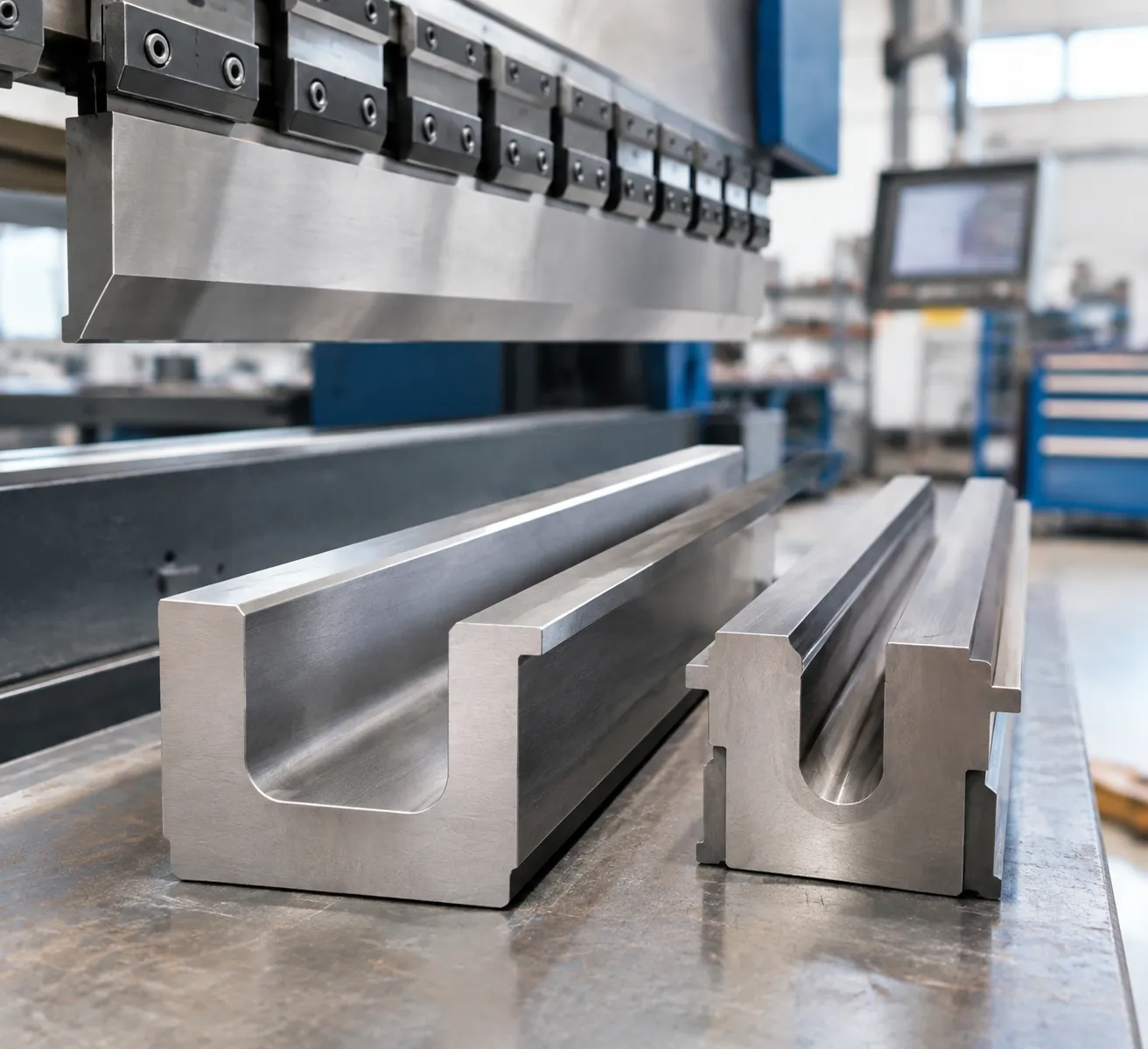
Precision Engineering & Durability Built for Production Bending
Micron-Level Grinding Accuracy (±0.01 mm)
Cumulative machining errors in a lower V die cause out-of-spec parts and expensive scrap.
Precision CNC Grinding: Machined to a strict tolerance of ±0.01 mm across the entire working length.
Seamless Modular Alignment: Combine sectionalized dies without height steps or seam line defects.
Repeatable Parallelism: Guarantees absolute center-line accuracy for uniform bend angles from end to end.
Deep Induction Hardening (HRC 55–60)
Shallow surface treatments fail quickly when processing hard materials. Our induction hardened press brake tooling provides deep-layer protection against severe wear.
Targeted Hardness: Critical wear zones heat-treated to HRC 55–60.
High Tonnage Resistance: Prevents shoulder collapse during thick plate and high-tensile steel bending.
Maximum Durability: Extends operational tool life by up to 300% compared to standard non-hardened dies.
Micro-Finished V-Shoulders (Ra < 0.8 µm)
Rough shoulder radii create excess friction, sheet drag, and visible galling on finished workpieces.
Polished Radius Finish: Precision-ground V-shoulder radius finish of Ra < 0.8 µm optimizes sheet glide.
Reduced Surface Damage: Minimizes gouging and drag marks on stainless steel, aluminum, and coated sheets.
Smooth Form Transitions: Ensures steady material entry into the female press brake v die opening during air bending.
Certified Alloy Tool Steel
Inconsistent raw materials risk sudden die failure under maximum load limits.
Traceable Metallurgy: Forged exclusively from certified high-grade tool steels including 42CrMo and Cr12MoV.
Ultrasonic Flaw Inspection: 100% internal defect testing ensures zero structural voids prior to precision grinding.
High Yield Strength: Maintains dimensional stability under extreme bending forces and high-pressure bottoming operations.
Types of Female Press Brake V Dies Available
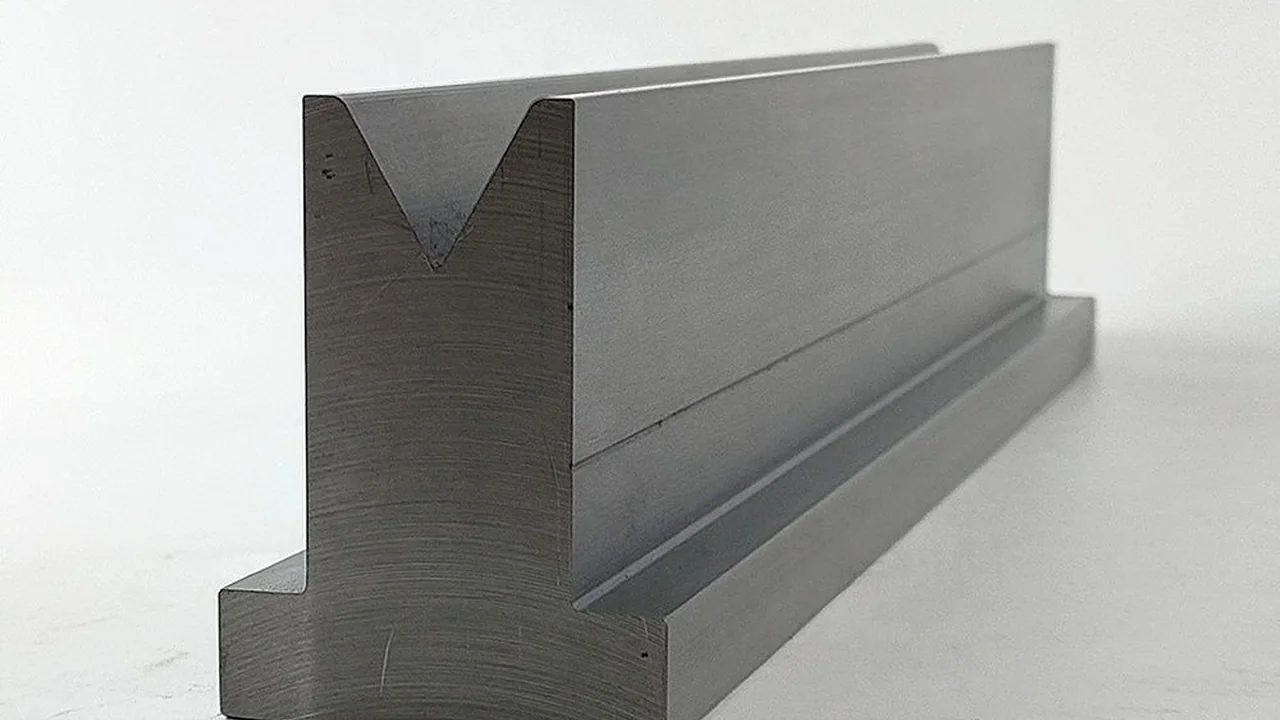
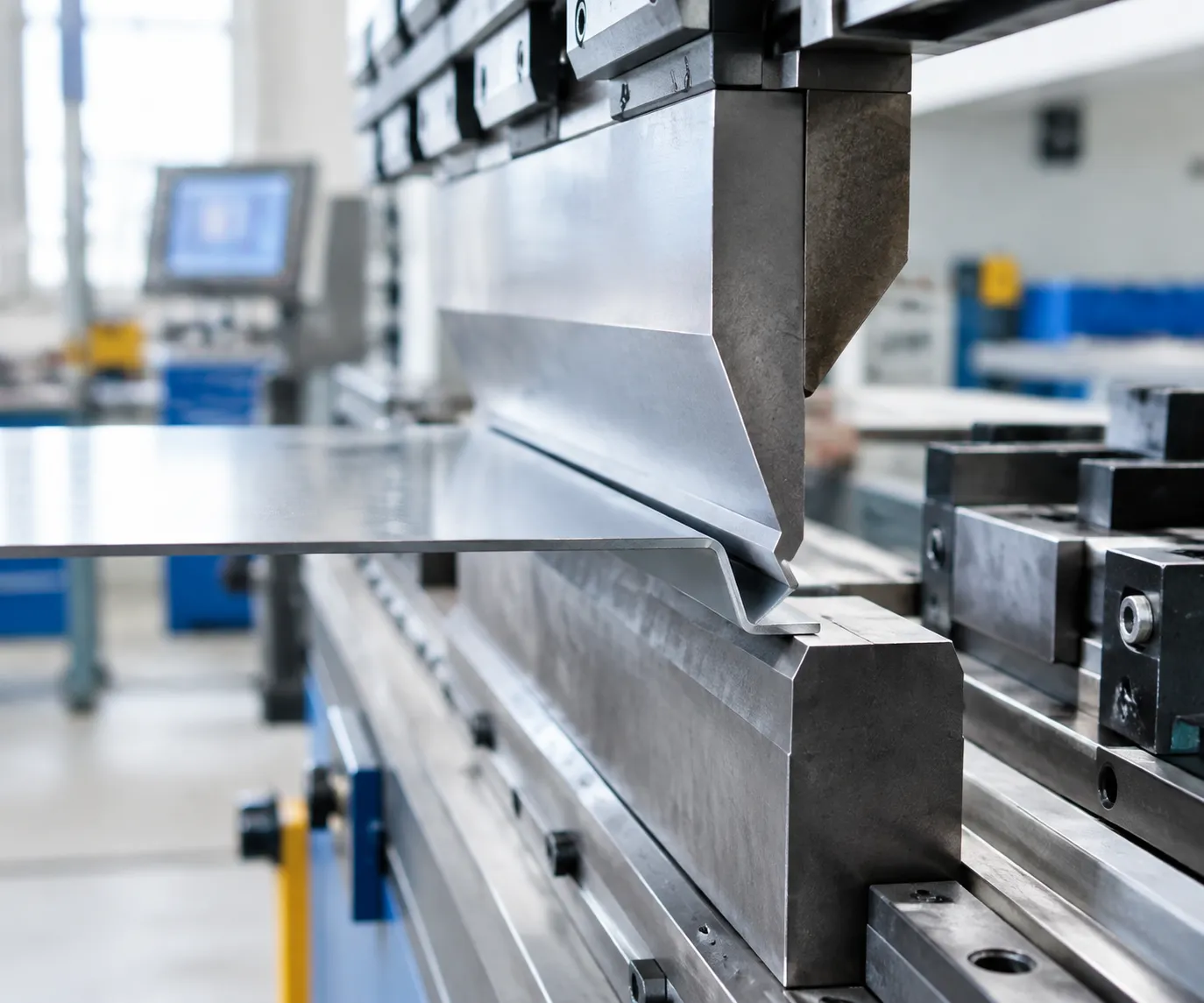
Matching the right female press brake die to your material thickness, bend radius, and cosmetic requirements is critical for precision bending and throughput. We engineer a full lineup of press brake bottom v-dies engineered to perform across standard air bending, bottoming, and specialty edge-forming setups.
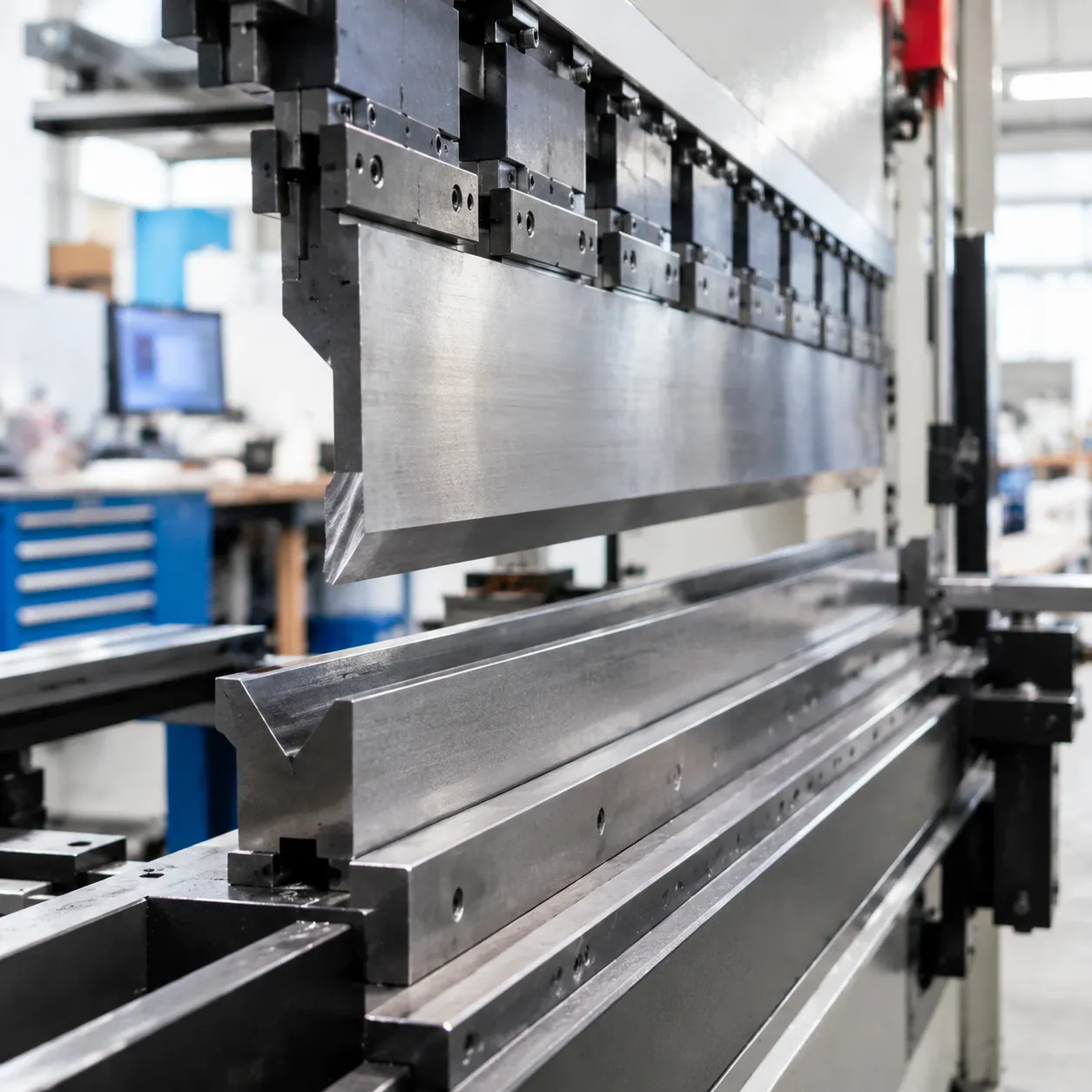
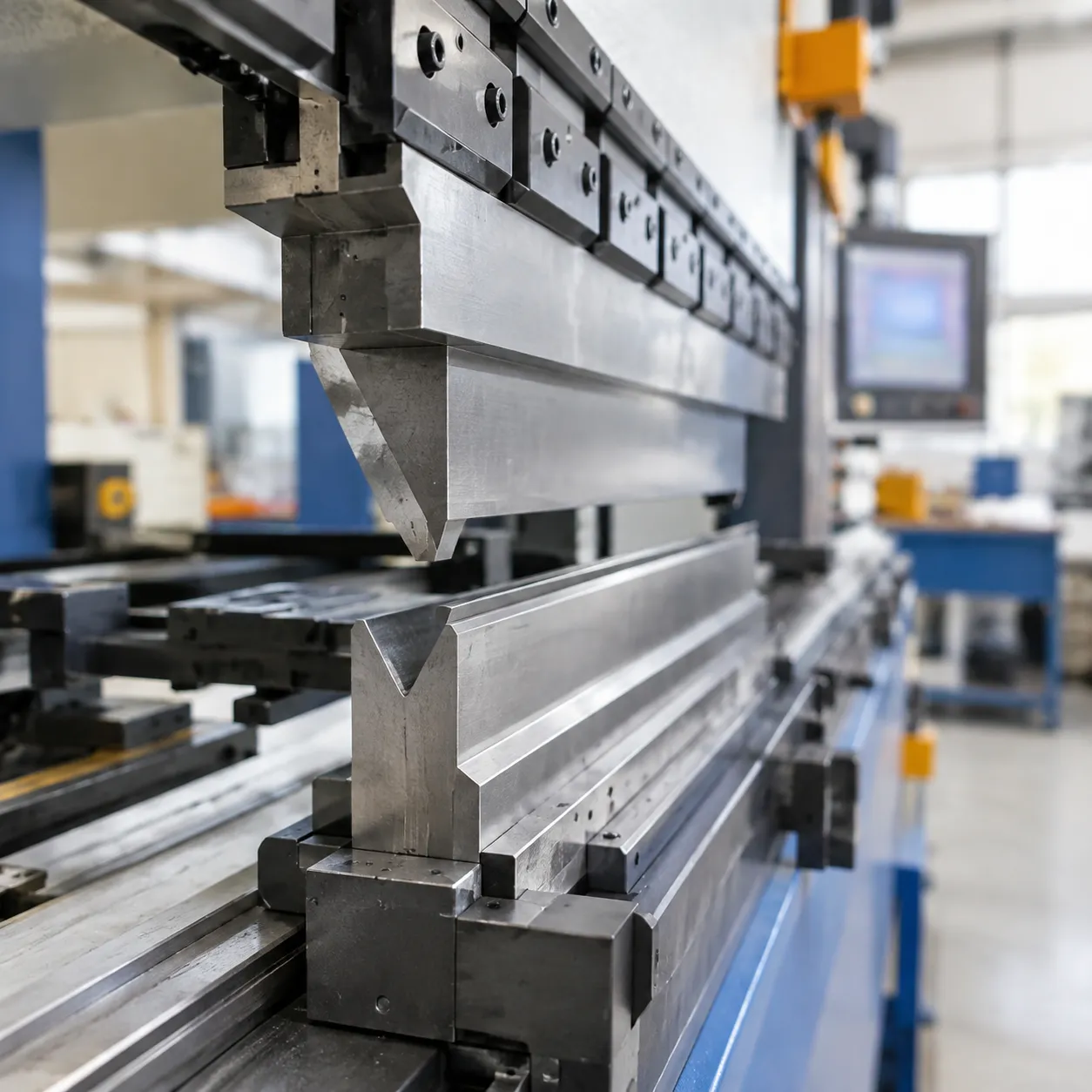
Single V Lower Dies
A single V press brake die is the industry standard for dedicated, high-precision production runs on specific sheet gauges.
- High Centering Precision: Self-centering design ensures quick alignment and tight angular tolerances across long bed lengths.
- Shoulder Protection: Micro-finished V-shoulder radiuses reduce friction, minimizing galling on sensitive alloys.
- Standard Angles: Available in 30°, 45°, 60°, 85°, 88°, and 90° profiles to handle acute bends and air-bending springback.
Multi-V & Double-V Bottom Dies
For job shops processing multiple metal thicknesses daily, multi-V press brake dies eliminate constant tool teardowns and maximize press uptime.
| Die Type | V-Opening Range | Ideal Application | Key Advantage |
|---|---|---|---|
| Double-V Die | 2 distinct openings (e.g., 8mm & 12mm) | Medium-mix precision bending | Flip 180° in seconds to change V-width |
| Multi-V Block Die | 4 to 8 multi-sided openings | Dynamic fabrication & heavy plate | Covers full gauge range on a single block |
Hemming & Flattening Lower Dies
Designed for safe-edge hems, door panels, and reinforced cabinet covers, these two-stage dies handle acute pre-bending and final flattening in a single press stroke setup.
- Spring-Loaded Hemming Dies: Top slide absorbs initial acute force before compressing flat under increased tonnage.
- Combination Die Sets: Execute a 30° pre-bend in the front pocket and move directly to the flat surface pad to close the hem.
Adjustable & Non-Marking Female Dies
Cosmetic surfaces and heavy-duty structural plates require specialized female press brake v die configurations to prevent tooling wear and part marring.
- Adjustable Female Press Brake Dies: Feature CNC-controlled or mechanical shims to adjust the V-opening width instantly without unmounting the bottom tooling.
- Non-Marking Lower Dies: Utilize rotatable shoulder rollers or high-density polymer inserts to eliminate metal-on-metal contact marks on polished aluminum, stainless steel, and pre-painted sheet metal.
Technical Sizing Guide for Female V-Die Openings
Air Bending V-Opening Sizing Formula
In standard air bending, the width of the lower V die opening (V) directly determines the inside bend radius (R) and required machine force.
- Standard Mild Steel Rule: V = 8 x t (where t is sheet material thickness)
- Thin Sheet / Tight Radius (t < 3 mm): V = 6 x t
- High-Tensile / Heavy Plate (t > 6 mm): V = 10 x t to 12 x t
Selecting an undersized female press brake die spikes required tonnage exponentially and risks cracking the V shoulder radius, whereas an oversized opening produces an excessive inside radius and unpredictable springback.
Bending Force (Tonnage) Estimation Formula
Calculate your required bending load before cycling the ram to avoid damaging your bottom v die setup:
- Tonnage Formula (Air Bending): P = (650 x t^2 x L) / V
- P = Required Bending Force (kN)
- t = Material Thickness (mm)
- L = Bend Length (m)
- V = V-Die Opening Width (mm)
Note: For stainless steel, multiply P by 1.5. For soft aluminum, multiply P by 0.5.
To skip manual calculations across complex sheet metal bending die configurations, reference our complete press brake v die chart and tonnage guide.
V-Opening Selection Matrix Table
Use this reference table to select the proper lower V die sizing for standard mild steel (420 MPa tensile strength):
| Material Thickness (t) | Rec. V-Die Opening (V) | Inside Radius (R) | Min. Flange Length (b) | Tonnage per Meter (kN/m) |
|---|---|---|---|---|
| 1.0 mm | 8 mm | 1.3 mm | 5.5 mm | 81 kN |
| 1.5 mm | 12 mm | 2.0 mm | 8.5 mm | 122 kN |
| 2.0 mm | 16 mm | 2.6 mm | 11.5 mm | 163 kN |
| 3.0 mm | 24 mm | 4.0 mm | 17.0 mm | 244 kN |
| 4.0 mm | 32 mm | 5.3 mm | 22.5 mm | 325 kN |
| 6.0 mm | 50 mm | 8.0 mm | 35.0 mm | 468 kN |
System Compatibility Across Global Machine Brands
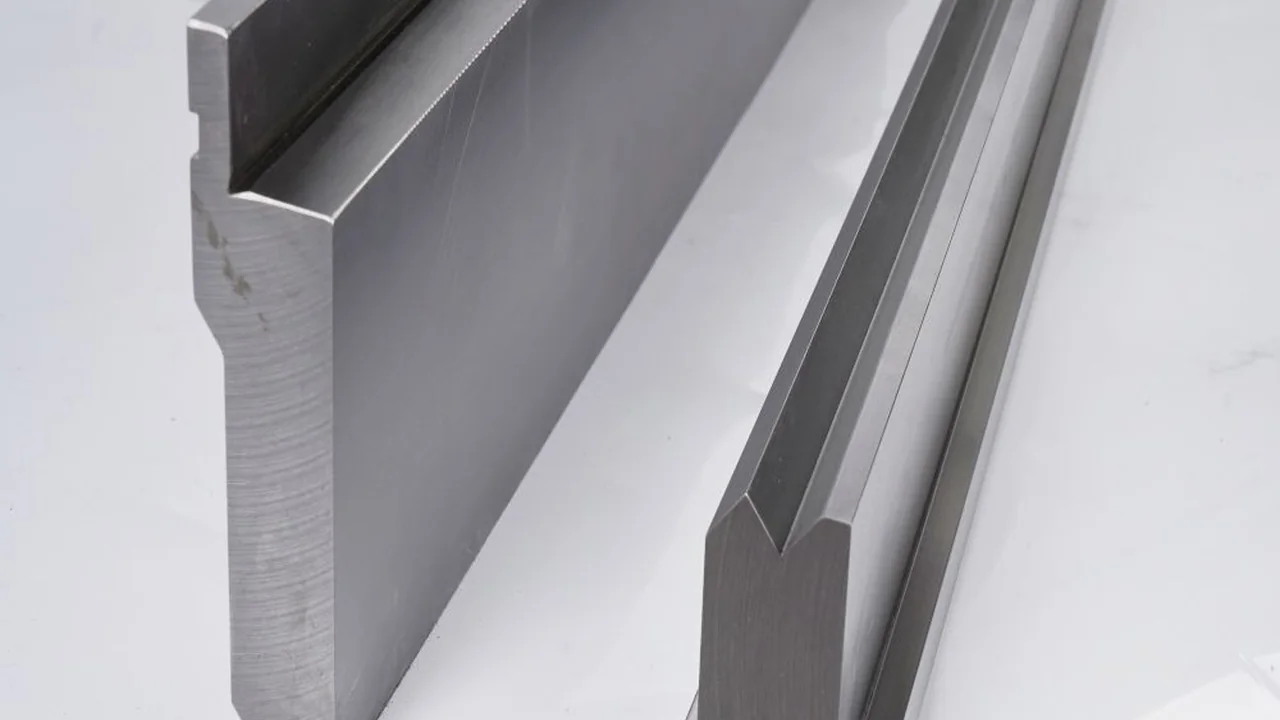
American Precision Style
Our American precision female die line features standard tang dimensions built for traditional mechanical and hydraulic clamping beds.
Tang Specification: Standard 0.5 in x 0.625 in (12.7 mm x 15.875 mm) centered tang.
Alignment: Manual or hydraulic keyway alignment with secure locking options.
Best Use: General job shop bending and legacy press brake setups.
European / Promecam Style
Designed for rapid setup changes, our European style lower die range fits standard 13 mm slot receivers with precision self-centering capabilities.
Tang Specification: 13 mm x 20 mm standard European tang.
Features: Self-centering alignment grooves for fast bottom v die tool swaps.
Best Use: Mid-to-high volume production runs requiring frequent tooling changes.
WILA / Trumpf / New Standard
For automated and high-precision bending centers, we produce bottom tooling engineered to New Standard tolerances. You can integrate our high-precision Trumpf compatible tooling or upgrade your system with WILA style press brake dies for automated hydraulic clamping.
Locking Mechanism: Pneumatic or hydraulic pin and button retention systems.
Accuracy: Tx/Ty axis positioning precision within ±0.01 mm.
Best Use: Automated CNC bending cells and tight-tolerance sheet metal fabrication.
Bystronic / LVD Style
Heavy-duty production demands specialized lower tooling interfaces capable of handling extreme tonnage without seat deformation.
Compatibility: Deep-slot LVD bases and specialized Bystronic pneumatic clamping tables.
Load Rating: Reinforced shoulder geometry built for high-tonnage air bending.
Best Use: Heavy plate fabrication, high-tensile steel processing, and long-bed press brakes.
Quality Assurance Matrix & Production Standards
6-Step Production Quality Process
- Material Verification: We source premium 42CrMo / 1.7225 alloy tool steel backed by certified mill test reports. Spectrochemical analysis verifies material chemistry before any machining begins.
- Rough CNC Machining: High-speed CNC mills establish core alignment channels and initial V-groove profiles, leaving precise stock allowances for finish grinding.
- Vacuum & Induction Hardening: Dies undergo deep vacuum thermal treatment followed by localized induction hardening along the critical V-shoulders, achieving a core strength of 28–32 HRC and a surface hardness of HRC 55–60.
- Precision CNC Grinding: Multi-axis grinding delivers micron-level grinding accuracy (±0.01 mm) across all critical working surfaces, helping maintain optimal shoulder radii and maximizing overall press brake v-die lifespan.
- Dimensional & CMM Inspection: V-die openings, angles, and micro-finished shoulders (Ra < 0.8 µm) are scanned on automated CMM machinery. Explore our complete quality control process for high-precision bottom tooling.
- Anti-Corrosion & Packaging: Every precision ground bottom die is deep-cleaned, treated with heavy-duty rust-preventive oil, sealed in VCI film, and encased in reinforced export packaging for safe global transit.
Manufacturing Quality Benchmarks
| Production Phase | Target Benchmark | Verification Protocol |
|---|---|---|
| Material Selection | High-Grade 42CrMo Alloy | Ultrasonic & Chemical Analysis |
| Heat Treatment | HRC 55–60 Surface / HRC 28–32 Core | Rockwell Hardness Testing |
| Machining Accuracy | ±0.01 mm Geometric Tolerance | Laser & Micro-Caliper Audit |
| Surface Finish | Ra < 0.8 µm V-Shoulder Finish | Digital Profilometer Check |
| Quality Gate | 100% Dimensional Accuracy | Multi-Axis CMM Verification |
Custom Female V-Die Development Workflow
When off-the-shelf bottom dies cannot meet your unique bend profiles, tight tolerances, or specialized sheet metal parameters, we engineer tailor-made lower tooling from scratch. Our streamlined custom press brake tooling development process ensures every custom female press brake die delivers high-precision bending from day one.
CAD Submission
- File Compatibility: We accept standard 3D and 2D CAD formats, including STEP, IGES, DXF, and DWG.
- Parameter Intake: Submit your target sheet metal thickness, material grade, tensile strength, inner bend radius, and machine clamping style.
Feasibility & Tonnage Analysis
- Tonnage Calculation: We evaluate the maximum bending force required per meter to ensure structural safety for both the machine and the die.
- Opening Optimization: We determine the exact lower V die opening ratio and shoulder radius to minimize contact marking and prevent material cracking.
3D Bending Simulation
- Interference Checks: Virtual simulation eliminates collision risks between the upper punch, the workpiece, and the female press brake v die.
- Springback Compensation: Advanced modeling calculates exact material springback, adjusting die angles dynamically before machining begins.
Rapid Prototyping & Verification
- First-Article Machining: We produce precise test sections of your custom press brake tooling to validate geometry.
- CMM Quality Control: Coordinate Measuring Machines inspect critical shoulders, V angles, and seating surfaces to ensure micron-level accuracy.
Full-Scale Production & Global Shipping
- Hardening & Grinding: Full production units undergo vacuum heat treatment, deep induction hardening (HRC 55–60), and precision CNC grinding.
- Protection & Delivery: Each lower V die is laser-etched with specs, coated in anti-corrosion oil, vacuum-sealed, and shipped in reinforced packaging worldwide.
Frequently Asked Questions About Female Press Brake V Dies
Ideal V-Die Opening Ratio for High-Tensile Stainless Steel
When air bending high-tensile stainless steel, we recommend a female press brake v die opening ratio of 10x to 12x sheet thickness (10T–12T), compared to the standard 8T ratio used for mild steel. Stainless steel requires significantly higher tonnage and exhibits greater springback. Increasing the V-opening reduces required bending force, protects your hydraulic press brake bed, and minimizes premature wear on the lower die shoulders. For a complete deep dive into material-specific calculations, check our practical guide on how to choose press brake tools.
Preventing Contact Marks on Polished or Pre-Painted Aluminum
To eliminate die drag lines and friction marks on critical cosmetic surfaces, we utilize three main solutions:
Urethane Protection Film: Apply heavy-duty protective film directly over the lower die V-opening before bending.
Micro-Finished V-Shoulders: Our precision-ground dies feature smooth V-shoulder radii (Ra < 0.8 μ m), reducing friction during sheet draw.
Synthetic & Rolla-V Inserts: Swap standard steel lower dies for non-marking urethane inserts or wing-type bending dies when processing high-finish aluminum or mirror-polish stainless.
Compatibility with Existing Machine Clamping Systems
Yes, our female press brake die configurations are fully compatible with your existing shop setup. We precision-machine die tangs and bases to match all major global clamping standards:
American Precision Style: 0.500" tang fits standard American bed slots.
European / Promecam Style: 13 mm tangs designed for fast-change die holders.
WILA / Trumpf New Standard: Self-centering hydraulic and pneumatic bottom clamping.
Bystronic / LVD: Specialized heavy-duty base grooves and localized locking pins.
Custom Lengths via Sectionalized Female Dies
We manufacture fully sectionalized female die sets to accommodate custom bending lengths without forcing you to buy dedicated full-length tooling.
Our standard sectionalized sets come precision-ground in matching heights (± 0.01 mm tolerance across all pieces), featuring individual segment lengths such as 10 mm, 15 mm, 20 mm, 40 mm, 50 mm, 100 mm, 200 mm, and 500 mm. You can quickly interchange and combine these segments to bend closed boxes, four-sided pans, and complex sheet metal parts of virtually any dimension.