
Formula details
Product Details
Overview
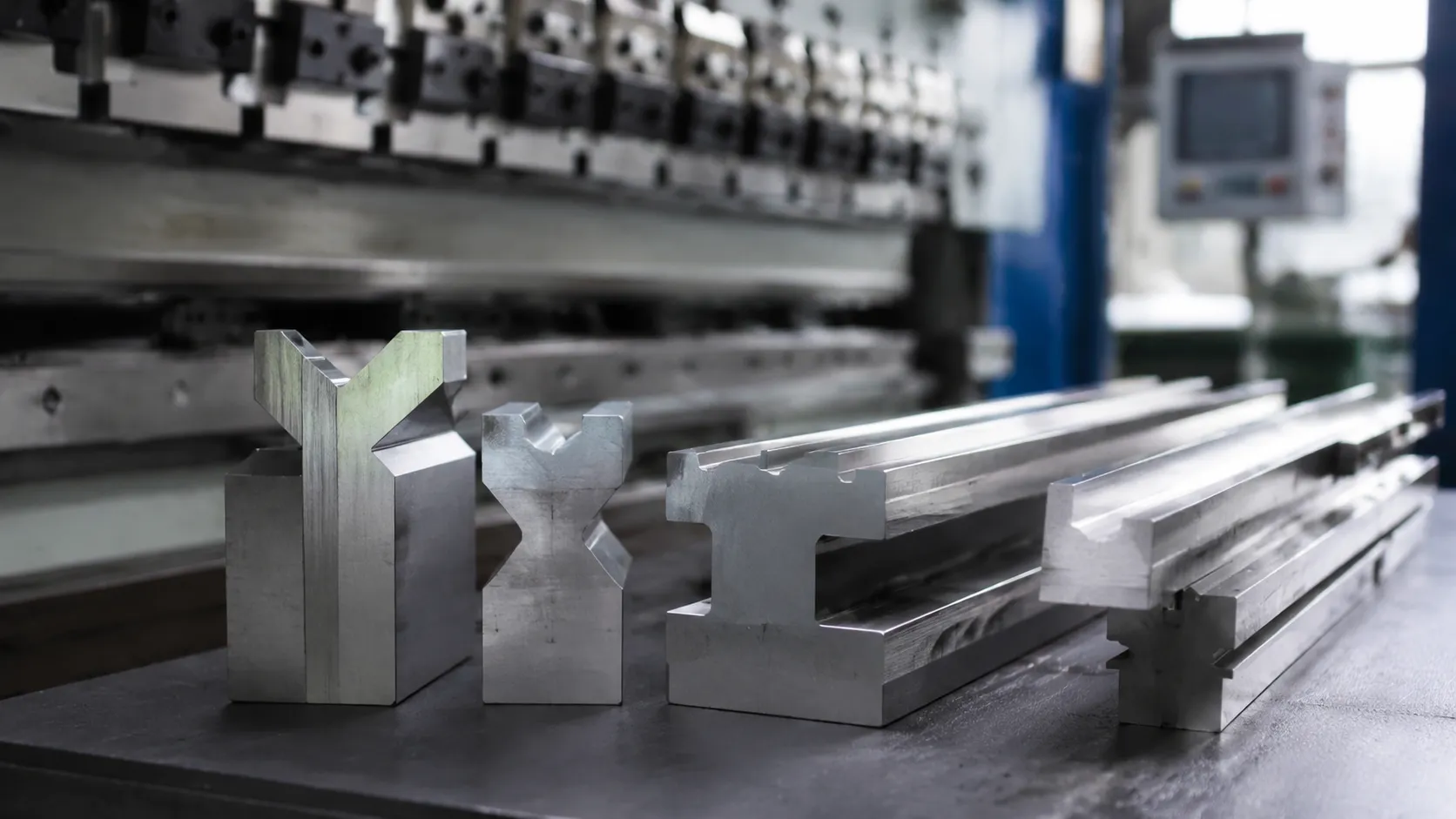
Plastic Press Brake Die: Executive Overview & Value Proposition
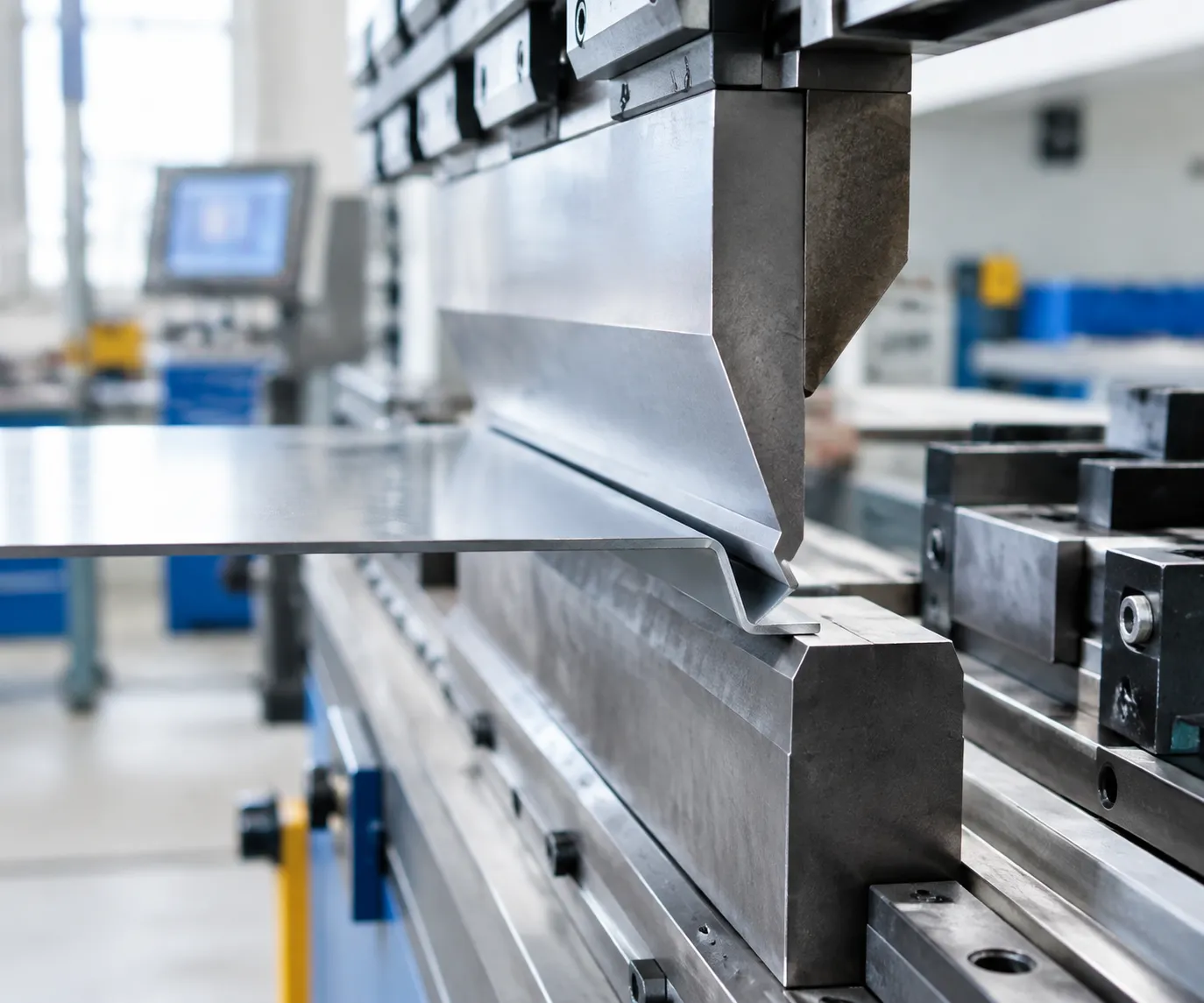
We engineer high-performance plastic press brake die systems designed to eliminate surface damage and streamline sheet metal fabrication. By integrating advanced synthetic polymer inserts into precision steel holder bases, our non-marking press brake tooling delivers distortion-free, high-repeatability bends without compromising machine tonnage or part accuracy.
Key Performance & Value Drivers
- Zero-Scratch Bending Performance: Completely eliminates die lines and witness marks on sensitive materials, including mirror-finish stainless steel, architectural aluminum, and pre-painted sheet metal.
- Precision Base Integration: Features CNC-ground alloy steel holders manufactured to ±0.01 mm repeatability, delivering consistent bend angles across full production runs.
- Operational Efficiency: Reduces post-bending polishing and finishing labor by up to 80% by eliminating the need for secondary surface restoration and protective film application.
- Universal Clamping Fit: Engineered with standardized mounting tangs for seamless compatibility with major industry clamping systems, including Amada, Trumpf, WILA, Bystronic, LVD, and Cincinnati.
Plastic Press Brake Die Technical Matrix
| Parameter | Specification | Technical Details |
|---|---|---|
| Holder Base Material | Certified Tool Steel | Vacuum heat-treated (HRC 47–60) for maximum structural integrity |
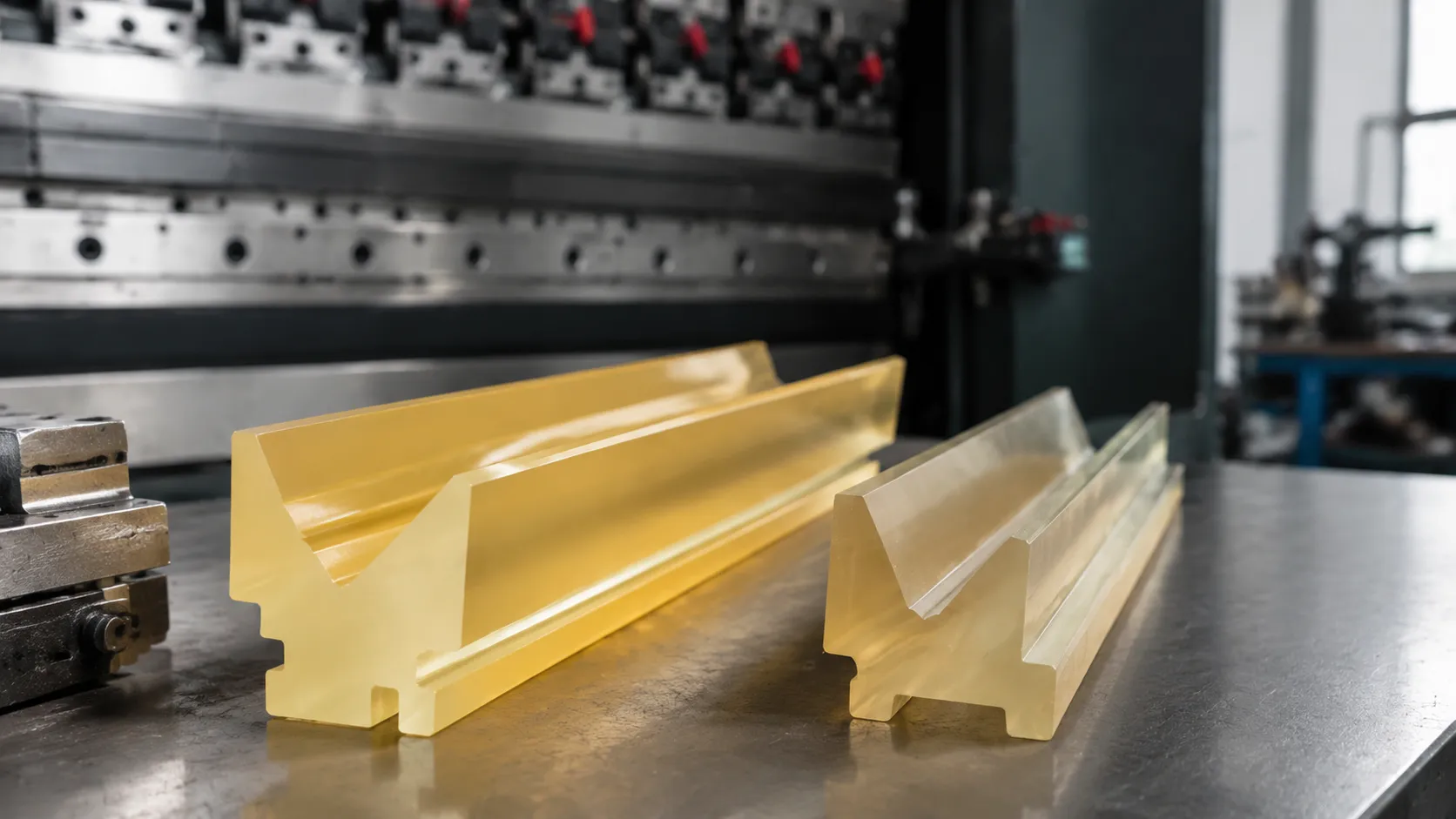
| Insert Materials | Polyurethane & Engineering Nylon | Durometer Shore 75D, 90A, 95A Urethane and PA66 Nylon |
| Machining Tolerance | ±0.01 mm | Precision CNC ground for exact parallelism and bed positioning |
| Surface Finish | Ra < 0.8 µm | Ultra-smooth contact zones to minimize surface friction |
| Available Lengths | 835 mm, 415 mm, Sectionalized sets | Standard and segmented lengths for flexible stage bending |
Tooling Compatibility & Materials
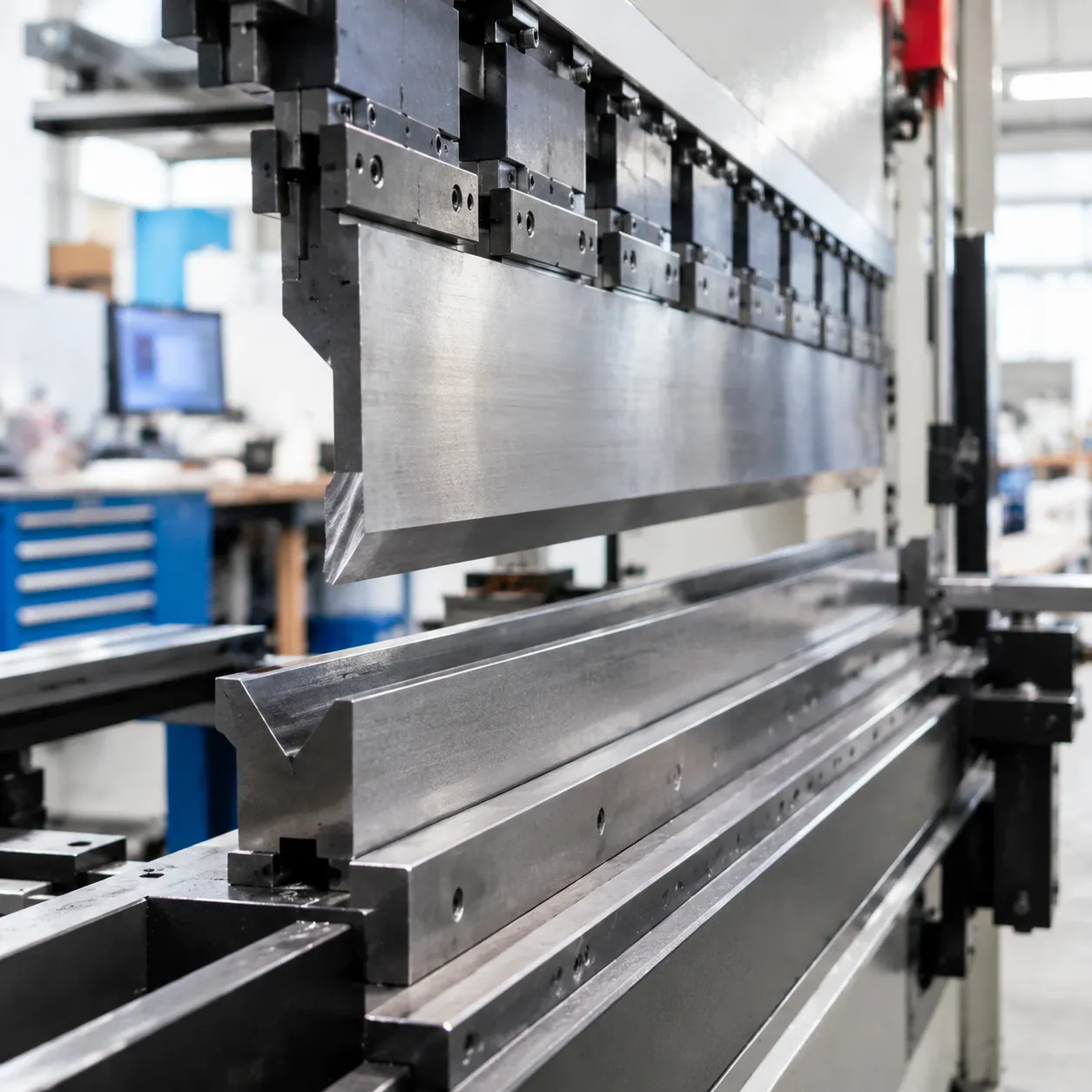
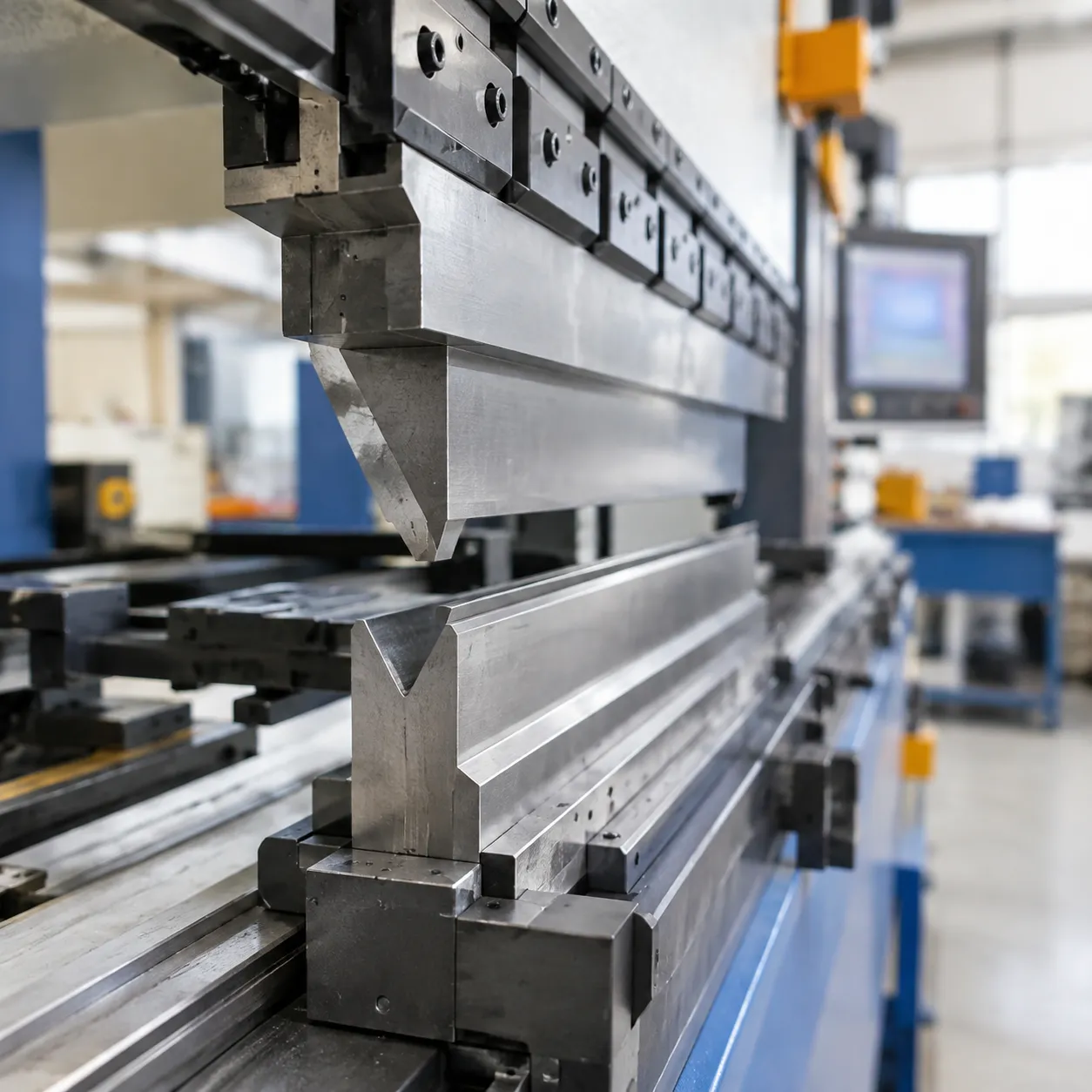
Our holder bases fit directly into standard power and manual clamping mechanisms. We engineer these systems to integrate seamlessly with WILA tooling standards, as well as mounting setups for Trumpf tooling interfaces, LVD, Amada, Bystronic, and Cincinnati machines.
For specialized bending requirements, our custom polyurethane V-dies and radius tooling pads absorb extreme pressure while maintaining structural memory, preventing surface galling on polished stainless steel, aluminum, and pre-painted sheet metal.
Plastic Press Brake Die Form Factors and Configurations
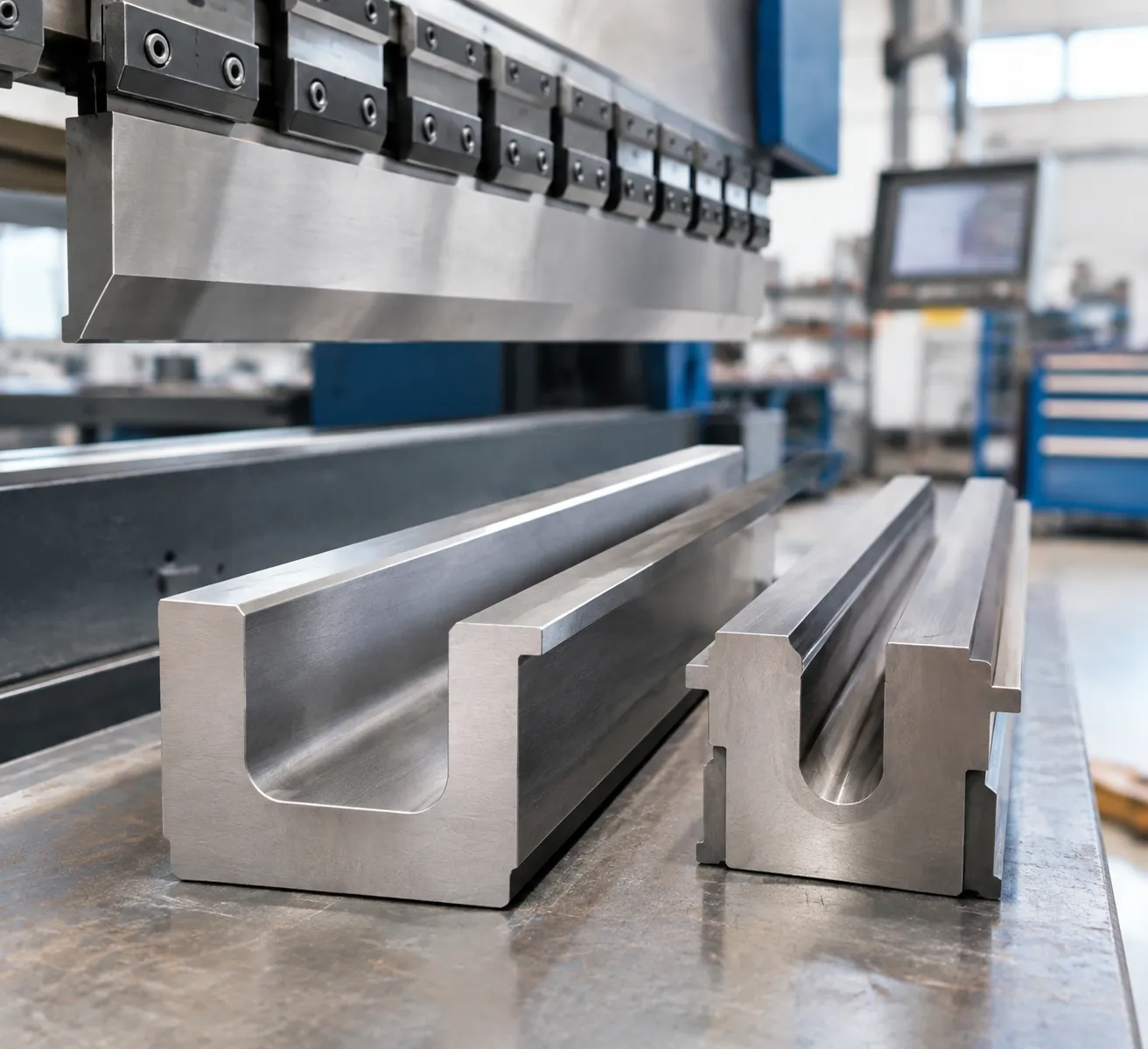
Modular Steel Holders with Urethane V-Inserts
Our modular assemblies combine precision-ground tool steel housing with swappable polymer inserts to deliver high versatility for high-mix production runs.
- Rigid Foundation: Machined from CNC-ground high-strength steel die sets to ensure zero deflection under full tonnage loads.
- Insert Adaptability: Accepts durable nylon bending dies and high-density urethane V-die inserts across multiple durometer options (75D, 90A, 95A).
- Quick-Change Design: Enables rapid insert replacement to handle different V-openings without removing the steel base from the press brake.
Solid Polyurethane Female V-Dies
Designed for severe-duty non-marking sheet metal bending, solid elastomer blocks compress predictably around the sheet metal to distribute forming pressure evenly across the bend line.
| Parameter | Specification |
|---|---|
| Material Base | High-durability polyether/polyester polyurethane |
| Deflection Response | High elasticity with continuous shape recovery |
| Primary Application | Large radius bends, variable gauge sheets, and delicate mirror-finish alloys |
Mark-Free Radius Bending Insert Strips
These synthetic press brake tooling inserts drop directly into standard steel V-grooves, creating a smooth, protective barrier between the workpiece and the steel die shoulder.
- Eliminates witness lines on prepainted, anodized, or mirror-finished stainless steel.
- Reduces friction coefficient, preventing material stretching at the bend point.
- Fits standard non-marking press brake tooling holders without setup modifications.
Composite Hemming & Flattening Synthetic Sets
For seamless two-stage sheet metal closing, our composite synthetic sets combine initial V-bending with flat hem closing. Integrating non-marring contact faces into specialized hemming dies ensures tight, crisp seams on architectural trims and enclosures without requiring post-bend buffing or refinishing.
Plastic Press Brake Die Applications & Material Compatibility
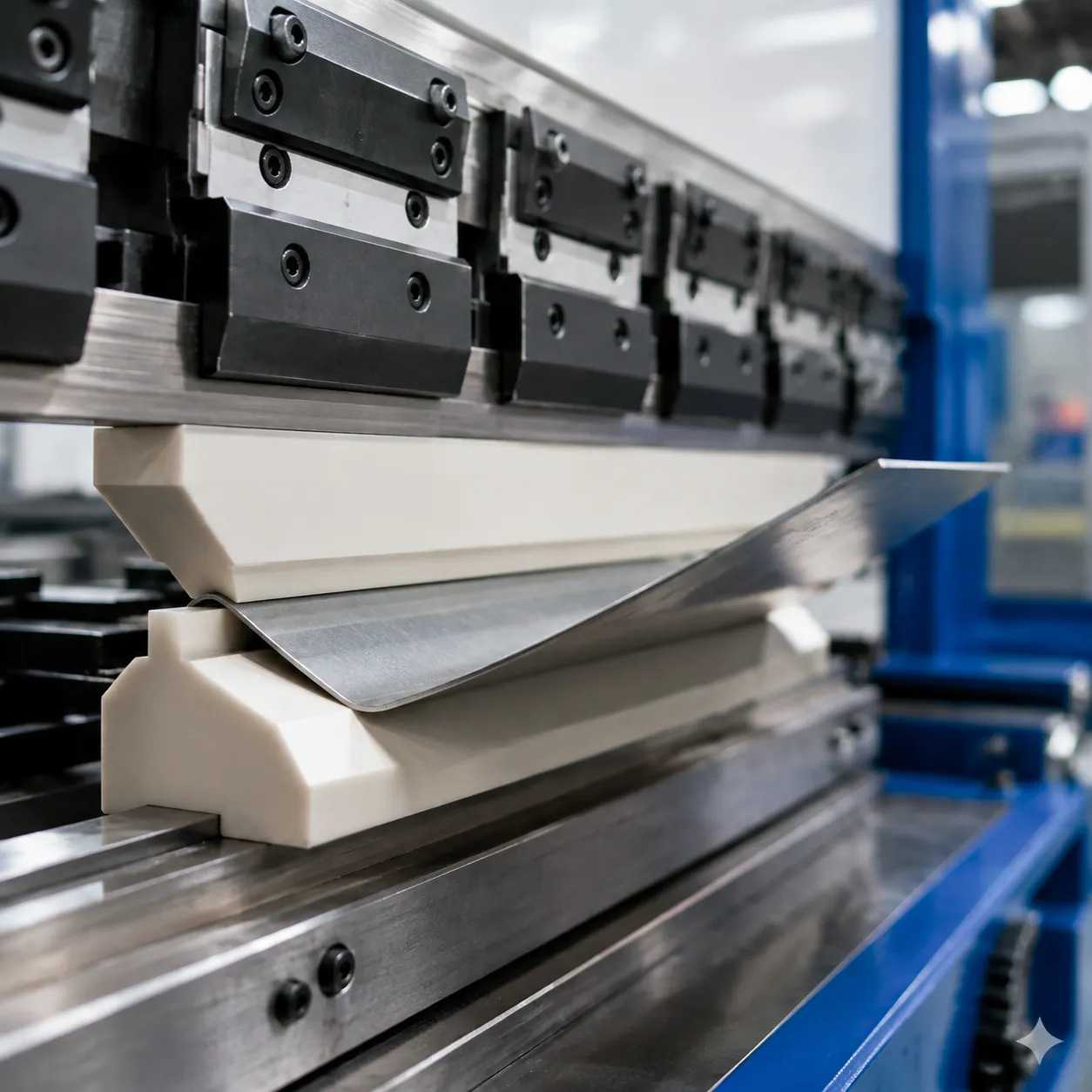
We engineer our plastic press brake die solutions to protect surface-critical materials from witness marks, die line pressure marks, and surface galling. Our synthetic press brake tooling handles delicate alloys and coated metals across several key industries.
Architectural Metalwork & Elevator Panels
High-finish architectural accents demand pristine surfaces without secondary rework.
Materials: #4 finish stainless steel, #8 mirror-polished sheets, anodized aluminum, and brass.
Application Focus: Decorative cladding, column covers, and specialized elevator manufacturing applications where scrap rates from die lines must be zero.
Tooling Benefit: Urethane V-die inserts absorb friction to eliminate post-bend grinding or polishing entirely.
HVAC & Appliance Enclosures
Commercial refrigeration, ductwork, and consumer appliance housings require pristine cosmetic finishes directly off the machine.
Materials: Pre-painted sheet metal, vinyl-coated steel, and bright-dipped aluminum.
Application Focus: Cabinet skins, access panels, and display trim.
Tooling Benefit: Non-marking press brake tooling prevents film rupture, paint cracking, and surface scratching during high-speed production.
Electronics & Electrical Cabinets
Precision control boxes and electronic chassis require consistent bend radii without carbon transfer or alloy contamination.
Materials: Aluminum 5052/6061, copper busbars, and thin-gauge stainless steel.
Application Focus: Server racks, custom shielding, and modular electrical cabinet components.
Tooling Benefit: Nylon bending dies provide rigid dimensional accuracy with zero metal-to-metal contact, preserving anti-corrosive zinc and galvanized coatings.
Automotive & Commercial Transportation Trim
Heavy-duty transport and automotive trims demand tight-tolerance forming on pre-finished exterior parts.
Materials: High-strength aluminum alloys, chrome-finished trim, and painted steel blanks.
Application Focus: Running boards, bus side-panels, door frames, and cab interior trim.
Tooling Benefit: High durometer polymer dies withstand elevated forming pressures while achieving scratch-free sheet metal bending across long production runs.
Manufacturing Excellence for Plastic Press Brake Dies
We manufacture every plastic press brake die set using strict production protocols and advanced engineering standards to deliver repeatable precision and long-term durability.
Quality Control & Production Matrix
- Material Authentication & Spectro-Analysis: We verify raw alloy tool steel and engineering polymers through spectro-analysis to guarantee material purity before machining.
- Multi-Axis CNC Machining: We utilize precision manufacturing workflows to shape steel holder bases and synthetic inserts with high positional accuracy.
- Controlled Vacuum Heat Treatment: We heat-treat alloy steel holders in vacuum furnaces to maintain structural integrity and achieve HRC 47–60 hardness without surface scale.
- Precision Surface Grinding: We grind critical contact surfaces to a ±0.01 mm tolerance and Ra < 0.8 µm surface finish for seamless machine fitment.
- CMM Optical & Hardness Inspection: Every tool undergoes a rigorous quality control inspection, including 3D optical CMM scanning and durometer testing for urethane inserts.
- Protective Packaging & Export Logistics: We apply anti-corrosion protection, vacuum-seal finished components, and use reinforced export packing to guarantee damage-free shipment.
Custom Plastic Press Brake Die Engineering & 3D Simulation Workflow
We engineer custom plastic press brake die solutions to meet complex non-marking bending requirements. Our production workflow eliminates guesswork, ensuring accurate springback compensation and long-life durability before cutting steel or casting polymers.
CAD File & Parameter Submission
We review your 3D CAD files (STEP, IGES, or DXF formats) alongside material specifications, bend radius targets, and surface finish requirements. Utilize our custom tooling development team to verify your part geometry early in the design phase.
Engineering & Tonnage Feasibility Analysis
Our team evaluates yield strengths and tonnage limits to select the correct polymer density and holder design.
| Analysis Factor | Engineering Focus | Standard Threshold |
|---|---|---|
| Material Thickness | Sheet metal gauge and yield strength | Up to 6.0 mm aluminum or stainless steel |
| Insert Durometer | Urethane/nylon displacement & hardness | Shore 75D to 95A durometer selection |
| Tonnage Capacity | Maximum allowable bending force | Prevents insert deformation and machine overload |
3D Bending Simulation & Collision Check
- Virtual Press Stroke: We simulate multi-axis machine movements to check punch entry, backgauge position, and sheet stroke clearance.
- Springback Correction: Computer modeling adjusts V-die insert angles to compensate for material rebound in stainless steel and aluminum.
- Interference Validation: Ensures zero collision between deep box side-flanges, tool holders, and machine frame throat depths.
Prototype & Sample Fabrication
We produce functional prototype inserts via precision CNC milling and cast molding for physical tryouts. Explore our complete custom press brake tooling options to test mark-free sample parts directly on your equipment.
Batch Production & Traceable Quality
- Precision CNC Machining: Alloy tool steel bases and synthetic inserts are milled within ±0.01 mm repeatability.
- Material Verification: Every batch of polyurethane and nylon inserts undergoes durometer, tensile, and hardness testing.
- Part Traceability: Each finished plastic press brake die receives laser-etched part numbers and production lot tracking codes for consistent reordering.
Technical Frequently Asked Questions
How do plastic press brake inserts prevent surface witness marks?
Traditional steel tooling creates extreme point pressure and sliding friction along the die shoulder, leaving carbon contamination and scratches. A plastic press brake die or elastomeric insert deforms elastically under load. This elasticity distributes tonnage across a wider contact surface, eliminating die friction marks on polished stainless steel, anodized aluminum, and prepainted sheets.
How do I select the right insert durometer for material thickness?
We select insert hardness based on sheet thickness, material tensile strength, and required bend radius. Higher Shore ratings handle heavier gauge sheet metal without premature insert breakdown:
| Insert Durometer | Material Thickness | Primary Applications |
|---|---|---|
| 80A – 90A Urethane | Up to 1.5 mm | High-finish aluminum, mirror stainless steel, light electronic chassis |
| 95A Urethane | 1.5 mm – 3.0 mm | General sheet metal fabrication, architectural trim, HVAC panels |
| 75D Hard Polymer / PA66 | 3.0 mm – 6.0 mm | Heavy-duty non-marking bends, thick structural parts, tight radius bends |
What V-die opening rule applies when using polyurethane or nylon inserts?
Standard air bending on steel tooling uses the standard rule of 8 times material thickness (8xT). When using flexible polyurethane press brake dies or nylon inserts, increase the V-groove width to 10xT or 12xT. This extra clearance allows the synthetic pad to displace laterally under tonnage while preventing over-pressurization. For precise angular calculations and springback compensation adjustments, consult our guide on press brake die angles and springback selection.
Are non-marking dies compatible with standard automatic clamping systems?
Yes. We build our non-marking press brake tooling with CNC-precision ground steel holder bases. These holder bases feature standard tang profiles compatible with:
- Amada / Promecam style quick-change clamping
- Trumpf / WILA button and safety pin automatic locking systems
- Bystronic, LVD, and Cincinnati standard punch and die holders