
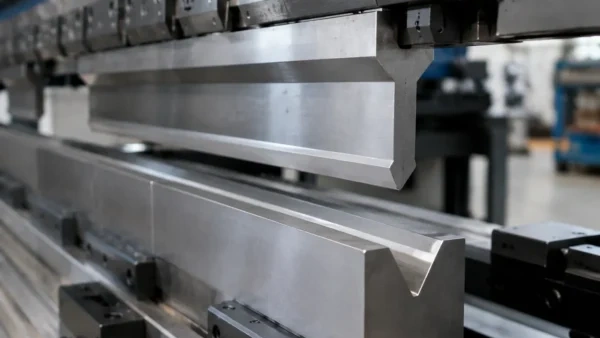
Formula details
Product Details
Overview
Technical Specifications: AAA Press Brake Die Matrix
| Technical Parameter | Engineering Standard |
|---|---|
| Material Grade | Certified 42CrMo alloy tool steel die / Cr12MoV |
| Working Edge Hardness | 55–60 HRC (Deep Induction Hardened) |
| Core Hardness | 28–32 HRC (Shock-Absorbing Core) |
| Grinding Tolerance | ±0.01 mm along full working length |
| Surface Finish | Ra < 0.8 µm (Micro-polished contact radii) |
| Sectional Lengths | Standard (835 mm, 415 mm, split sets) or solid up to 6000 mm |
| Clamping Compatibility | American Precision, European Style, New Standard / Wila, LVD |
Metallurgy & Tolerances
- Dual-Zone Heat Treatment: Deep induction hardened press brake dies provide extreme wear resistance at contact radii (55–60 HRC), paired with a tough core (28–32 HRC) to absorb heavy impact loads without fracturing.
- Precision Grinding: Machined to a strict ±0.01 mm tolerance, eliminating the need for time-consuming shimming during setup.
- Micro-Polished Contact Radii: Ra < 0.8 µm surface smoothness reduces friction, minimizes sheet marking, and lowers tonnage requirements.
- Versatile Mounting Profiles: Fully compatible with American style press brake tooling, European style press brake dies, and Wila Trumpf style tooling systems.
Press Brake Die Configurations & Product Lineup
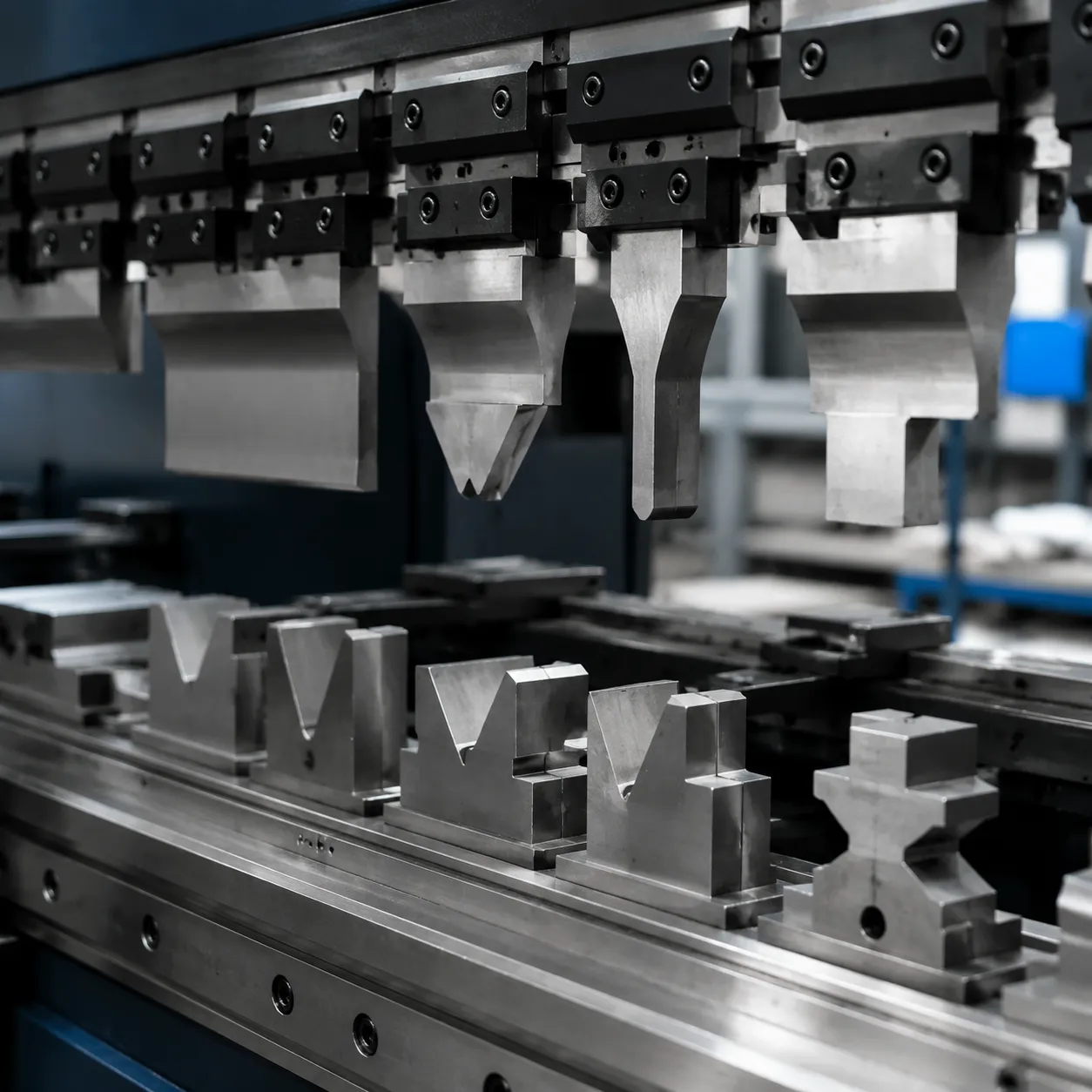
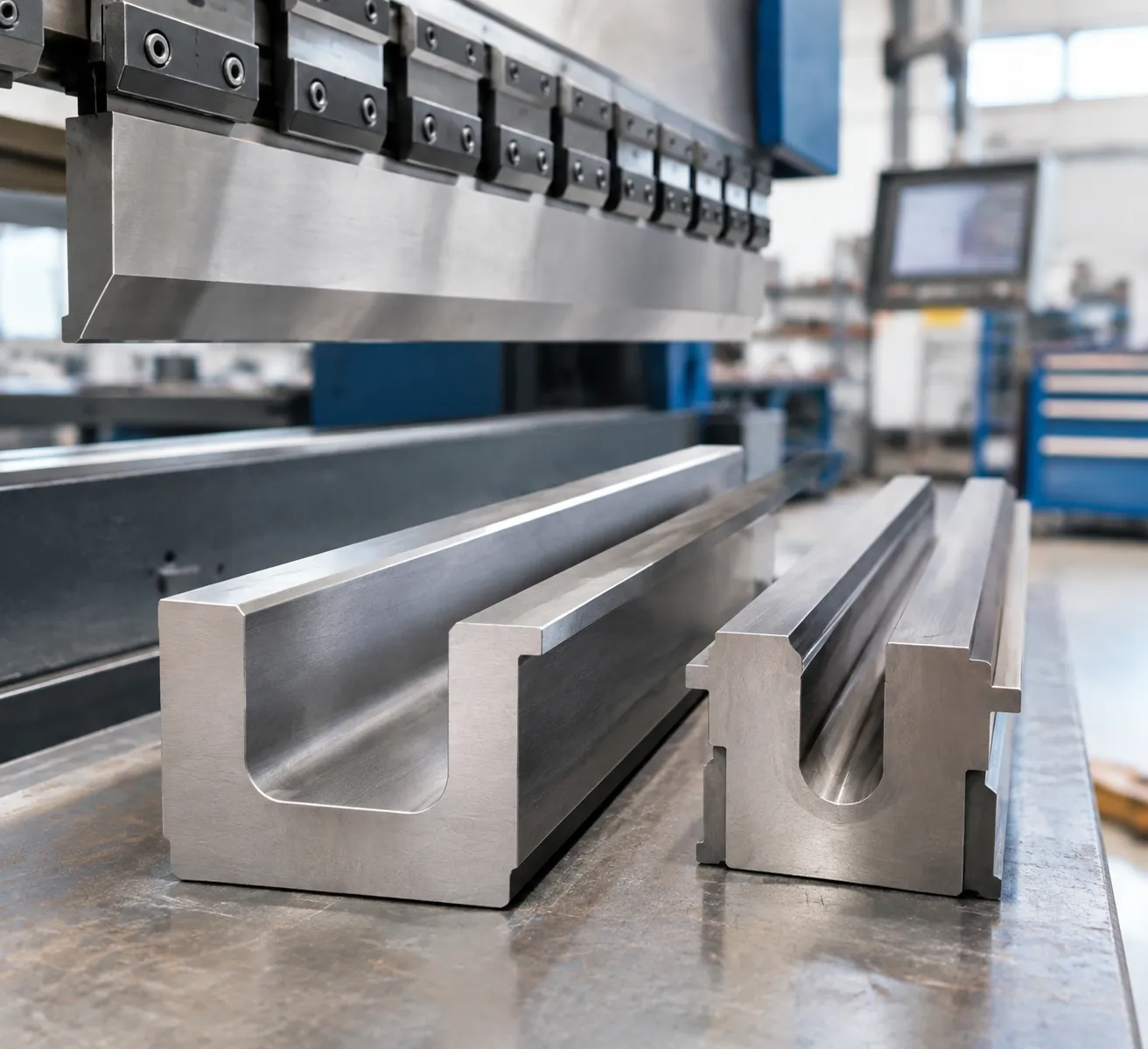
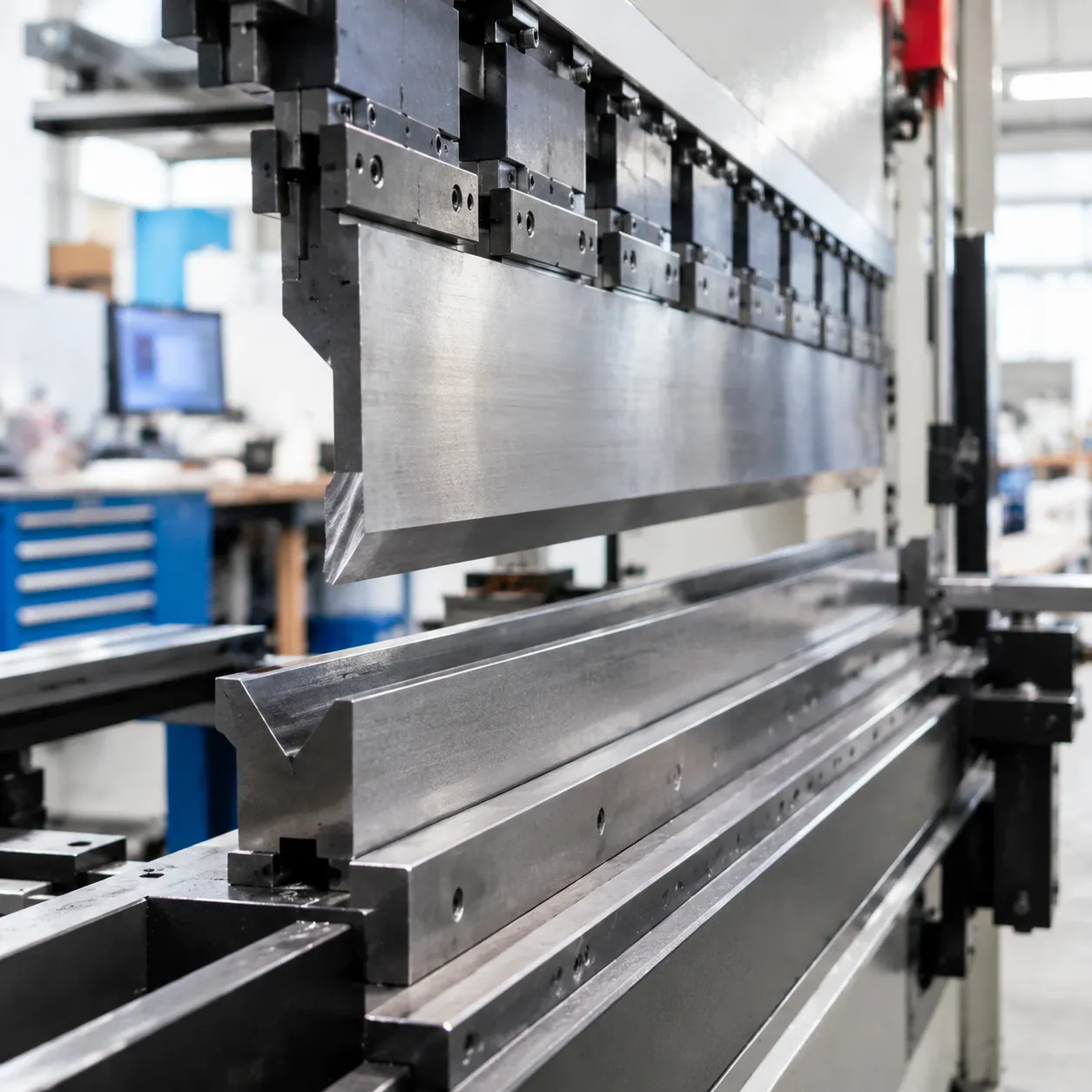
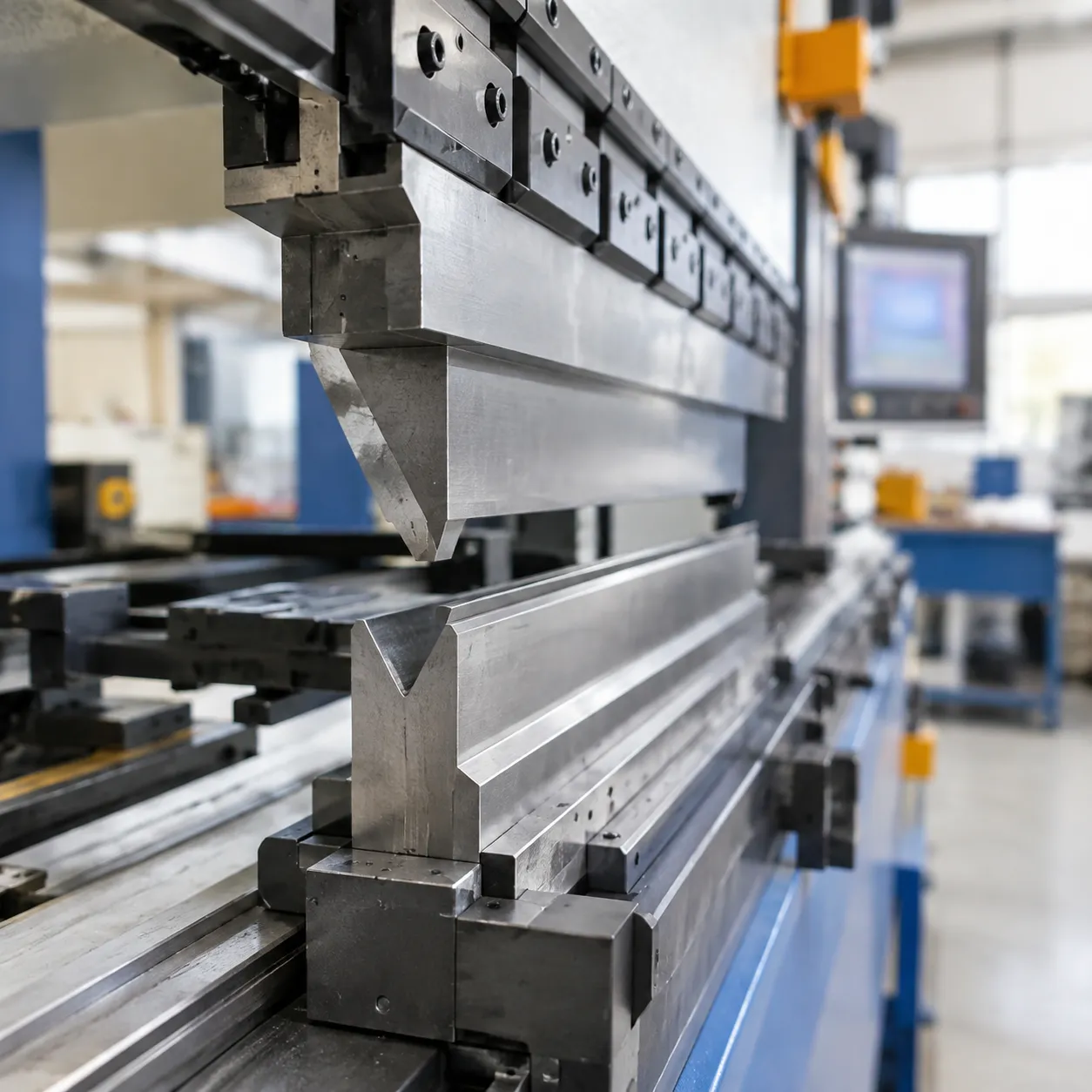
- Single V-Dies: Precision-ground 30°, 45°, 60°, 88°, and 90° single bottom v die for press brake operations. Designed specifically for acute air bending and bottoming with tight radii and zero tool distortion.
- Multi-V & 4-Way Block Dies: Self-centering multi-v dies and heavy-duty 4-way die blocks engineered for rapid setup changes when handling varying plate thicknesses without constantly swapping out tooling.
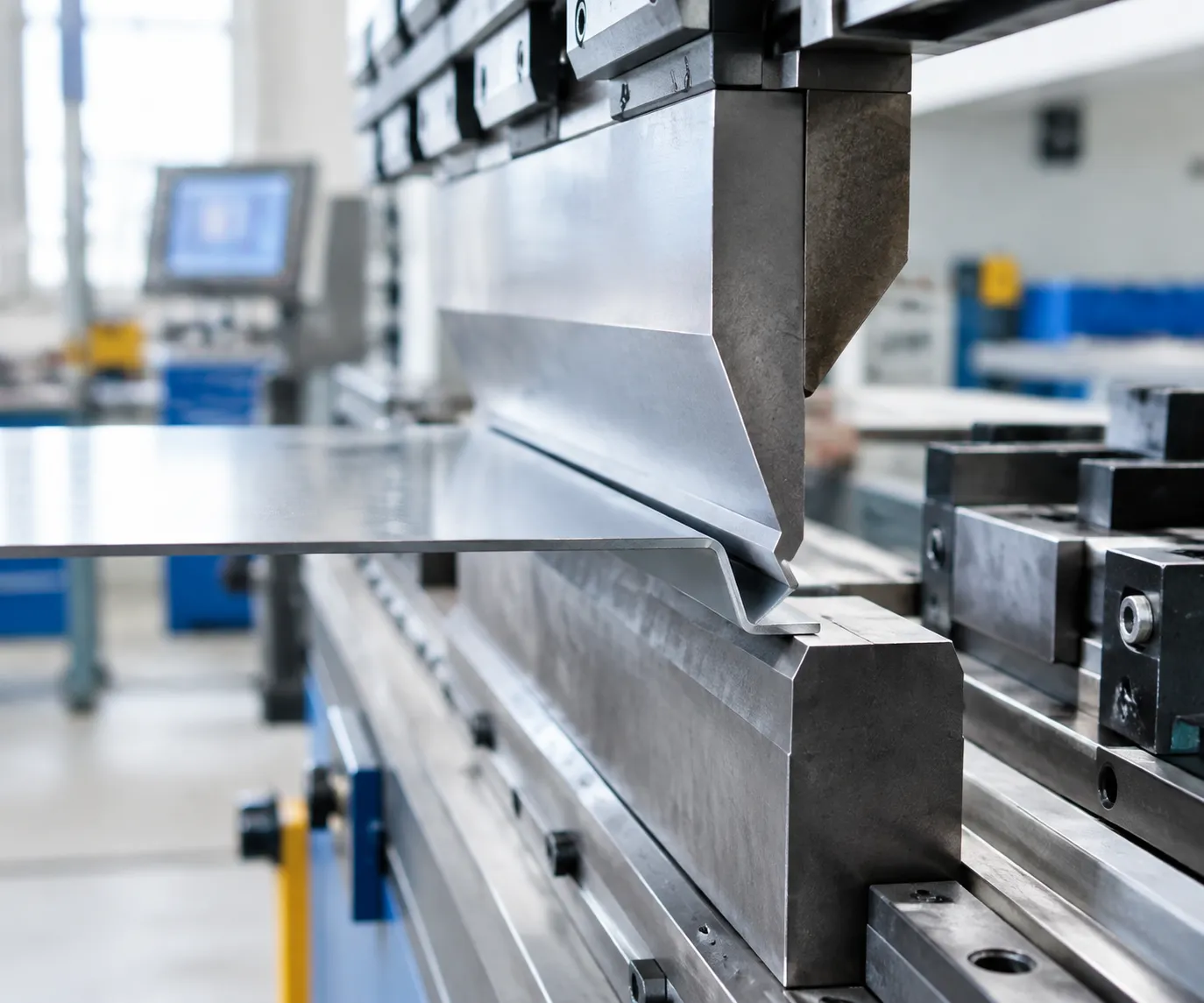
- Hemming & Flattening Die Sets: Two-stage acute bend and flat-hemming combination tooling that creates clean, reinforced safety edges on sheet metal panels in a single continuous workflow.
- Adjustable & Custom V-Width Dies: Modular bottom dies featuring variable V-opening widths, built specifically to handle heavy plate forming, structural steel processing, and high-tonnage bends.
Machine Compatibility & Clamping Systems
System Mounting Profiles
- American Style (1/2" x 5/8" Tangs): Standardized tang design for traditional American press brake clamping beds. We supply specialized options like Cincinnati press brake die set compatible T-style dies and standard 3-inch American style press brake die configurations for immediate installation.
- European Style (Promecam / Euro-Clamp): Micro-milled grooves and precision-ground tangs built for fast side-loading, self-seating, and rapid hydraulic clamping systems.
- New Standard / Wila Style: Engineered for wila trumpf style tooling receivers, featuring automated pin-locking systems for ultra-fast tooling changes and high-tonnage precision.
OEM Brand Interoperability
Our precision ground press brake tooling integrates seamlessly with all leading global hydraulic press brake machinery:
| Machine Brand | Compatible Clamping Style | Key Advantage |
|---|---|---|
| Amada | European Style / Promecam | Zero-gap mounting & fast side-loading |
| Trumpf & WILA | New Standard / Wila Style | Self-seating vertical load alignment |
| Cincinnati & Accurpress | American Style Tang / T-Style | Heavy-duty structural plate compatibility |
| Bystronic & LVD | LVD Style / European | High-tonnage load distribution |
| Prima Power | Multi-Style Adaptive | Precision center-line alignment |
Whether you are running european style press brake dies or high-tonnage American machinery, our tooling eliminates custom shimming and guarantees instant centerline alignment.
Material Science, Heat Treatment & Quality Control
Dual-Zone Heat Treatment Process
Conventional single-hardness tooling either cracks under high tonnage or wears out prematurely. We eliminate this trade-off using a dual-zone heat treatment approach:
- Shock-Absorbing Core (28–32 HRC): We process the core through deep vacuum heat treatment, giving the tool structural flexibility to absorb severe bending loads without fracturing. Read our press brake die material guide to learn how we optimize alloy chemistry for structural integrity.
- Induction Hardened Working Edges (55–60 HRC): We apply targeted, deep induction hardening directly to the V-opening shoulder radii. These induction hardened press brake dies provide maximum resistance against friction, galling, and deformation over hundreds of thousands of bends.
6-Step Precision Quality Assurance
To ensure exact angle control and repeatability across the full working length, every batch passes through a rigorous 6-step testing protocol. You can explore our complete quality control inspection system to see our full testing procedures.
- 1. Spectrometric Analysis: Raw 42CrMo alloy tool steel die blocks undergo chemical composition testing to confirm metallurgical purity.
- 2. Multi-Axis CNC Machining: Precision milling forms the primary tool profiles, tangs, and V-openings.
- 3. Deep Vacuum Thermal Processing: Thermal cycling establishes the dynamic balance between core toughness and tensile strength.
- 4. CNC Profile Surface Grinding: High-precision grinding brings working surfaces to strict precision ground press brake tooling tolerances of ±0.01 mm.
- 5. CMM & Optical Projector Inspection: Coordinate measuring machines and optical comparators verify V-angle symmetry and radius accuracy.
- 6. Profilometer Inspection: Contact surfaces are measured to ensure a ultra-smooth micro-finish of Ra < 0.8 µm, reducing sheet marking during operation.
Engineering Selection Guide & Tonnage Calculations
V-Opening Selection Rules of Thumb
Selecting the correct V-opening width depends on your target sheet thickness ($T$). If you are unsure which profile fits your material, refer to our detailed guide on how to choose the right press brake die.
- Standard Mild Steel: V = 8 x T — Offers the ideal balance between radius control and tonnage consumption.
- Thin Gauge Sheet (< 1.5 mm): V = 6 x T — Ensures clean contact and minimizes severe material distortion.
- Thick Plate (> 10 mm): V = 10 x T to 12 x T — Reduces the required forming force and lowers wear on your bottom v die for press brake setups.
Air Bending Tonnage Formula
Calculating your required bending force guarantees safe operation for both your machine hydraulics and your precision ground press brake tooling.
Use our standard air bending tonnage formula:
P = (650 x T² x L) / V
| Parameter | Description | Unit |
|---|---|---|
| P | Required Bending Force | Metric Tons (or kN) |
| T | Material Thickness | mm |
| L | Total Bend Length | m |
| V | Die V-Opening Width | mm |
- Material Multipliers: Standard calculations apply to mild steel (approx. 450 MPa tensile strength). For stainless steel or high-tensile alloys, multiply the resulting tonnage by 1.5x to 2.0x.
- Safety Margin: Always cross-reference your calculated load against our press brake V-die chart and tonnage guide to prevent exceeding maximum load limits per meter.
Industrial Application Scenarios
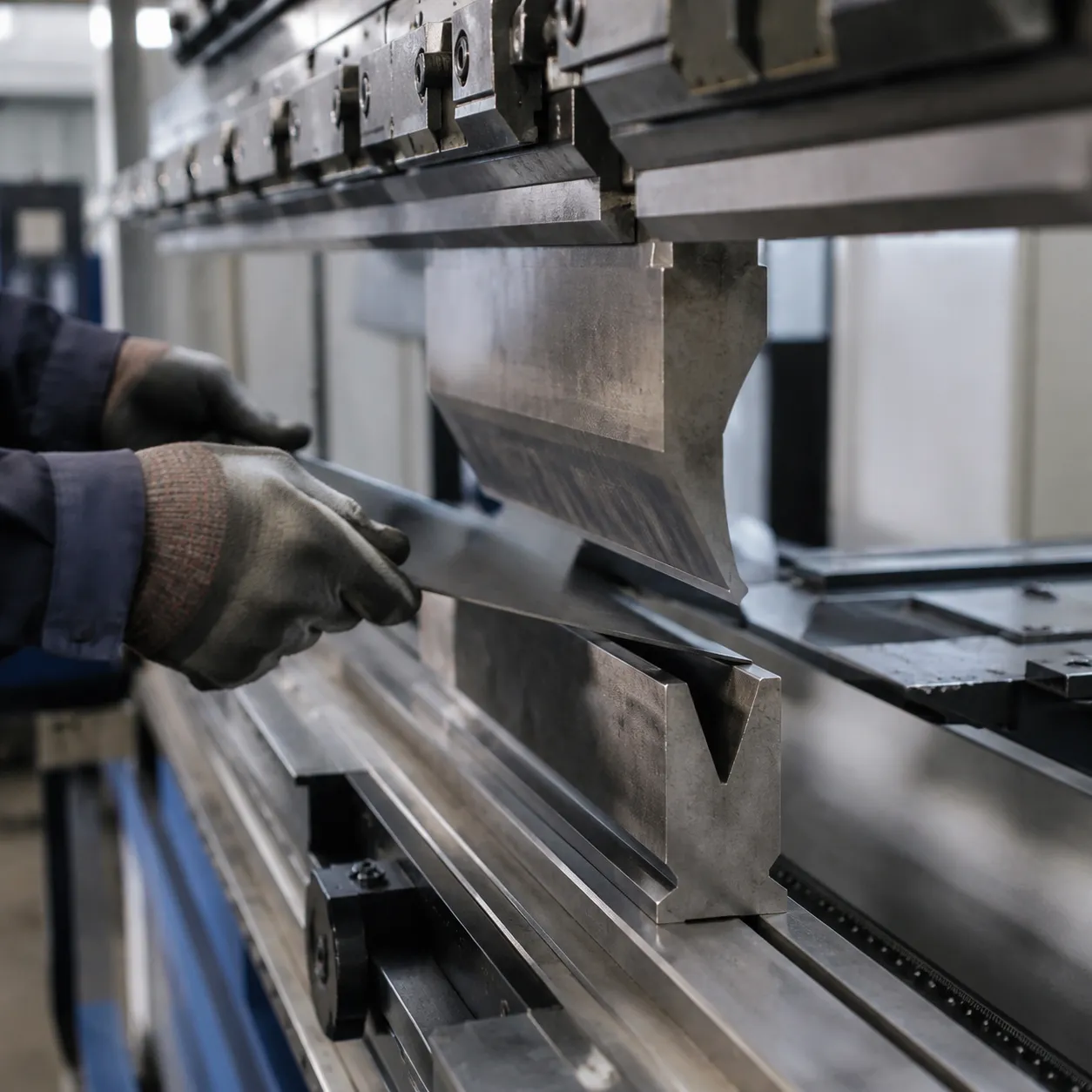
We build every AAA press brake die to handle aggressive production environments without losing precision.
- Cosmetic Metal Fabrication: Essential for stainless steel appliances, architectural metalwork, and elevator manufacturing. Micro-polished contact radii prevent surface marking and eliminate costly secondary finishing.
- Heavy Machinery & Construction Equipment: Built for heavy-gauge plate forming, including structural channels, crane boom arms, and chassis frames. Our deep-hardened bottom V-dies withstand extreme tonnages without deformation.
- Electrical Enclosures & HVAC: Optimized for high-speed, repeatable bending of pan sections and control boxes used in electrical cabinets and HVAC ductwork systems.
- Automotive & Aerospace Components: Engineered for strict tolerance control and accurate spring-back compensation when forming high-strength alloy brackets, chassis ribs, and structural channels.
Custom Press Brake Die Engineering & Direct Factory RFQ
Our direct-factory custom tooling development process eliminates middleman markups while delivering precision-ground, long-lasting tooling designed for immediate drop-in fit.
Streamlined Custom Die Manufacturing Workflow
We follow a rigorous five-step engineering pipeline to guarantee exact part geometry and prevent job-site collision issues before metal is ever cut:
- CAD Drawing Submission: Send us your workpiece or desired press brake die profile.
- Tonnage & Feasibility Analysis: We evaluate bend radii, material spring-back, and tonnage thresholds.
- 3D Bending Simulation: Virtual sequence modeling ensures tool clearance and prevents ram collisions.
- Rapid Precision Machining: High-accuracy CNC grinding and deep induction hardening.
- Batch Production & Global Export: Rigorous final inspection, protective packaging, and direct global dispatch.
Quick RFQ Submission Requirements
To receive a fast, accurate direct-factory quotation on your custom press brake tooling, please provide the following technical parameters:
| Input Requirement | Technical Specifications Required |
|---|---|
| CAD Files | 2D/3D engineering vector files (DXF, DWG, STEP, IGES) |
| Material Parameters | Sheet metal material type, yield strength, and tensile strength |
| Sheet Thickness (T) | Minimum and maximum thickness range (T) to be formed |
| Machine Specs | Press brake brand, model name, and maximum tonnage capacity |
| Bed Clamping Style | American Tang, European Promecam, Wila / New Standard, or LVD |
Frequently Asked Questions (Technical FAQ)
We provide clear, direct answers to the most common engineering questions regarding our aaa press brake die lineup, machine compatibility, and custom tooling requests.
Quick Technical Reference
| Bending Concern | Our Engineering Solution | Manufacturing Capability |
|---|---|---|
| Extending Tooling Life | Dual-zone heat treatment & surface micro-polishing | 55–60 HRC wear edges / 28–32 HRC shock-absorbing core |
| Legacy Press Brake Fit | Custom tang, shoulder, and slot machining | Direct retrofits for all legacy hydraulic press brake die mounts |
| Mar-Free Surface Finish | Expanded V-geometry & polished contact radii | Custom shoulder radii & Ra < 0.8 µm micro-polished finish |
| Custom Tooling RFQs | Fast-track 2D/3D CAD profile integration | STEP, IGES, DXF, and DWG format processing |
How does CAMT achieve a 3x service life extension compared to standard press brake dies?
We utilize a specialized dual-zone heat treatment process on high-grade 42CrMo alloy tool steel. Rather than simple through-hardening, which can leave tooling brittle, we combine a resilient, shock-absorbing core (28–32 HRC) with deep localized induction hardening (55–60 HRC) along the primary wear zones. Paired with micro-polished contact radii (Ra < 0.8 µm) and precision profile surface grinding along full working lengths to ±0.01 mm, this process minimizes friction, eliminates galling, and significantly extends working lifespan under high-tonnage production.
Can CAMT press brake dies be manufactured to custom tang dimensions for older machine models?
Yes, we regularly design and produce custom tang dimensions, altered shoulder heights, and specialized mounting slots for older or non-standard press brakes. Whether your machine uses modified American style press brake tooling or custom hydraulic press brake die mounts, we match your exact machine bed configuration. We also upgrade older machine beds to multi-side setups, such as our 4-way 90-degree tooling, allowing you to increase shop capability without altering bottom rail clamps.
What V-opening size should be selected to avoid surface marking on stainless steel?
To eliminate cosmetic marking on stainless steel and aluminum, we recommend opening the V-width to V = 10 x T to 12 x T (where T is sheet thickness), instead of the standard V = 8 x T rule. Selecting a wider bottom v die for press brake operations lowers the required tonnage and reduces shoulder friction against the workpiece. Additionally, utilizing larger shoulder radii or adopting a flexible 10-way multi-V die spreads contact pressure evenly across the metal sheet to stop drag lines before they start.
What CAD file formats are required for custom press brake die engineering requests?
For fast direct-factory quotes and precise 3D bending simulation, we accept the following engineering files for custom sheet metal bending tooling requests:
- 2D Drawings (DXF or DWG): Required for verifying exact cross-sectional profiles, tolerance callouts (±0.01 mm), and shoulder radii.
- 3D Solid Models (STEP, IGES, or X_T): Used for tool path generation, FEA load analysis, and CNC profile grinding verification.
- Operational Details: Material type, tensile strength, sheet thickness range (T), machine model name, total tonnage capacity, and bed clamping profile.