
Understanding Aluminum Mechanical Properties & Bend Behavior
Why does aluminum snap or crack on your press brake while mild steel forms effortlessly? CNC operators face constant scrap loss from micro-fracturing, severe material galling, and unpredictable springback when treating aluminum like ferrous metals. Matching your tooling and press brake die selection to the specific metallurgical profile of the alloy prevents costly tool damage and rework.
Alloy Bendability Matrix
Aluminum alloys react differently to tensile stress along the outer bend radius. Selecting the right press brake punch and die depends directly on material yield strength and elongation limits.
| Alloy & Temper | Mechanical Category | Minimum Inside Bend Radius (R) | Formability & Risk Factor |
|---|---|---|---|
| 3003-H14 | Soft / Ductile | 0.0T – 0.5T | Superior formability; zero risk of cracking. |
| 5052-H32 | Medium / Formable | 0.5T – 1.0T | Standard marine/sheet grade; excellent air bending performance. |
| 6061-T6 | Hard / Brittle | 3.0T – 5.0T | High yield strength; extreme micro-fracturing risk if bent tight. |
| 7075-T6 | Very Hard / High-Tensile | 4.0T – 6.0T | Aircraft grade; requires large punch radius and controlled tonnage. |
Bend Radius Grain Direction Sheet Metal
The sheet metal rolling process creates a distinct grain structure along the coil direction. Bending orientation relative to this grain determines the minimum air bending inside bend radius:
- Transverse Bending (Across Grain): Bending at 90° to the rolling direction distributes tensile stress evenly across grain boundaries. This orientation yields maximum ductility and allows tighter inside bend radii without cracking.
- Longitudinal Bending (Along Grain): Bending parallel to the rolling direction forces tension along grain boundaries, triggering micro-fracturing aluminum sheet bending failures.
- Adjustment Rule: When bending parallel to the grain, increase your inside punch nose radius and V-die opening by 30% to 50% to prevent surface tearing.
Air Bending vs Bottom Bending vs Coining
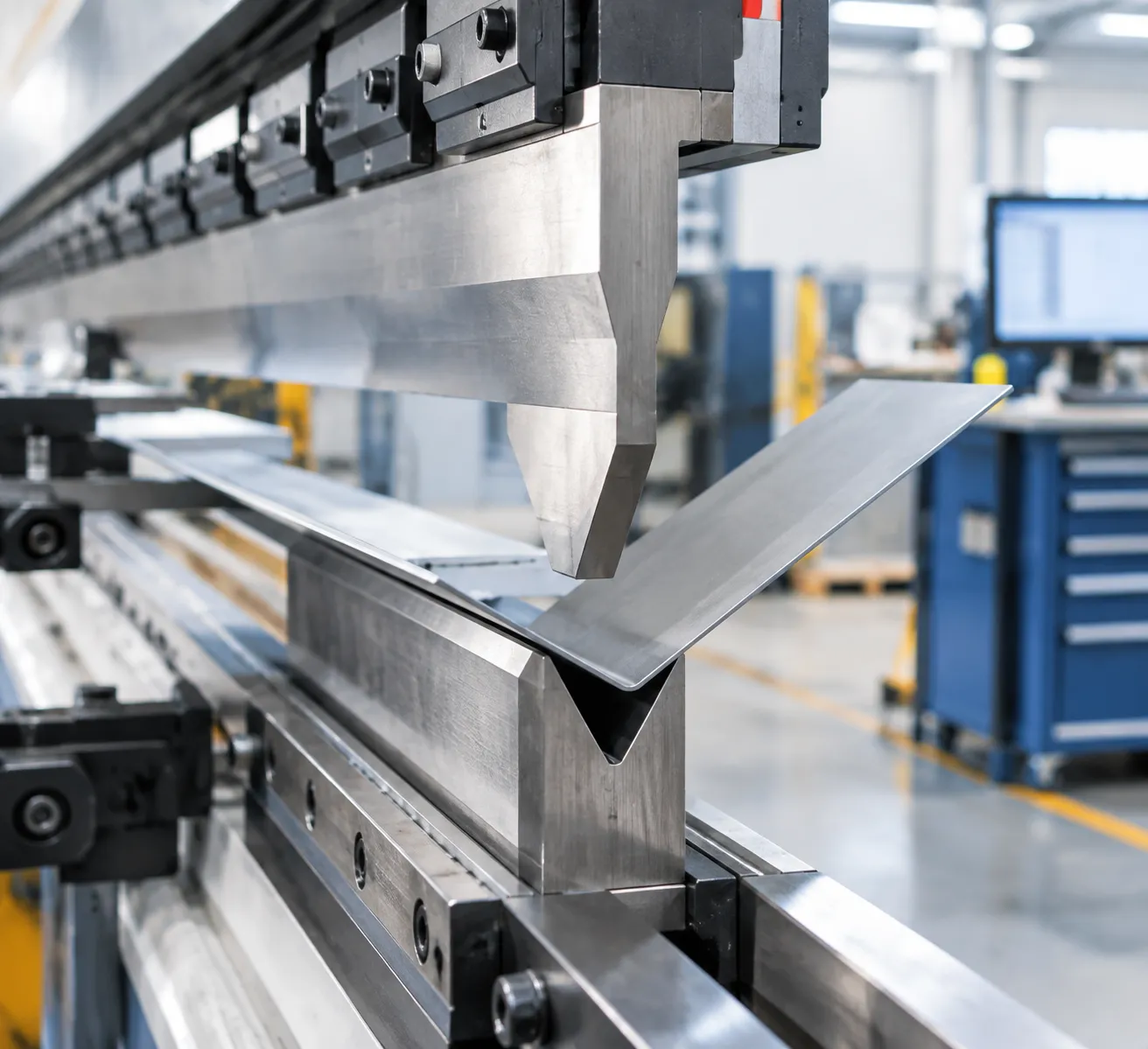
- Air Bending (Recommended): The primary choice for aluminum. The material contacts only three points (the punch tip and die shoulder radii). Air bending minimizes tonnage, limits sheet galling, and provides flexibility to over-bend and absorb material springback.
- Bottom Bending: Forces the material to conform to the die angle. Requires 3x to 5x higher tonnage than air bending and increases the risk of work-hardening and cracking T-temper alloys.
- Coining (Avoid): Penetrates the material thickness to eliminate springback. Extremely dangerous for hard aluminum alloys like 6061-T6, leading to catastrophic material splitting and press brake tooling damage.
Standardizing V-Die Opening Calculations for Aluminum
Getting your V-opening width right is the single most critical step in press brake die selection for aluminum. Choosing the wrong die width leads to cracked bend lines, excessive springback, or unexpected tonnage spikes. We calculate the required V-opening using the variable multiplier formula:
V = M × T
Where V is the V-die opening width, T is the sheet thickness, and M is the material multiplier.
Matching Die Multipliers to Alloy Tempers
Unlike mild steel—which defaults to an 8T rule—aluminum temper determines the multiplier you must select to maintain structural integrity:
- 6T to 8T Multipliers (Soft Alloys): Ideal for ductile grades like 3003-H14 and 5052-H32. A tighter V-die produces smaller inside radii without splitting the sheet.
- 10T to 12T Multipliers (Hard Alloys): Required for high-yield tempers like 6061-T6 and 7075-T6. Spreading the bend across a wider die opening prevents outer-fiber micro-fracturing and drastically cuts required forming force.
When running mixed production jobs with varying sheet thicknesses, using a 4-way press brake die with multiple V-openings keeps setup times low and eliminates constant tooling changes.
Calculating Floated Radius with the 20% Air Bending Rule
During air bending, the punch nose does not dictate the final air bending inside bend radius. Instead, the radius floats naturally based on the V-die width. Under the 20% air bending rule, soft to medium aluminum alloys float an inside radius equal to 13%–16% of the V-opening, while high-tensile alloys like 6061-T6 sit closer to 18%–20%.
| Material Thickness (T) | Alloy Grade | Recommended Multipliers | V-Die Opening (V) | Estimated Inside Radius |
|---|---|---|---|---|
| 2.0 mm | 5052-H32 | 8T | 16 mm | 2.24 mm – 2.56 mm |
| 2.0 mm | 6061-T6 | 10T | 20 mm | 3.60 mm – 4.00 mm |
| 3.0 mm | 5052-H32 | 8T | 24 mm | 3.36 mm – 3.84 mm |
| 3.0 mm | 6061-T6 | 12T | 36 mm | 6.48 mm – 7.20 mm |
Tonnage Adjustments: Aluminum vs. Mild Steel
Running an accurate press brake tonnage calculation for aluminum requires adjusting the baseline force used for mild steel. Because aluminum has lower ultimate tensile strength (UTS) than steel, we apply these tonnage adjustment factors relative to standard 60,000 PSI (450 MPa) mild steel:
- Soft Aluminum (3003-H14, 5052-O): Multiply standard steel tonnage by 0.50×
- Medium Aluminum (5052-H32, 6061-O): Multiply standard steel tonnage by 0.60× to 0.70×
- Hard Aluminum (6061-T6, 7075-T6): Multiply standard steel tonnage by 0.80× to 0.85×
Applying this V die opening formula alongside correct tonnage adjustments prevents tool overload, extends die life, and maintains machine precision over high-volume production runs.
Punch Radius & Die Angle Selection
Matching punch nose radius to material temper is critical for preventing part cracking and achieving precise bend angles during press brake die selection for aluminum.
Matching Punch Nose Radius to Material Temper
Using a punch nose radius that is too tight concentrates tensile stresses directly on the outer bend line, causing immediate micro-fracturing in hard tempers.
- Soft & Ductile Tempers (3003-H14, 5052-H32): Accept tighter punch radii down to Rn = 0.8T to 1.0T without structural degradation.
- Hard & Brittle Tempers (6061-T6, 7075-T6): Require a larger nose radius. Avoid sharp punches where nose radius is less than sheet thickness (Rn < T). Maintain Rn = 1.5T to 3.0T to spread forming forces evenly across the bend profile.
- Tooling Selection: Utilizing targeted radius punches eliminates severe crease lines and prevents structural failure across high-yield alloys.
Overcoming High Springback with Acute Tooling
Aluminum exhibits high elastic recovery after load release, requiring calculated overbending during air bending.
| Material Temper | Expected Springback | Target Punch Angle | Target V-Die Angle |
|---|---|---|---|
| 3003-H14 / 5052-H32 | 2° – 4° | 88° or 85° | 88° or 85° |
| 6061-T6 / 7075-T6 | 5° – 12° | 85° or 80° | 85° or 80° |
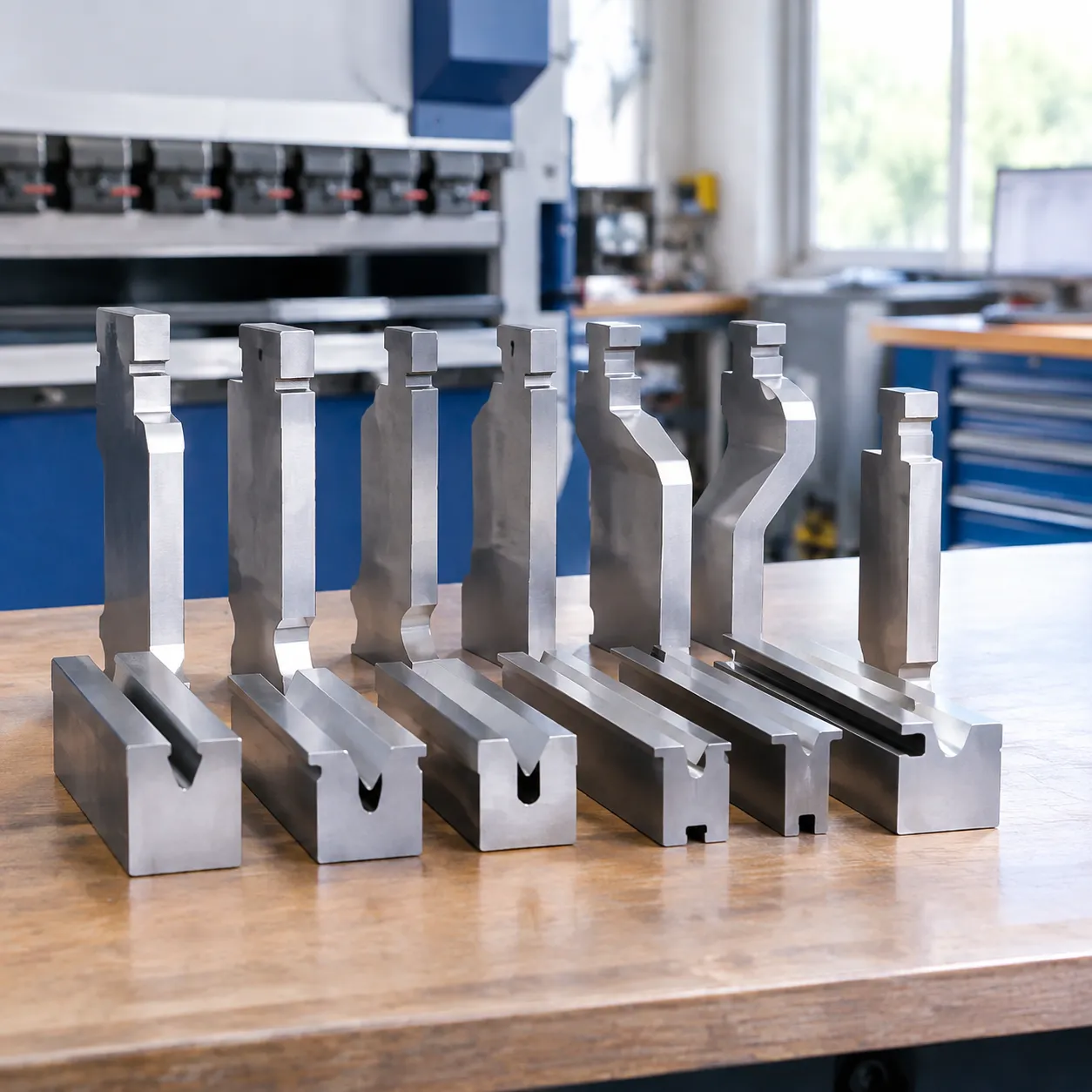
| Deep Return Channels | 4° – 10° | 30° Gooseneck | 30° Acute Die |
Standard 90° punch and die sets hit physical mechanical limits before fully compensating for high springback. We deploy acute punches and matching acute V-dies (85°, 80°, or 30° gooseneck profiles) to give the ram enough angular clearance to overbend sheet metal down to an exact, repeatable final 90° part geometry.
Preventing Cosmetic Surface Damage & Material Galling
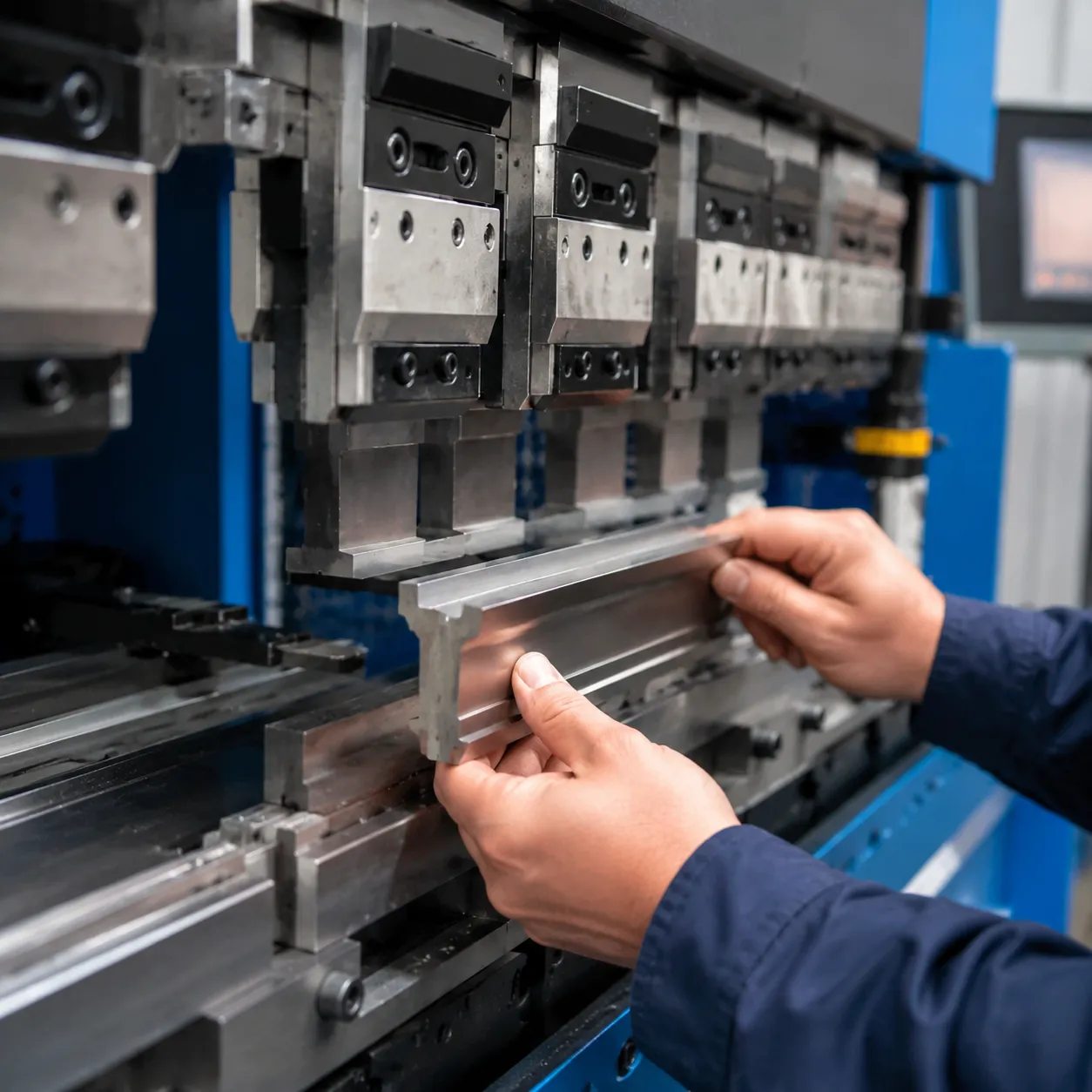
Soft aluminum alloys carry a high friction coefficient, causing raw metal to bond onto standard tool steel shoulders during forming. This material transfer creates galling, which acts like sandpaper and ruins cosmetic, anodized, or painted finishes—a primary concern during press brake die selection for aluminum. We engineered our non-marking solutions specifically to address these friction dynamics and eliminate post-bend finishing costs.
CAMT Non-Marking Tooling Solutions
- Mirror-Polished Shoulder Radius: Precision profile grinding achieves a surface roughness under Ra 0.8 µm. This ultra-smooth contact zone drastically lowers sliding resistance to prevent sheet metal galling and micro-scratching.
- Polyurethane Inserts & Pads: Eliminates direct metal-to-metal contact entirely. Integrating non-marking polyurethane die inserts into your V-block protects delicate architectural and aerospace panels with zero surface impairment.
- Rotary Die Systems: Replaces traditional static V-die shoulders with hardened rotating rollers. The sheet rolls into the die pocket rather than dragging over a sharp edge, stopping drag marks cold on soft 3003-H14 and 5052-H32 sheets.
Tooling Quality, Tolerances, and Longevity
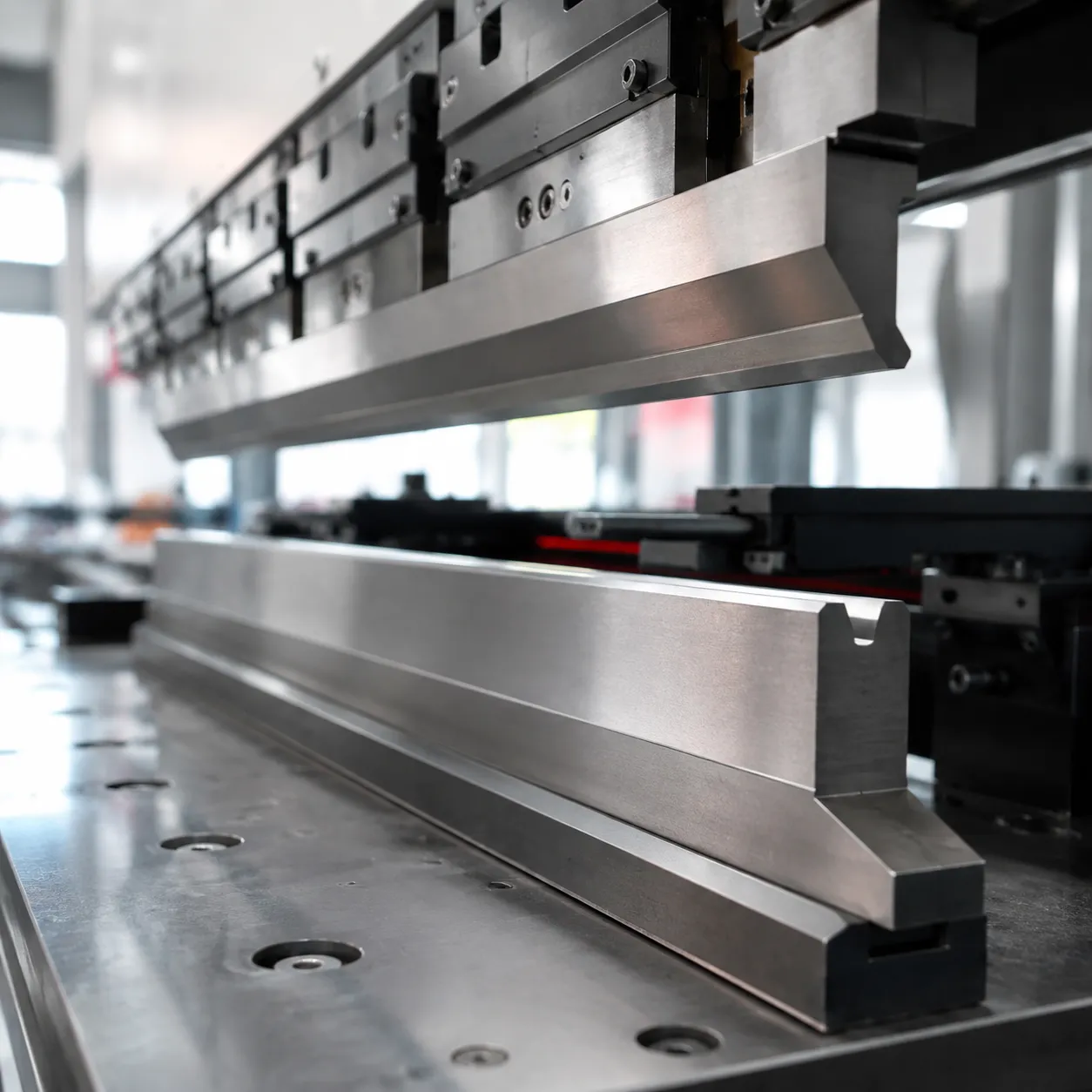
Baseline steel quality and hardening methods directly dictate bend accuracy and tool life during press brake die selection for aluminum. We manufacture our high-precision press brake dies to withstand abrasive aluminum oxides while maintaining strict mechanical stability.
Tooling Specification Benchmark
| Specification Parameter | Standard Target | Impact on Aluminum Bending |
|---|---|---|
| Base Material | High-Grade 42CrMo / 4140 Alloy Tool Steel | Prevents structural flex under high concentrated loads |
| Core Heat Treatment | Vacuum Heat Treatment | Ensures uniform grain structure and shock absorption |
| Surface Hardness | Deep Induction Hardening (55–60 HRC) | Stops shoulder wear, scoring, and material galling |
| Profile Tolerance | Precision Profile Grinding (±0.01 mm) | Guarantees identical bend angles across the full bed length |
| Surface Finish | Mirror Polish Finish (Ra < 0.8 µm) | Lowers surface friction to prevent cosmetics marking |
Core Tooling Standards
- High-Grade Tool Steel Selection: Premium 42CrMo alloy tool steel provides high tensile strength and resilience, eliminating mechanical deflection during repetitive bending cycles.
- Deep Induction Hardening: Critical contact points undergo deep induction hardening to a depth of 3–5 mm, delivering 55–60 HRC surface durability over a tough, crack-resistant core.
- Micron-Level Precision Grinding: All V-die shoulders and punch noses undergo precision profile grinding to ±0.01 mm tolerances, ensuring perfect alignment across multi-segment tool setups.
- Maximizing Tool Life: Integrating polished working surfaces (Ra < 0.8 µm) with structured press brake die maintenance practices prevents micro-welding and significantly extends overall tooling longevity.
Press Brake Compatibility & Custom Tooling Simulation
Machine Clamping System Integration
We manufacture tool tangs and safety groves for full compatibility with major OEMs, including Amada, Trumpf, Bystronic, WILA, and LVD:
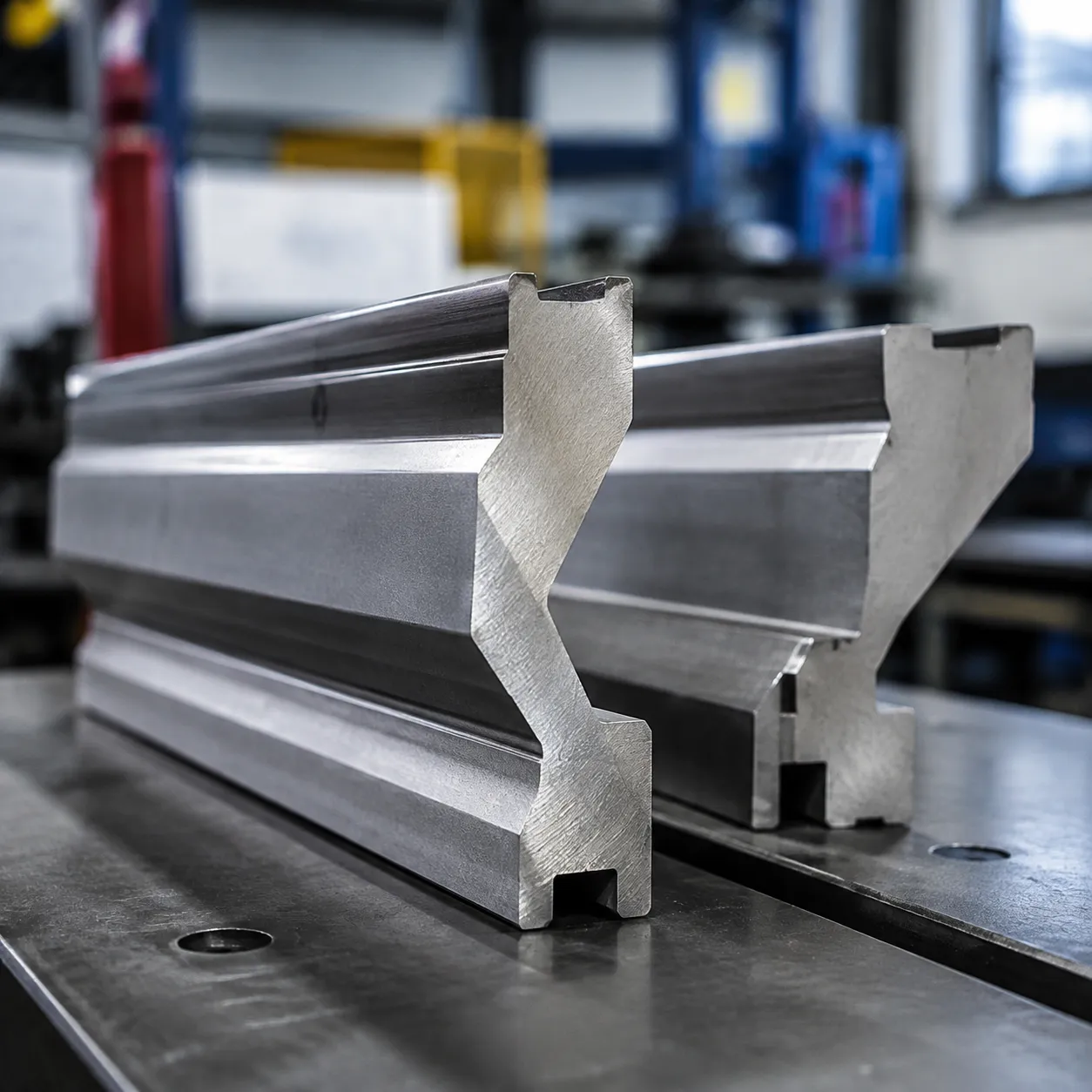
- European Style Tooling: Standardized 13 mm tangs with safety grooves for fast vertical or horizontal self-seating on European press brake systems.
- American Precision Tooling: Traditional 0.500-inch tang geometries engineered for exact centerline alignment on American-style press brakes.
- New Standard / WILA: Self-seating hydraulic clamping profiles designed for automatic seating and high-speed tool changeovers.
Integrating precision-ground American and European press brake tooling ensures consistent centerlines and reduces load spikes during press brake die selection for aluminum forming operations.
3D Bending Simulation & Rapid Prototyping
Before cutting tool steel, we run virtual forming cycles to eliminate interference risks and verify precise tonnage limits.
- 3D Press Brake Simulation Clearance: Identifies punch-to-part and die-to-housing collisions on complex, multi-bend aluminum sheet metal components.
- Springback & Tonnage Validation: Simulates material springback and calculates peak tonnage loads to prevent tool overloading when forming T6 tempers.
- Rapid Tool Prototyping: Delivers physical concept models and custom profiles for rapid validation on non-standard bends.
Our specialized custom tooling development service resolves tight part clearances, deep return flanges, and unique bend radius constraints before production begins.
Technical RFQ Submission & Selection Checklist
Before submitting a tooling Request for Quote (RFQ), we verify four primary variables to guarantee your press brake die selection for aluminum delivers precise bend angles without exceeding machine load limits or cracking parts. Reviewing these parameters upfront eliminates costly rework and tooling mismatch.
| Key Variable | Target Specification | Engineering Impact on Aluminum Bending |
|---|---|---|
| Alloy Grade & Temper | 3003-H14, 5052-H32, 6061-T6, etc. | Determines tensile strength, springback allowance, and minimum punch nose radius. |
| Material Thickness (T) | Exact sheet thickness in mm or inches | Establishes the baseline V-die opening multiplier (6T, 8T, or 10T–12T). |
| Inside Bend Radius (Ir) | Transverse vs. longitudinal grain direction | Controls micro-fracturing risks and dictates acute die angle requirements. |
| Press Brake Tonnage Limit | Tons per meter / foot rating | Prevents tool overload when air bending high-yield structural alloys. |
Technical RFQ Checklist for Custom Tooling
When submitting drawings to our team, include these exact specs to accelerate tool production:
- Part Profile & Clearance Requirements: Send 3D CAD models (.STEP / .DXF) to run collision checks for deep channels or narrow return flanges.
- Surface Finish Criteria: Specify if cosmetic appearance requires mirror-polished shoulders (Ra < 0.8 µm) or non-marking polyurethane inserts.
- Machine Clamping System: Define your beam interface (European Style, American Precision, Wila/TRUMPF, or LVD) to ensure proper tang compatibility.
- Tooling Length & Segmentation: Detail required sectionalized lengths for box forming or long sheet processing.
For complex geometries, establishing a precise press brake die selection strategy during the RFQ phase ensures maximum tool longevity. Pairing accurate tonnage limits with a dedicated female press brake V-die yields repeatable, fracture-free aluminum bends from the first hit.
Press Brake Die Selection for Aluminum FAQs
What is the recommended V-die opening multiplier for 6061-T6 aluminum?
For hard tempers like 6061-T6, we recommend a 10T to 12T V-die opening (where T is material thickness). Standard 8T openings designed for mild steel generate excessive stress concentration on high-strength aluminum, resulting in severe micro-fracturing along the outer bend radius. Applying a wider V-opening increases the floated inside bend radius and drops required tonnage by 30% to 50%.
- 3003-H14 / 5052-H32: 6T to 8T multiplier
- 6061-T6 / 7075-T6: 10T to 12T multiplier
When forming thicker plate stock, using high-precision metal forming press brake dies engineered for wide V-openings keeps bending forces well within press tonnage limits while protecting material integrity.
How do you stop galling and die marks on soft aluminum sheet during forming?
Soft aluminum alloys readily adhere to hardened die shoulders under pressure, causing material pickup, scuffing, and severe surface galling. We eliminate cosmetic defects using three primary strategies:
- Mirror-Polished Shoulder Radii: Maintain die shoulder surface roughness at Ra < 0.8 µm to reduce friction coefficient.
- Non-Marking Protection: Apply heavy-duty polyurethane protective tape or urethane die inserts over the V-opening to prevent direct metal-to-tooling contact.
- Rotary Wing Dies: Deploy rotating shoulder dies that roll with the sheet during stroke penetration rather than scraping across the material surface.
Why does aluminum micro-fracture when bent parallel to the rolling grain line?
Sheet metal mills elongate grain structures in the direction of rolling. Bending parallel to the grain forces tensile loads directly along these parallel grain boundaries, causing microscopic cracks to propagate on the outer radius.
- Perpendicular Bending: Form parts transverse (90°) to the grain direction to distribute stress across multiple boundaries.
- 45° Diagonal Offset: Rotate parts 45° to the grain when complex multi-flange layouts prevent pure transverse bends.
- Punch Nose Radius Expansion: Increase the punch nose radius to at least 1.5x to 3x material thickness when longitudinal bending is unavoidable.
How do acute angle dies compensate for aluminum springback in air bending?
Aluminum exhibits substantial elastic recovery after load release. Springback ranges from 2° on soft 3003 sheet up to 15° or more on aerospace-grade 7075-T6.
To overcome this without bottoming, we use acute angle punches and dies (85°, 80°, or 30° goosenecks) to over-bend the material past its target angle during air bending. The sheet spring-backs naturally to the desired 90° angle upon punch retraction while avoiding bottom-forming tonnage spikes.