
Formula details
Product Details
Overview
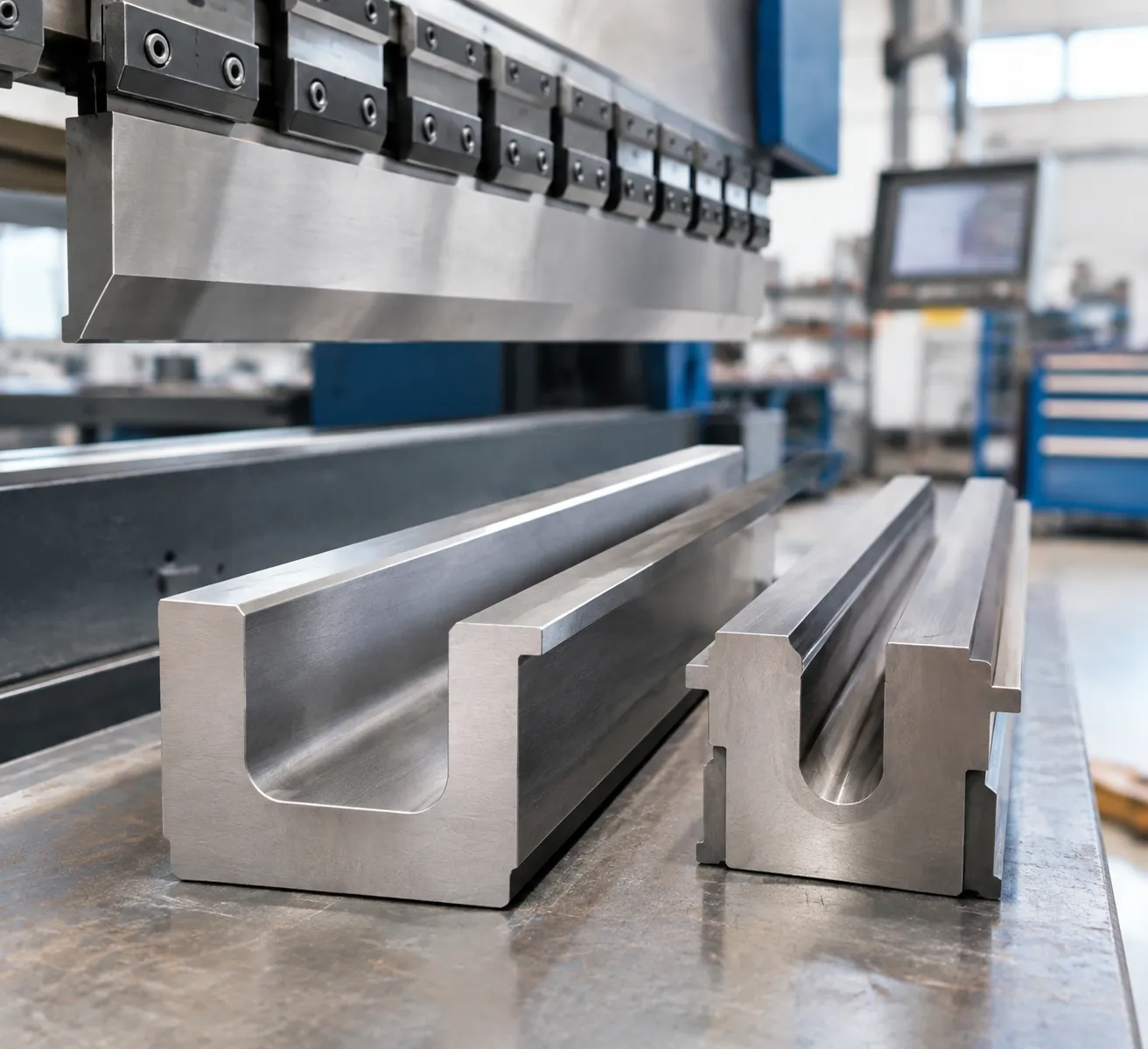
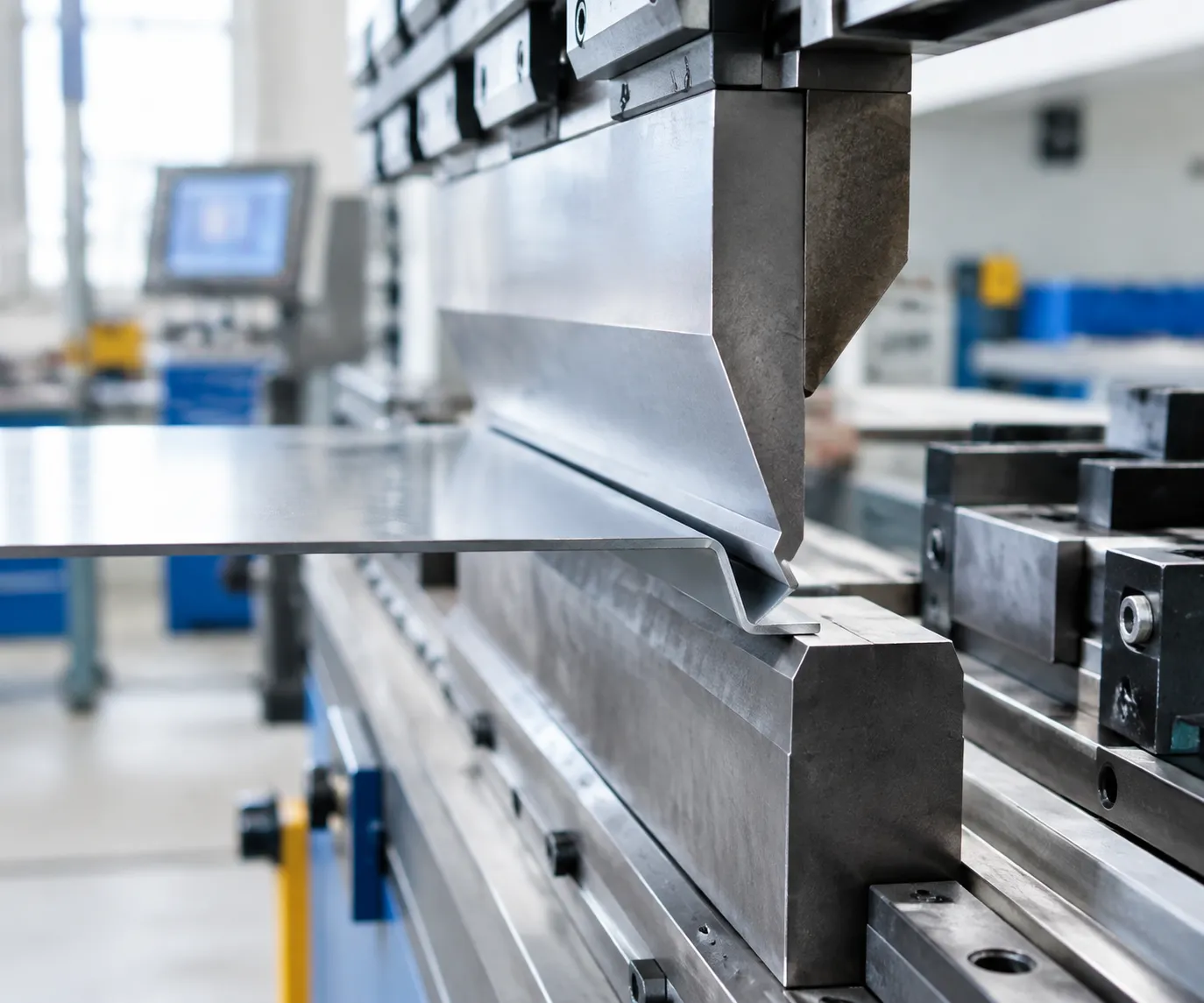
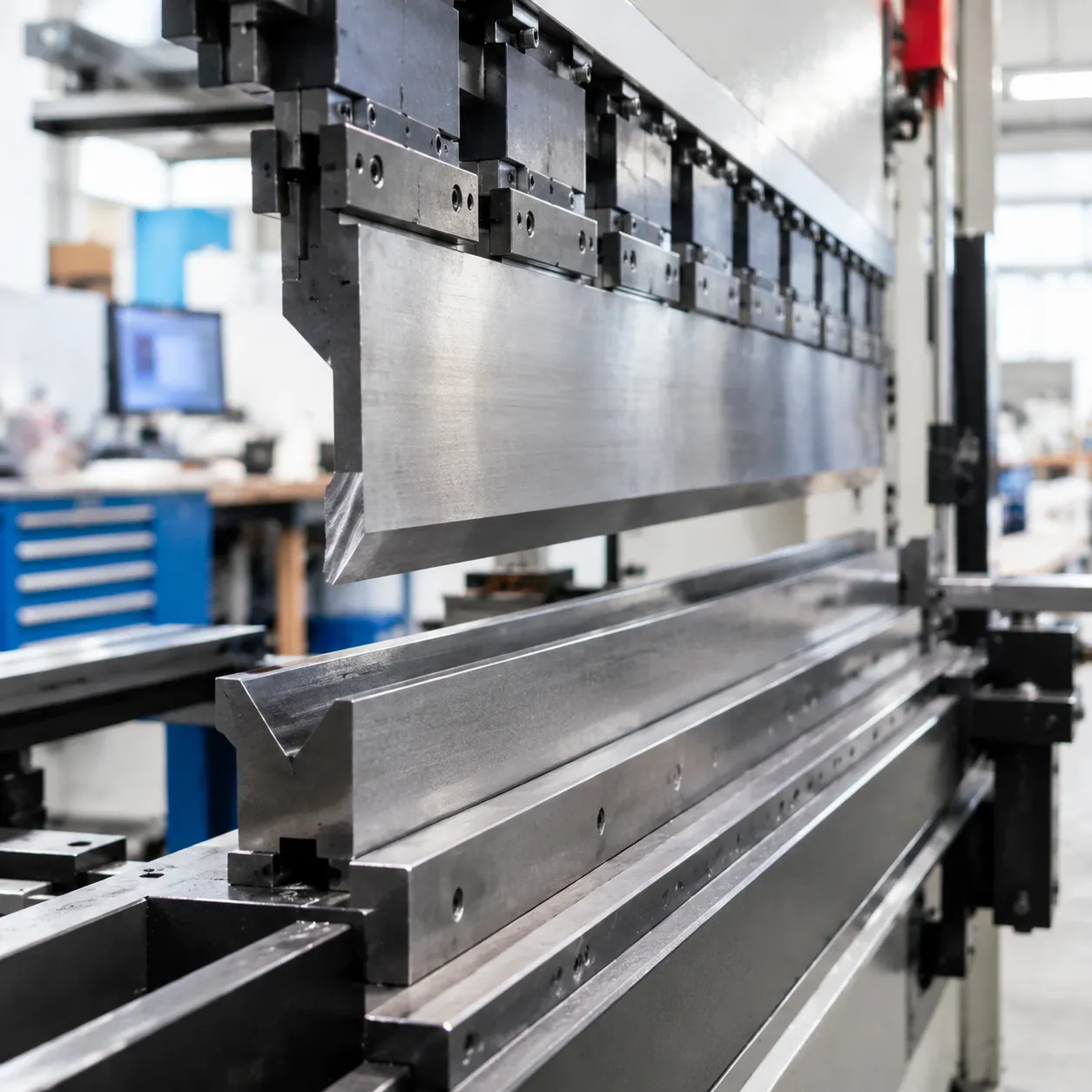
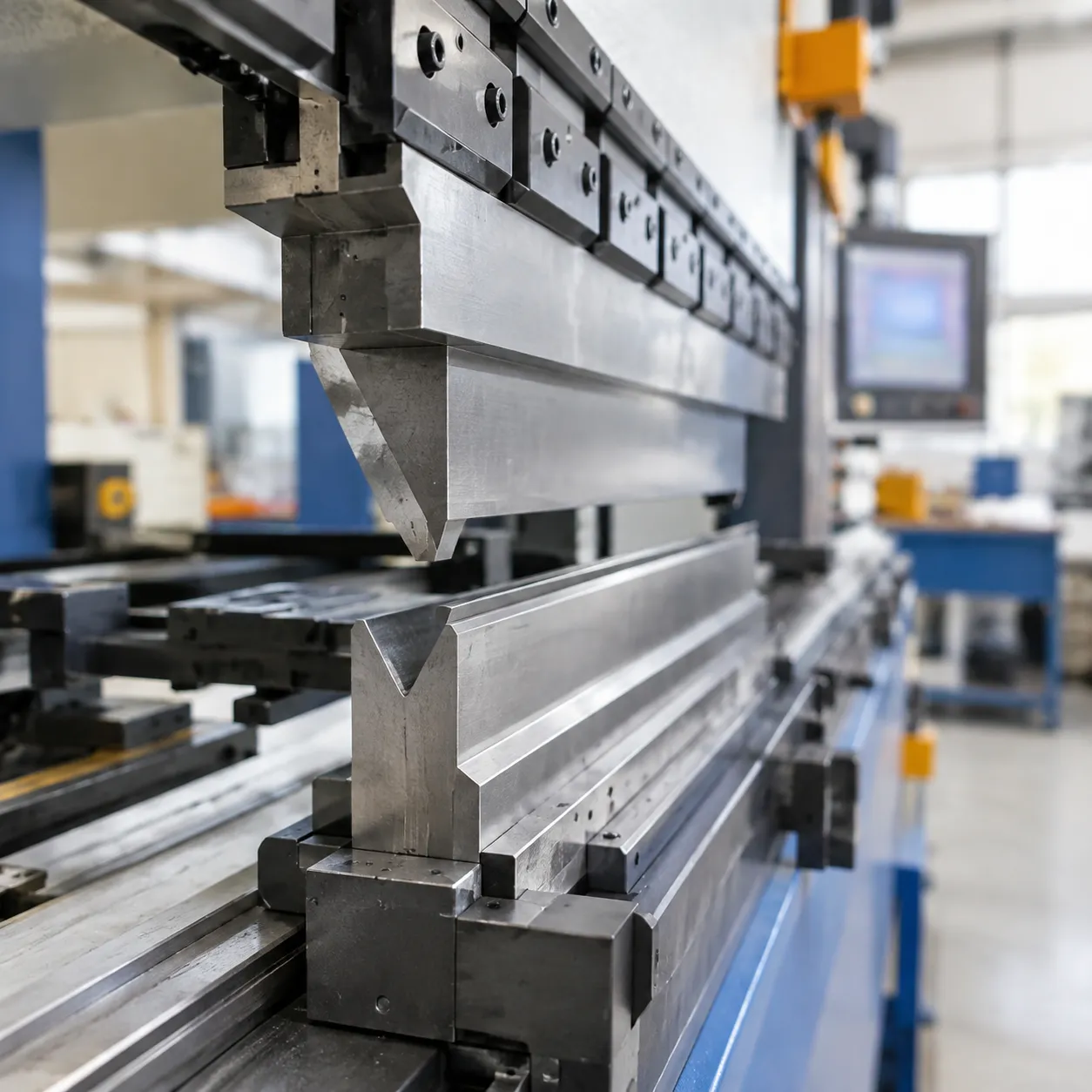
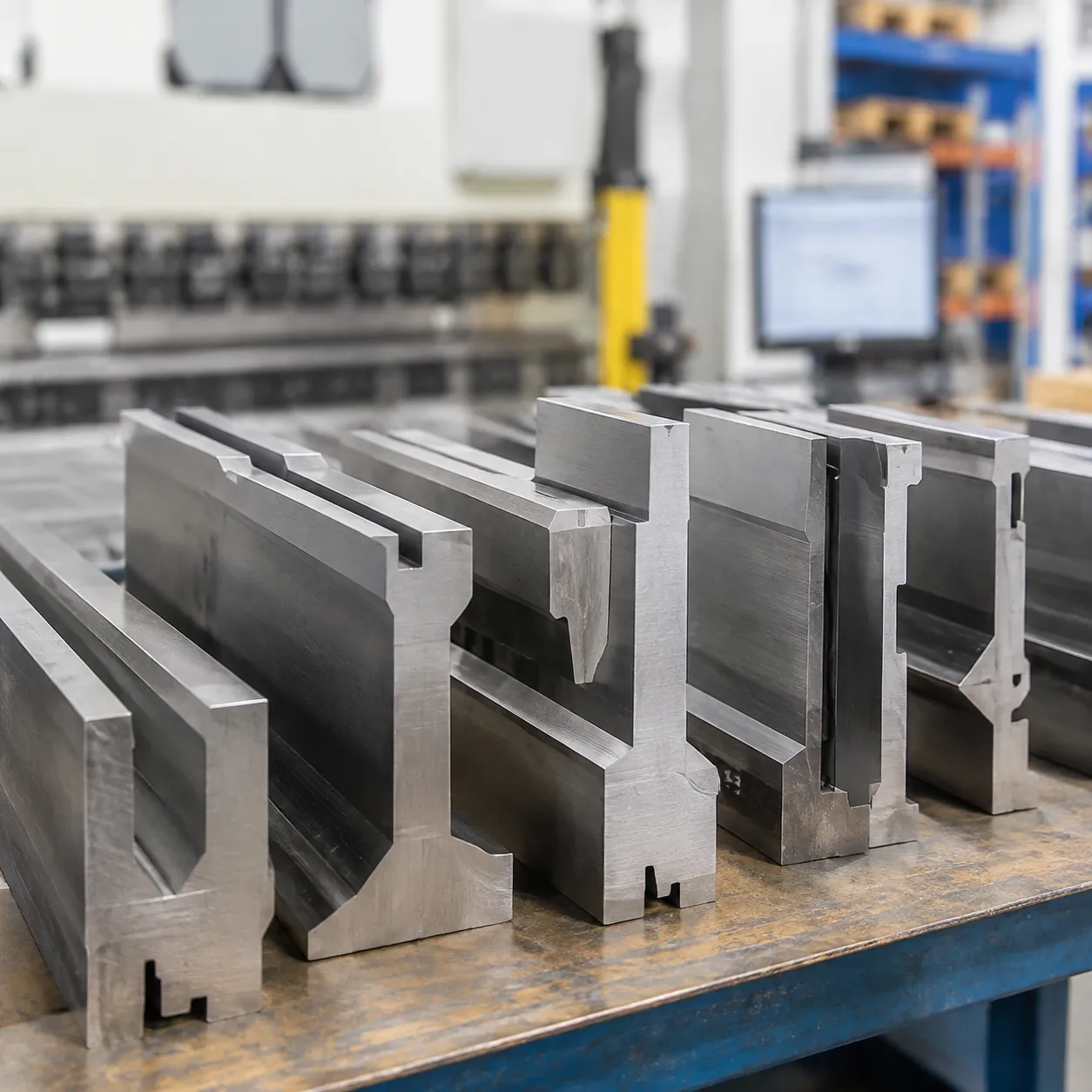
High-Precision Hardened Press Brake Die Sets Overview
Core Technical Capabilities
- Working Edge Hardness: Deep induction-hardened working zones reaching 55–60 HRC (2–4 mm hardened depth) to prevent edge breakdown, deformation, and wear during continuous operation.
- Profile Dimensional Accuracy: Precision ground profile tolerances strictly maintained within ±0.01 mm for reliable bend angle repeatability along the entire machine bed.
- Surface Polish Finish: High-grade surface finishing achieving Ra < 0.8 µm roughness, significantly reducing friction, material drag, and sheet metal galling.
- Certified Tool Steel: Machined exclusively from certified 42CrMo / 4140 high-tensile alloy tool steel, ensuring high core toughness and impact resistance under heavy loads.
- Direct Factory Supply: Complete manufacturing oversight yielding direct factory pricing, expedited lead times, and global shipping backed by full material traceability.
| Specification Parameter | Technical Rating / Standard |
|---|---|
| Tooling Type | CNC Hydraulic Press Brake Die Sets |
| Material Grade | Certified 42CrMo / AISI 4140 Alloy Tool Steel |
| Edge Hardness | 55–60 HRC (Deep Induction Hardened) |
| Profile Tolerance | ±0.01 mm |
| Surface Finish | Ra < 0.8 µm |
| Supply Capabilities | Factory-Direct Pricing & Global Logistics |
Integrating our high-precision press brake die set solutions into your shop floor reduces setup downtime caused by tool wear, ensuring exact tolerances and peak productivity on every bend cycle.
Key Technical Specifications & Metallurgy
Selecting the right material grade and surface treatment determines the operational lifespan and precision of your press brake die set. We engineer our tooling using high-tensile alloy tool steels to handle high-tonnage sheet metal bending without permanent deformation or premature wear.
Material Grade Options
| Material Grade | Application Focus | Tensile Strength | Surface Hardness | Performance Profile |
|---|---|---|---|---|
| 42CrMo / 4140 | Standard & heavy-duty bending | 1080 MPa | 55–60 HRC | High fatigue strength, excellent shock absorption |
| Cr12MoV | High-volume production tooling | 1250 MPa | 58–62 HRC | Superior wear resistance, high core stability |
| D2 Steel | Extreme wear & tight-radius precision | 1400 MPa | 60–62 HRC | Maximum abrasive resistance, low heat distortion |
| Carbon Steel | Low-tonnage / budget prototype work | 650 MPa | 48–52 HRC | Cost-effective entry grade, lower impact resistance |
Hardness, Tolerances, and Surface Finish
Our press brake die sets feature deep induction hardening along all critical working edges (55–60 HRC), preserving a ductile core that absorbs dynamic loads without cracking.
- Profile Accuracy: Precision CNC grinding delivers tight dimensional tolerances within ±0.01 mm, maintaining uniform bend angles across the entire bed length.
- Anti-Galling Polish: Surface polishing achieves a smooth finish of Ra < 0.8 µm, drastically reducing material drag and surface scoring on delicate stainless steel and aluminum sheets.
- Consistency: Dimensional stability on every female press brake v die guarantees predictable springback control across batch production runs.
Segmented Press Brake Dies and Modular Configurations
We supply standard and sectionalized length options to accommodate various box-folding configurations and operator handling preferences:
- Standard Solid Lengths: 835 mm and 500 mm solid dies for long-run straight bending.
- Sectionalized Tooling Sets: Pre-cut segmented press brake dies (including 10, 15, 20, 40, 50, 100, 200, and 300 mm segments) enable fast custom-width setups without grinding or modification.
- Custom Sizing: Bed lengths modified to fit specialized hydraulic press brake tooling channels. Consult our press brake die size chart and dimensions guide to select the correct height and tang style for your machine bed.
Machine Clamping Compatibility Matrix for Press Brake Die Sets
European / Promecam Style Tooling
Designed with standard 13mm/14mm tangs, our European-style press brake die sets feature precision-ground self-seating grooves for rapid drop-in installation.
Compatible Machinery: Amada, Promecam, Durma, Haco, Yawei, and similar European-mount presses.
Key Feature: Perfect center alignment for high-repeatability jobs. Browse our dedicated line of Amada tooling for complete press integration.
American Precision Style Tooling
Built with traditional 0.5-inch tang dimensions to withstand heavy-duty air bending and bottoming operations.
Compatible Machinery: Cincinnati, Pacific, Accurpress, LVD, and standard US hydraulic presses.
Key Feature: Deep hardened safety tangs engineered for high-tonnage resistance and secure clamping.
Wila / Trumpf / New Standard Bending Systems
For modern automated CNC bending centers, we supply self-seating, pin-locking tool sets designed for rapid push-button tool changes.
Compatible Machinery: Trumpf, Wila, and New Standard ram profiles.
Key Feature: Automatic alignment across full bed lengths with zero shimming required. Explore our precision-matched Wila tooling options to maximize press efficiency.
Universal Adapter Systems & Sub-Plates
Mix and match tooling styles without replacing your machine bed. We manufacture hardened adapter sub-plates, tang converters, and quick-clamp risers that allow you to run European, American, or New Standard bottom dies on any press brake model.
Specialized Press Brake Die Set Categories
Single V & Multi-V Bottom Dies
- Single V Bottom Dies: Engineered for high-precision air bending with tight tolerance repeatability.
- 4-Way Multi-V Blocks: Built for job shops handling multiple sheet thicknesses without frequent tool changes. Our versatile multi-V dies allow rapid rotational indexing to minimize setup downtime.
Adjustable V-Width Dies for Heavy Plate Bending
- Variable V-Opening: Eliminates physical die swapping by utilizing CNC-controlled or mechanical shim adjustments.
- High-Tonnage Structural Bending: Designed for thick alloy plate processing, featured in our heavy-duty 250-ton press brake die set engineered to withstand severe forming loads.
Specialty Bending & Surface Protection Tooling
- Hemming & Flattening Die Sets: Two-stage spring-loaded or combination tooling designed for tight flat seams, safety edges, and structural panel stiffening.
- Gooseneck & Acute Angle Dies: 30° and 35° acute geometries with deep throat clearance for forming return flanges, deep channels, and complex profiles.
- Mark-Free Polyurethane Inserts: High-durometer synthetic pads that prevent die-marking and surface galling on polished stainless steel, aluminum, and pre-painted sheet metal.
| Die Set Category | Primary Application | Key Specification |
|---|---|---|
| Single & Multi-V Bottom Dies | Precision air bending & multi-gauge production | 4-way rotational blocks, CNC-ground V-grooves |
| Adjustable V-Width Dies | Heavy structural plate forming | Variable V-opening via CNC shim or motorized drive |
| Hemming & Flattening Dies | Seams, safety edges & panel stiffening | Two-step pre-bend and close-flattening action |
| Gooseneck & Acute Angle | Deep channels & narrow return flanges | 30°/35° acute tips with deep throat clearance |
| Polyurethane Die Inserts | Architectural stainless steel & polished aluminum | Zero-marking flexible urethane channel pads |
Technical Selection & V-Die Opening Guide
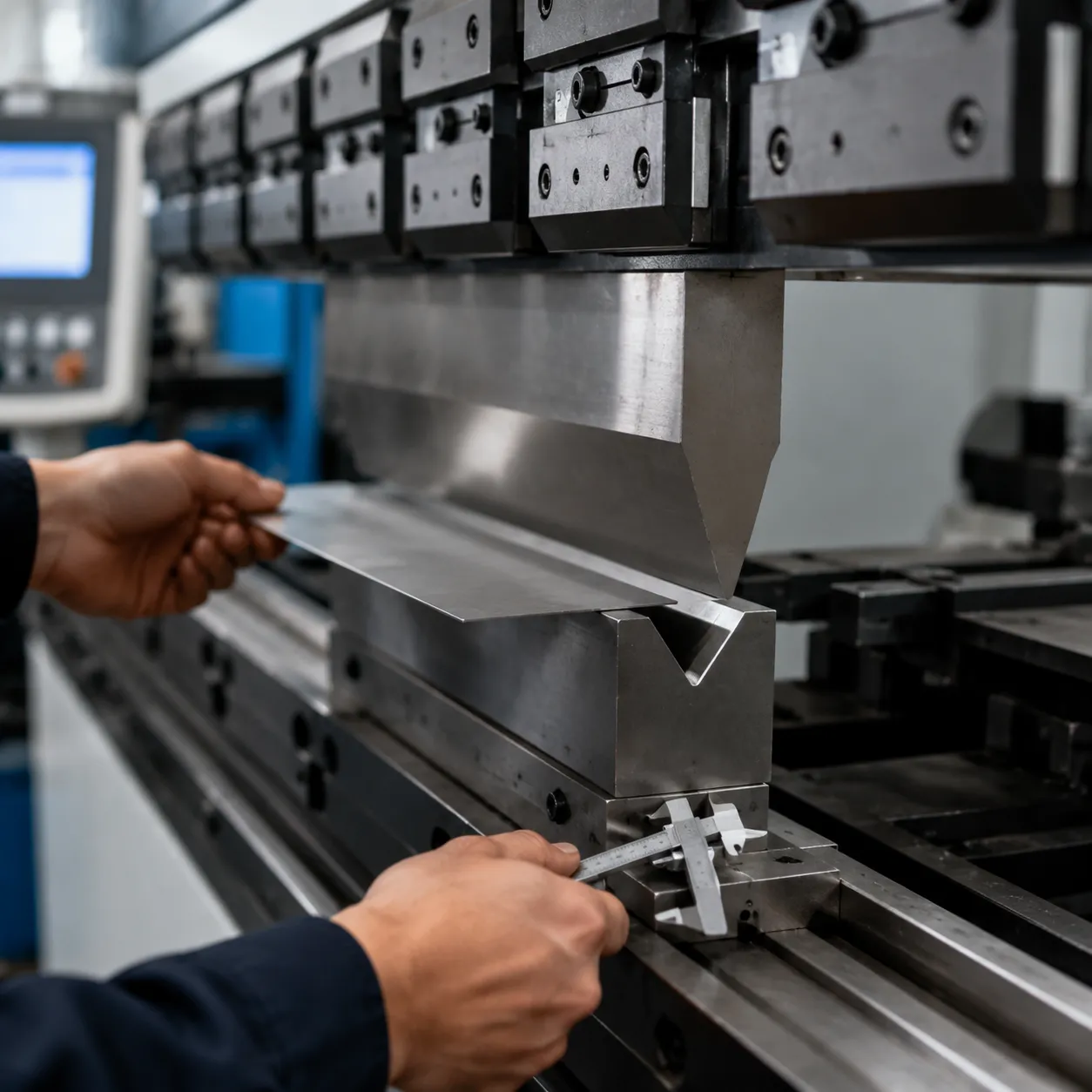
Selecting the correct V-opening for your press brake die set directly impacts bend accuracy, tonnage limits, and overall tool lifespan. Matching the V-die opening to the material type and thickness prevents cracking and premature tool failure.
V-Opening Calculation Matrix
| Material / Application | Sheet Thickness (t) | V-Die Formula | Inside Radius (Ir) |
|---|---|---|---|
| Standard Mild Steel | 0.5 mm – 6.0 mm | V = 8 x t | 16% of V (0.16 x V) |
| Thin Stainless Steel | Under 2.5 mm | V = 6 x t | 16% of V (0.16 x V) |
| Heavy Plate & High-Tensile Steel | Over 6.0 mm | V = 10 x t to 12 x t | 16% of V (0.16 x V) |
V-Die Selection Rules
- Standard Mild Steel (V = 8 x t): For typical air bending operations, we calculate the standard V-opening at 8 times the sheet thickness. This delivers consistent bend angles and manageable tonnage draw.
- Thin Stainless Steel (V = 6 x t): Achieving tight inside radii on stainless steel requires a narrow V = 6 x t opening. Utilizing high-strength multiple V-opening dies allows fast switching between narrow slots for precise flange control.
- Heavy Plate & High-Tensile Steel (V = 10 to 12 x t): Thick plate bending demands a wider opening (10 x t to 12 x t) to reduce required tonnage, prevent material fracture, and protect heavy-duty press brake die sets from excessive stress.
- Minimum Inside Bend Radius (16% Rule): During standard air bending, the inside bend radius forms naturally at roughly 16% of the V-die opening width (Ir = 0.16 x V), regardless of the punch tip radius unless bottoming. Always verify load capacities against our press brake die tonnage safety guide before running high-tonnage jobs.
CAMT 6-Stage Quality Protocol for Press Brake Die Sets
Every press brake die set we manufacture undergoes a strict, fully traceable manufacturing process. We enforce dedicated quality control protocols at every stage to ensure maximum durability, exact tool alignment, and repeatable bending accuracy.
1. Spectrometric Alloy Verification & Raw Steel Inspection
We verify raw steel heat numbers using optical emission spectrometry. Every batch of certified 42CrMo or 4140 high-tensile alloy steel is tested for chemical purity and structural integrity before entering production.
2. Multi-Axis Rough Machining & CNC Profile Shaping
Using high-torque multi-axis CNC milling machines, we rough-cut tool profiles, clamping tangs, and V-grooves, leaving calculated stock allowance for post-heat-treatment finishing.
3. Deep Vacuum Heat Treatment & Controlled Tempering
Tooling undergoes deep vacuum heat treatment and multi-stage tempering to achieve core toughness alongside deep induction-hardened working surfaces rated at 55–60 HRC.
4. Precision CNC Surface & V-Edge Grinding
Our high-precision profile grinders finish all working edges and seating surfaces to a tight ±0.01 mm tolerance, eliminating tolerance stack-up across segmented tool setups.
5. CMM Laser Optical Profiling & Surface Roughness Testing
Each finished press brake die set undergoes CMM laser profiling to verify V-angle geometries and radius dimensions. We perform surface roughness testing to guarantee an Ra < 0.8 µm finish for galling-free sheet metal forming.
6. Anti-Corrosion Chemical Bluing & Protective Export Packaging
To prevent corrosion during sea transport, finished tooling receives an anti-rust chemical bluing treatment, VCI oil film application, vacuum sealing, and custom reinforced crate packing for safe global delivery.
Custom Press Brake Die Set Engineering Workflow
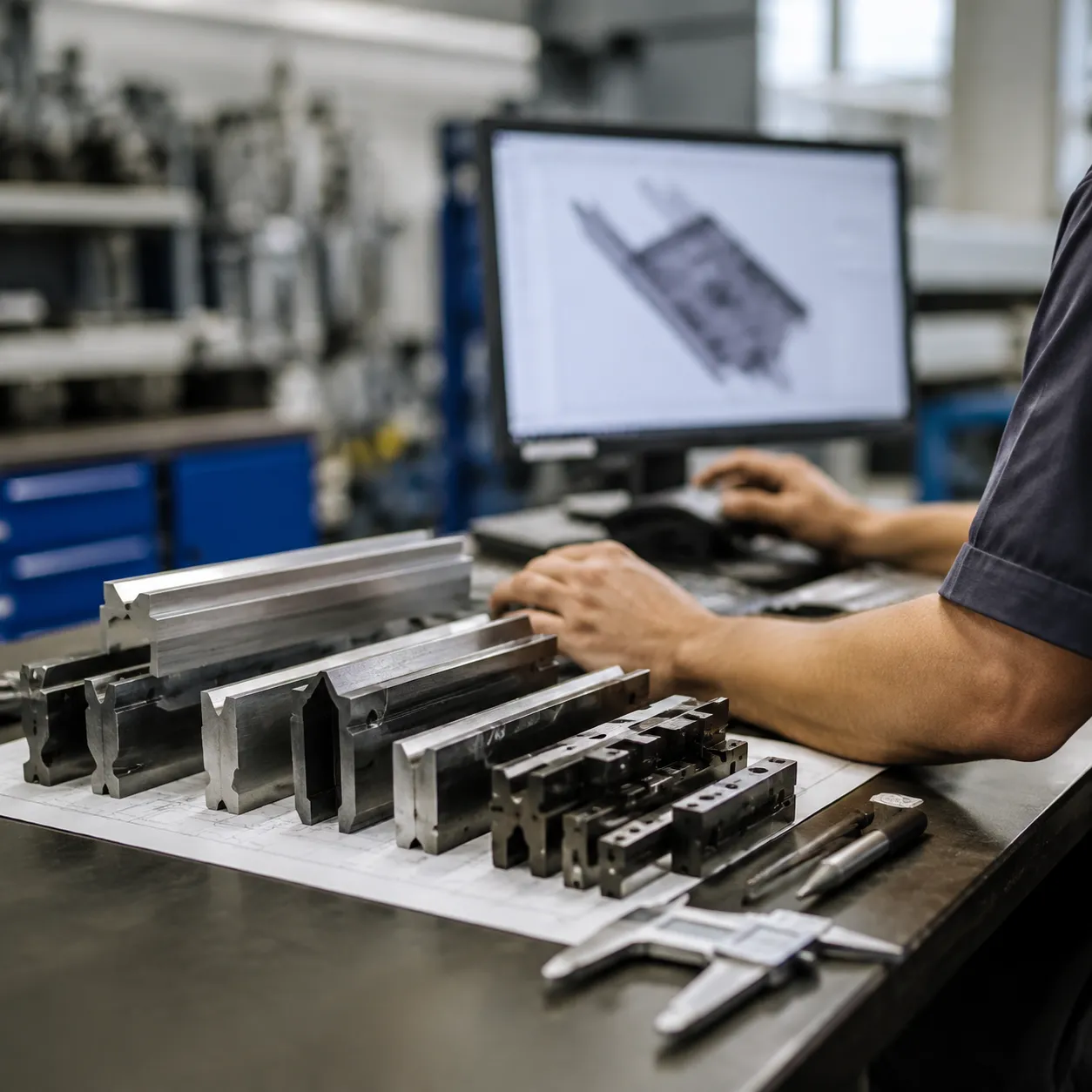
When off-the-shelf profiles cannot meet complex bending geometries, we engineer specialized custom press brake tooling tailored to exact machine specifications and part profiles. Our end-to-end engineering process eliminates guesswork, ensuring custom press brake die sets perform flawlessly from the first stroke.
- 2D/3D CAD Drawing Submission: Submit part or tool designs in DXF, DWG, or STEP formats. Our technical team imports geometry directly into CAD/CAM software to establish precise centerline dimensions and profile offsets.
- Engineering Feasibility & Springback Analysis: We calculate required bending tonnage, sequence feasibility, and material springback behavior. Through our dedicated custom tooling development services, we fine-tune V-angle and radius parameters to guarantee accurate bend angles across high-tensile alloys.
- 3D Bending Collision Simulation: We execute full digital ram clearance and tool interference simulations to identify potential collision points between the sheet metal, die bed, and machine frame before cutting metal.
- Rapid Fabrication & Custom Tang Machining: Approved designs move straight to multi-axis CNC machining and profile grinding. We cut custom tang styles to match European, American Precision, Wila/Trumpf, or universal quick-change clamping systems.
- Global Factory Delivery & Material Traceability: Finished press brake die set orders ship directly with raw material traceability certificates, optical inspection reports, and anti-corrosion export packaging for immediate shop-floor deployment.
Frequently Asked Questions
How to Prevent Tool Marking on Cosmetic Stainless Steel Panels
Standard metal-on-metal contact creates visible friction lines on mirror-finished or brushed stainless steel. You can stop surface marring using these field-proven solutions:
Polyurethane Protective Film: Lay high-durability urethane film across the V-opening to eliminate direct steel contact.
Optimized V-Shoulder Radii: We engineer specialized press brake dies with enlarged, micro-polished shoulder radii to reduce contact friction.
Synthetic Die Inserts: Utilize mark-free composite or high-durometer polyurethane pad holders for scratch-sensitive architectural panels.
Manufacturing Custom Die Sets for Non-Standard Press Brakes
We manufacture tailored press brake die sets designed specifically for orphan, older, or modified hydraulic bending machines.
CAD Integration: Submit your machine ram profiles, bed slot dimensions, or part cross-sections in STEP, DWG, or DXF formats.
Custom Tangs & Adapters: We precision-machine custom tang configurations, sub-plates, and intermediate clamps to fit non-standard hydraulic beds.
Specialized Geometry: We engineer off-center tooling, custom offsets, and non-standard V-dies to accommodate complex sheet geometry.
Expected Lifespan of 42CrMo Induction-Hardened Press Brake Dies
Our 42CrMo alloy steel tooling features deep induction hardening (55–60 HRC) across all critical working edges, offering superior longevity under high-tonnage operation:
Mild Steel Fabrication: Up to 1,000,000+ bends before requiring profile re-grinding.
Stainless Steel Processing: Expect 300,000 to 500,000 cycles under heavy load conditions.
Life Extension Practices: Clean mill scale regularly, avoid exceeding maximum tonnage limits, and maintain proper lubrication to maximize working tool life.
Direct Factory Quotation Checklist for Press Brake Die Sets
To receive an accurate, direct factory quotation for a precision press brake die set, we need specific engineering data to ensure exact fitment, accurate tonnage calculations, and flawless bend angles. Use this checklist to compile your project details before submitting your RFQ.
| Requirement Category | Required Data Points | Engineering Purpose |
|---|---|---|
| Part Geometry & CAD | 2D/3D CAD files (DXF, DWG, STEP) or dimensioned cross-sections | Verifies flange clearance, side-wall angles, and ram collision limits during forming. |
| Material Specifications | Metal grade, sheet thickness ($t$), and ultimate tensile strength | Determines tonnage requirements and springback allowances. Cross-reference your sheet thickness with our tonnage guide and V-die chart. |
| Machine Interface | Press brake brand, total bed length, and clamping tang setup | Guarantees precise mechanical fitment across American Precision, Promecam, or Wila/Trumpf seating grooves. |
| Tooling Configuration | Single V, Multi-V, Hemming, Gooseneck, or Custom profiles | Identifies profile style and segmenting requirements. Check our press brake die selection guide to pick the ideal geometry for your application. |
Data Points to Submit with Your RFQ
Providing complete specifications upfront eliminates technical back-and-forth and speeds up production turnarounds for standard or custom press brake die sets:
- Detailed Part Cross-Sections: Fully dimensioned prints showing target inside bend radii, acute angles, and required flange lengths.
- Workpiece Material Properties: Exact material composition (e.g., 304 Stainless, 6061-T6 Aluminum, Structural Steel) and maximum sheet gauge.
- Machine Bed & Clamping Specs: Machine model, total bed length capacity, max tonnage, and tang dimension dimensions.
- Tooling Length Breakdown: Preferred overall length and custom segmented lengths (such as 835mm, 500mm, or sectionalized sets for 4-sided box bending).