
Core Press Brake Tooling Components: Punches vs. Dies
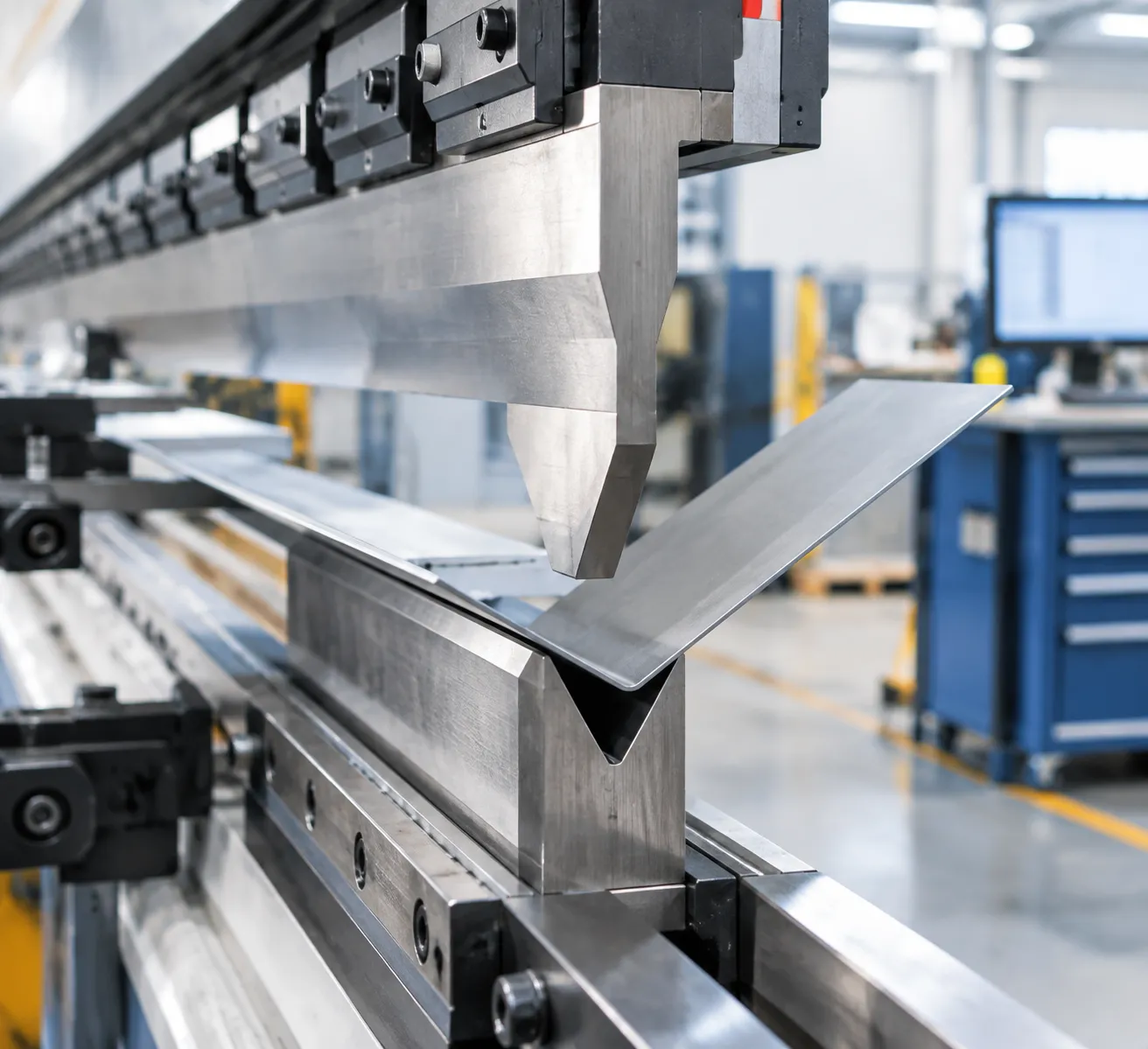
Precision sheet metal fabrication starts with understanding the fundamental tooling components installed on the press brake. Bending accuracy, angular consistency, and structural integrity rely on how top punches and bottom dies interact with raw sheet metal under tonnage.
Ram / Upper Beam
↓
Top Punch → Pushes downward / Sets inside profile
↓
Sheet Metal Blank
↓
Bottom Die → Supports sheet / Defines V-opening width
↓
Machine Bed
Difference Between Top Punches and Bottom Dies
Press brake operations rely on two distinct tooling units working in opposition:
- Top Punches (Male Tooling): Mounted to the moving upper beam (ram) or lower bed (in up-acting machines), the punch applies targeted vertical tonnage. The punch tip profile, angle, and tip radius directly form the interior contour of the bent part.
- Bottom Dies (Female Tooling): Mounted to the stationary bed via a tool holder or die rail, bottom dies feature machined cavities (typically V-grooves, U-channels, or flat surfaces). They support the workpiece shoulders and allow the sheet metal to flow downward under punch force without premature fracture.
| Feature | Top Punch (Male) | Bottom Die (Female) |
|---|---|---|
| Primary Function | Transmits force and shapes inside bend profile | Supports sheet outer edges and guides bend angle |
| Key Critical Dimension | Tip radius ($R$), tool height, tool angle | V-opening width ($V$), shoulder radius, die angle |
| Mounting Location | Upper ram clamping beam | Lower bed holder / bolster plate |
| Wear Points | Punch tip radius, tool tang | Die shoulder radii, V-groove flanks |
How Punch Radius and V-Die Opening Width Determine Inside Bend Radius
In air bending operations—the dominant forming technique in modern fabrication—the inside bend radius (Ir) is not strictly identical to the punch tip radius. Instead, it is primarily established by the V-die opening width (V) through the natural float of the material:
- The 16% / 20% Rule: For standard mild steel, the naturally formed inside radius equals approximately 16% of the V-die opening width (Ir \approx 0.16 × V). For high-strength materials like stainless steel, this increases to roughly 20% of the V-die width.
- Punch Tip Radius Interaction: If the punch tip radius is smaller than the naturally produced inside radius, the material forms its own natural curve over the die shoulders. If the punch tip radius is larger than the natural radius, the sheet metal conforms directly to the larger punch profile.
- Critical Threshold: Selecting a punch tip radius that is too sharp (less than 63% of the sheet thickness for mild steel) causes the punch to crease or coin the material centerline, leading to erratic bend angles and structural weakness.
Major Mounting Styles: American, European, and Wila/Trumpf
Press brake punch and die sets utilize specific clamping tangs and seating profiles. We categorize industrial tooling into three global standard mounting platforms:
1. American Standard Tooling
- Design Profile: Features a traditional 0.500 in (12.7 mm) wide straight tang with a safety retention groove.
- Clamping Method: Secured manually using set-screws or basic mechanical wedge clamps against the punch holder.
- Best For: Legacy press brakes, general job-shop fabrication, and heavy-tonnage structural bending.
2. European / Promecam Style
- Design Profile: Characterized by a stepped tang with a front-facing safety catch tab (20 mm tang with a hook).
- Clamping Method: Utilizes mechanical or quick-release lever clamps that secure the tool vertically and horizontally against a precision-ground reference shoulder.
- Best For: Mid-to-high precision production shops requiring faster tool changeovers and consistent centerline alignment.
3. Wila / Trumpf New Standard
- Design Profile: Modern precision-ground tooling system with hydraulic/pneumatic pin retention and self-seating mechanisms (Safety-Click system).
- Clamping Method: Push-button vertical loading with automated clamping; self-aligns and seats precisely along the $X$, $Y$, and $Z$ axes without manual adjustment.
- Best For: High-mix/low-volume automated production, multi-axis CNC bending cells, and applications demanding tolerances within ± 0.01 mm.
| Mounting Standard | Tang Dimensions | Clamping Speed | Alignment Accuracy | Loading Direction |
|---|---|---|---|---|
| American Standard | 0.500 in (12.7 mm) straight | Moderate (Set screws) | Standard (± 0.05 mm) | Horizontal slide-in |
| European / Promecam | 20 mm stepped with hook | Fast (Quick levers) | High (± 0.02 mm) | Horizontal / Vertical tilt |
| Wila / Trumpf | Hardened dynamic seating profile | Ultra-fast (Push-button / Auto) | Ultra-precision (± 0.01 mm) | Vertical drop-in / click-in |
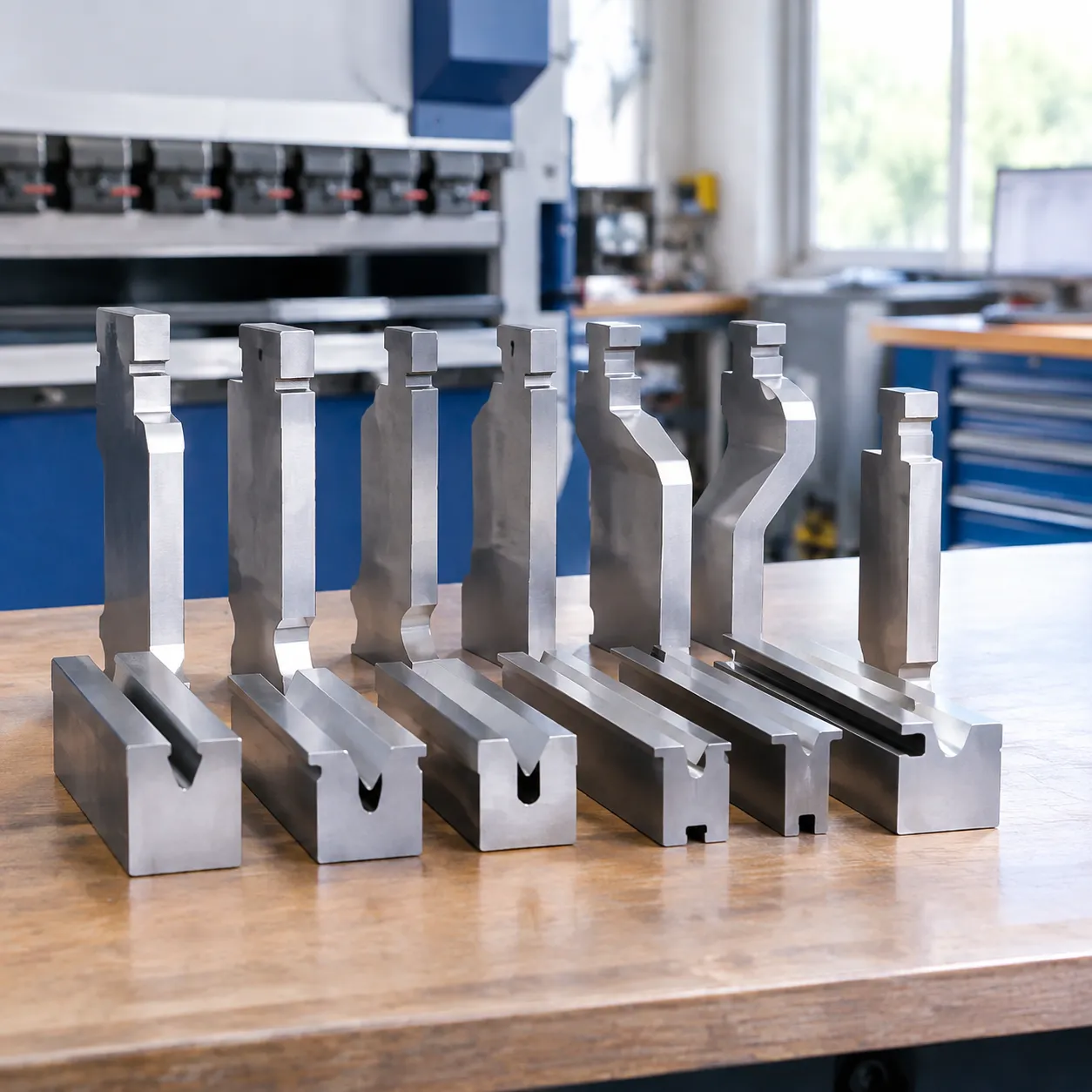
Common Press Brake Die Types by Geometry and Function
Selecting the right tooling geometry is essential to achieve clean bends, prevent tool collisions, and maximize machine output. We design and classify our tooling profiles based on part geometry, flange clearance, and bending mechanics.
1. V-Dies (Single V, 2-V, and Multi-V Blocks)
The standard V-die is the backbone of most sheet metal shops.
- Single V-Dies: Feature a single precision groove, offering maximum rigidity and accuracy for CNC crowning and precision air bending.
- 2-V (Double V) Dies: Provide two different V-openings in a single reversible block, speeding up transitions between different material gauges.
- Multi-V / 4-Way Die Blocks: Feature multiple openings around a square block, making them a cost-effective choice for heavy fabrication and general maintenance shops handling varied plate thicknesses.
2. Acute Angle Dies
Acute tooling profiles typically range from 30° to 60°. We use these dies to form sharp, tight angles, compensate for severe springback in high-strength steels, and create the pre-bend stage for hemming. A standard 30-degree press brake die for air bending and hemming delivers the clearance needed to overbend sheet metal before final closing.
3. Gooseneck Punches and Relieved Dies
When standard straight punches collide with previously formed return flanges, gooseneck tooling provides the required relief area. The recessed throat profile allows deep channel forming, U-profiles, and narrow interior return bends without crushing existing flanges.
4. Hemming and Flattening Dies
Hemming tools create safe, smooth sheet metal edges for covers, panels, and brackets.
- Two-Stage Spring-Loaded Tools: Combine an acute pre-bend notch with a lower flattening pad, allowing you to create a tight or teardrop hem in one setup.
- Flat Combination Tools: Use a flat punch face against a flat die block to close pre-bent flanges cleanly in a single stamping pass.
5. Offset and Joggle Dies
Offset tooling creates two parallel bends (a Z-profile) in a single press stroke. These dies eliminate repetitive handling on stepped parts, overlapping panels, and stiffening ribs, significantly cutting down cycle times.
6. Radius and U-Bend Dies
When a job requires sweeping curves instead of sharp inside radiuses, radius tooling is the solution. Matched round punches and open radius dies form smooth contours for tank shells, architectural handrails, and rounded bracket channels without multiple step-bending marks.
7. Box Forming Dies
Deep four-sided box forming requires extra-tall punches with side clearance. High-clearance box forming dies allow deep side panels to rise alongside the tool without making contact with the punch body or upper clamping beam.
8. Rotary Bending and Wiping Dies
Standard V-die edges can leave visible pressure marks on cosmetic materials like polished stainless steel, soft aluminum, or pre-painted sheet. Specialized press brake dies with rollers utilize rotating cylindrical inserts that roll with the metal sheet during the stroke, eliminating friction scratches and reducing dragging tonnage.
Press Brake Die Selection by Bending Method
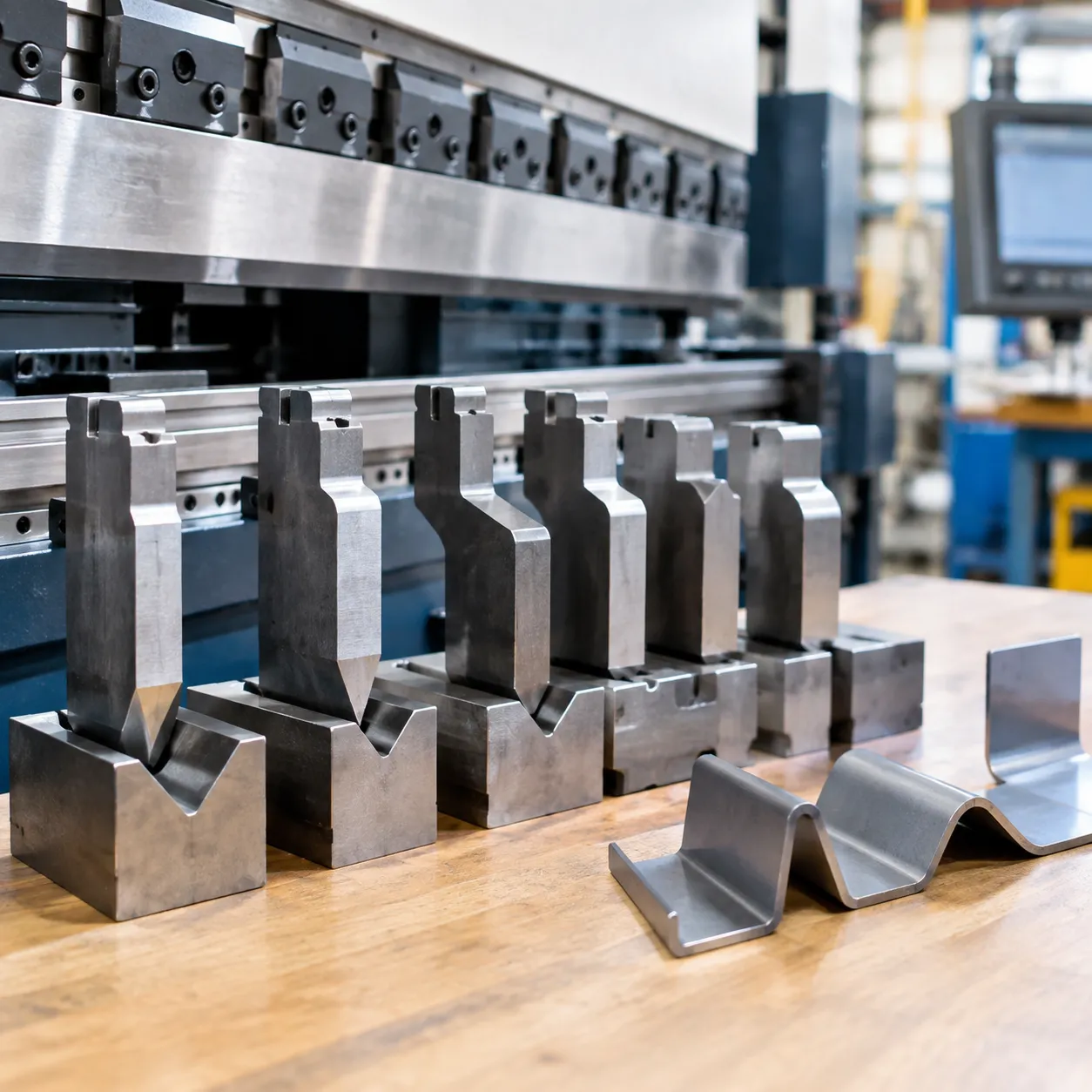
Air Bending Dies
Air bending is the most versatile method we use in modern fabrication shops. The punch presses the sheet metal into the V-die cavity without touching the bottom of the tool.
- 3-Point Contact: The material only touches the punch tip and the two die shoulder radii.
- Angle Flexibility: A single 85° or 88° acute die can produce multiple bend angles simply by adjusting the ram depth.
- Lower Tonnage: Uses significantly less force than bottoming or coining, reducing wear on your machine and tooling.
- Springback Management: Because the sheet does not fully seat into the tool cavity, check our press brake die angles guide for springback selection to match punch and die geometry accurately.
Bottoming Dies
Bottoming (bottom bending) brings the metal into direct contact with the punch face and the V-die walls, leaving a slight gap at the bottom of the V-opening.
- Matched Geometry: Punch and die angles are closely matched (commonly 88° for mild steel to set a clean 90° bend).
- Tighter Consistency: Delivers repeatable angles on older or non-CNC hydraulic machines by mechanically setting the bend profile.
- Moderate Tonnage: Requires roughly 3 to 5 times more tonnage than standard air bending tooling.
Coining Dies
Coining is a precision stamping process where extreme force drives the punch tip directly into the neutral axis of the metal, thinning the bend radius area.
- Crisp Radii: Creates sharp, ultra-consistent inside corners with zero springback.
- Extreme Tonnage Loads: Demands 5 to 10 times the tonnage of air bending, requiring heavy-duty tools like our precision press brake V-die for accurate bending to prevent tool fracture.
- Dedicated Operations: Best reserved for critical aerospace, medical, and electronics parts where angle tolerances cannot deviate.
Tooling Materials, Hardening, and Surface Treatments
The durability and precision of your press brake die types depend directly on base metallurgy, heat treatment, and surface finishing. Using the wrong steel grade or insufficient hardening leads to premature shoulder wear, tip deformation, and inaccurate bending angles under heavy tonnage.
Popular Tool Steels for Press Brake Tooling
We select alloy tool steels based on tensile load, shock resistance, and bending cycle volume:
- 42CrMo / 4140: The industry benchmark for high-performance press brake punches and dies. This chromium-molybdenum alloy delivers excellent core toughness, high fatigue strength, and uniform response to heat treatment.
- T8 / T10 Carbon Tool Steel: A budget-friendly choice suitable for standard air bending and light-gauge sheet metal applications with moderate daily cycle counts.
- D2 / Cr12MoV Die Steel: High-carbon, high-chromium tool steel offering maximum abrasive wear resistance. It is ideal for heavy-duty bottoming dies, wiping tools, and thick stainless steel forming.
Industrial Hardening Techniques
Proper hardening ensures critical working surfaces withstand extreme localized contact stress without cracking:
- Induction Hardening: Delivers localized hardening (typically 56–60 HRC) along the punch tip and V-die shoulder radii while leaving the core ductile enough to absorb shock.
- Laser Hardening: Provides precise case depth control with minimal thermal distortion, maintaining strict tolerances across precision-ground segmented tools.
- Through-Hardening (Core Hardening): Hardens the tool uniformly to 48–52 HRC, providing consistent strength across heavy-tonnage block dies and acute angle punches.
Wear-Resistant Surface Coatings
Surface treatments reduce friction, prevent galling on stainless steel, and extend working life:
- Nitriding (Black Oxide / Gas Nitriding): Produces a hard outer case (up to 65–70 HRC equivalent) with superior anti-friction properties and excellent corrosion resistance.
- TiCN (Titanium Carbonitride): A low-friction physical vapor deposition (PVD) coating designed for abrasive materials and high-speed CNC bending cells.
- Hard Chrome Plating: Prevents metal pick-up and cosmetic scratching when forming galvanized sheets, polished aluminum, or stainless panels. For detailed specifications and tooling profiles across these materials, refer to our comprehensive press brake die size chart and dimensions guide.
How to Choose the Right Press Brake Die for Your Project

When we match press brake die types to a specific project, we evaluate four key parameters: die opening ratios, tonnage limits, flange geometry, and tooling sectionalization.
Calculating Optimal V-Die Opening (The 8xT Rule)
The standard benchmark for air bending mild steel is the 8xT rule, where the V-die opening width (V) equals 8 times the sheet metal thickness (T).
- Thin Gauges (Under 3 mm / 0.12 in): A ratio of 6x to 8x material thickness produces tight inside radii and clean profiles.
- Medium Plate (3 mm to 6 mm): Standard 8x thickness delivers balanced forming tonnage and reliable bend angles. Explore our precision-ground V-dies for consistent bend consistency across standard sheet sizes.
- Heavy Plate (Over 6 mm / 0.25 in) and Stainless Steel: A ratio of 10x to 12x thickness lowers tonnage demand and prevents surface cracking along the outer bend radius.
Determining Tonnage Limits per Foot
Every die has a maximum rated load capacity per foot or meter. Exceeding these limits causes permanent shoulder deformation, hairline fractures, or catastrophic tool failure.
To protect your setup:
Always check your machine’s bending chart before running thick or high-yield materials like Hardox or stainless steel.
Wider V-openings significantly reduce required forming tonnage, preserving both top punches and bottom dies under high-volume production cycles.
Evaluating Minimum Flange Length Requirements
If a flange is too short, the sheet falls directly into the V-groove before reaching its yield point, causing uneven bends, part distortion, or slippage.
- As a baseline, the minimum flange length equals roughly 70% of the V-die opening width (0.7 × V).
- If your part drawings specify micro-flanges that cannot bridge a standard V-gap, switch to an acute angle die, a smaller V-opening with reduced sheet thickness, or a specialized rotary wiping die.
Solid Full-Length Dies vs. Precision Segmented Tooling Sets
Choosing between solid-length sections and segmented sets depends on production flexibility, clearance needs, and setup times.
| Tooling Feature | Solid Full-Length Dies | Precision Segmented Tooling Sets |
|---|---|---|
| Best Used For | Long, continuous sheet runs, panels, and heavy plate bending | Box forming, multi-bend chassis, and complex 3D profiles |
| Handling & Setup | Requires crane or two operators for heavy, long-bar tools | Quick manual changeovers by a single press brake operator |
| Custom Length Flexibility | Fixed lengths (e.g., 2.5m, 3m, 4m) | Mix-and-match sectional pieces with ear pieces / horn cuts |
| Maintenance & Replacement | Entire bar requires regrinding if one section is chipped | Individual damaged segments can be swapped out cost-effectively |
We supply industrial-grade press brake dies configured in both matched segmented toolkits and solid lengths to match your exact bed dimensions and production requirements.
Press Brake Die Maintenance, Alignment, and Inspection
Keeping precision-ground press brake die types in top working condition is the fastest way to avoid costly rework, part inconsistency, and premature tool failure. We treat our press brake tooling as high-precision assets—because even a fraction of a millimeter in wear or misalignment shows up immediately across your bend angles.
Proper Die Alignment and Centering Procedures
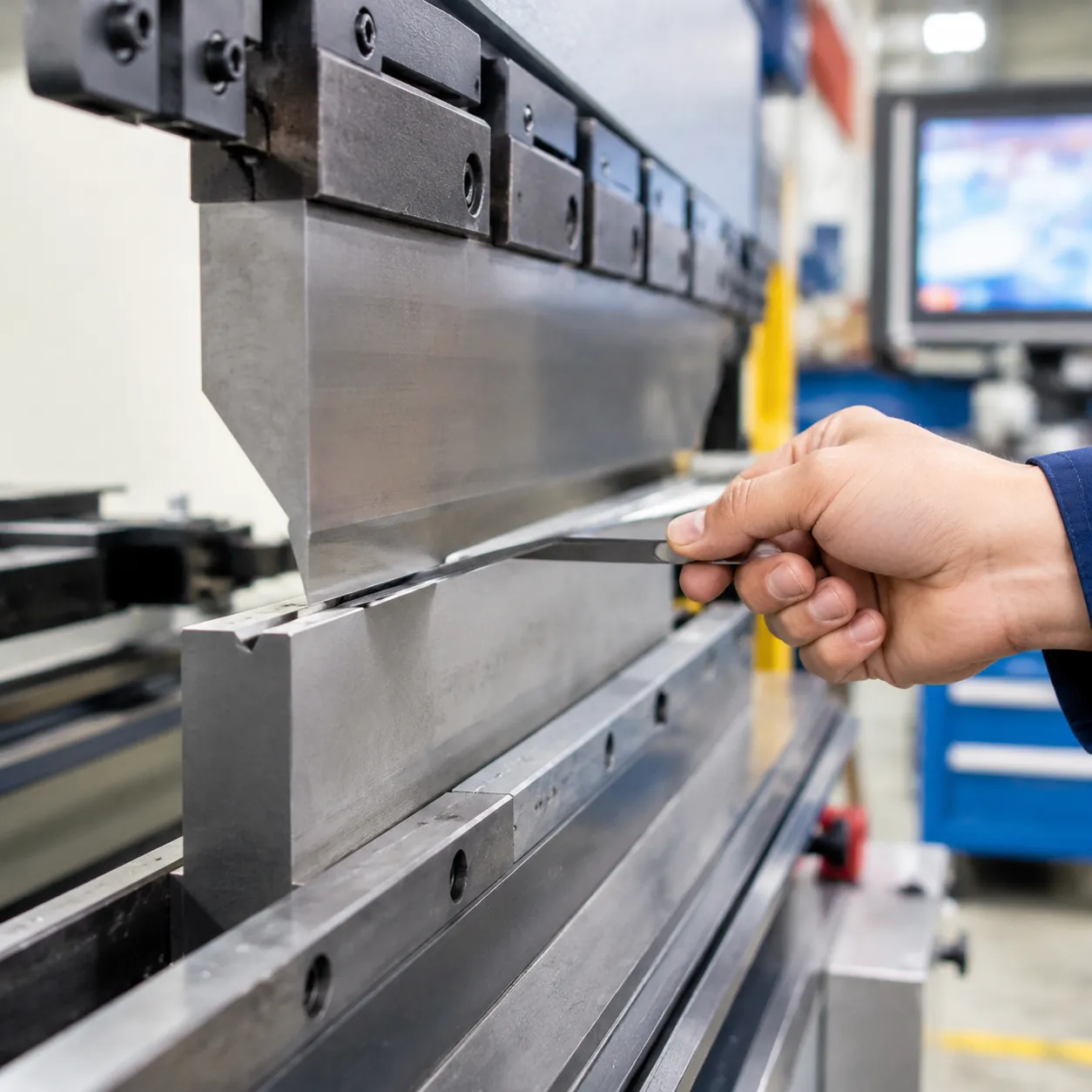
Accurate bend angles depend on the top punch aligning dead-center with the bottom V-die.
- Clean mounting surfaces: Clear all chips, dust, and mill scale from the press brake bed and upper clamping beam before seating any tools.
- Low-pressure seating: Lower the ram under zero or minimal tonnage to bring the punch tip gently into the center of the V-groove.
- Torque from the center outward: Lock the clamping bars starting from the middle of the tool section and move toward both ends to ensure uniform clamping force without mechanical binding.
Routine Cleaning, Debris Removal, and Rust Prevention
Fine metal dust and mill scale accelerate friction wear across the die shoulders. Consistent shop maintenance keeps tooling surfaces running smoothly:
- Daily wipe-downs: Remove abrasive particulates, metal shavings, and oil residue at the end of every shift using lint-free cloths and non-corrosive degreasers.
- Corrosion inhibition: Apply a light coat of industrial anti-rust spray or protective tool oil across precision-ground contact zones before storage.
- Surface treatment checks: Following dedicated press brake die maintenance tips for longer tool life helps protect surface coatings like nitriding and hard chrome from abrasive scratching.
| Maintenance Task | Frequency | Focus Area |
|---|---|---|
| Surface Debris Wipe-Down | Daily / Per shift change | V-die shoulders and punch tip radius |
| Alignment Verification | Every tool setup | Centerline matching on the press brake bed |
| Wear & Micro-Crack Check | Monthly | High-stress shoulders and clamping tangs |
| Anti-Rust Coating | Prior to storage | All ground tool steel surfaces |
Inspecting for Wear, Punch Tip Deformation, and Overloading
Periodic visual and dimensional inspections keep damaged tools off the press brake bed:
- Die shoulder radius wear: Heavy air bending rounds off the crisp shoulders of V-dies, altering friction and causing unpredictable angle variations.
- Punch tip flattening (mushrooming): Excessive tonnage or bottoming thick steel causes the punch tip radius to compress and widen.
- Tonnage overloading cracks: Always check the throat area of gooseneck punches and bottom die grooves for hairline fractures caused by exceeding tonnage-per-foot limits.
Safe Storage Systems for Precision Tooling
Precision ground edges will chip if stored loosely or stacked metal-on-metal. We organize tooling using purpose-built storage solutions:
- Modular tooling cabinets: Heavy-duty drawers fitted with polyurethane or high-density foam dividers keep segmented tooling sets separated and secure.
- Vertical tool racks: For long, solid dies, vertical pull-out racks prevent sagging and eliminate contact between adjacent cutting and forming edges.
- Labeling by type and radius: Clearly mark punch radii, V-openings, and max tonnage limits right on the storage slots to eliminate setup guesswork and prevent operators from overloading tools.
Frequently Asked Questions About Press Brake Die Types
What is the difference between American and European style press brake dies?
The primary difference lies in the clamping tang, alignment method, and precision tolerance:
| Feature | American Standard Tooling | European / Promecam Style Tooling |
|---|---|---|
| Tang Profile | Standard 0.5-inch (12.7 mm) wide straight tang | Distinctive safety groove / hook with offset tang |
| Clamping Mechanism | Manual set screws tightened against the tang | Mechanical or hydraulic quick-clamp levers |
| Alignment | Relies on manual centering and bed shims | Self-seating precision shoulders for faster setups |
| Best Application | General fabrication and legacy machinery | High-precision CNC air bending and fast tool changes |
How do I calculate the right V-die width for aluminum vs. stainless steel?
Material tensile strength and ductility dictate your opening width. While standard mild steel follows the baseline 8 × T rule (opening equals 8 times material thickness), alloy characteristics require quick adjustments:
- Aluminum (Soft to Half-Hard): Use a 6 × T to 8 × T opening. Softer alloys bend easily with lower tonnage, allowing tighter dies without cracking risks.
- Stainless Steel: Step up to a 10 × T or 12 × T opening. Stainless requires significantly higher bending tonnage and displays aggressive springback; a wider die lowers load spikes and protects your tooling shoulders.
For specific material charts and tonnage evaluations across different sheet thicknesses, reference our practical press brake die selection guide before setting up the machine.
Can I use an acute angle die to make a standard 90-degree air bend?
Yes. During air bending, the punch pushes the metal into the die space without bottoming out against the die walls. A 30-degree or 45-degree acute angle die gives the ram ample room to overbend past 90 degrees to compensate for springback before relaxing to a perfect right angle. Ensure your punch tip matches the required inside radius and check that you do not over-stroke into a bottoming state.
When should I use urethane or polyurethane die inserts?
Switch to non-metallic tooling whenever bending high-finish parts where tool steel contact causes visible surface gouges, scuffs, or cross-contamination. Dedicated plastic press brake dies for non-marking bending cushion delicate mirror-finish stainless, aerospace titanium, polished brass, and pre-painted architectural panels, eliminating expensive secondary surface finishing.
How long do hardened press brake dies typically last before re-grinding?
High-grade 42CrMo or equivalent tool steel with induction-hardened working surfaces (50–60 HRC) routinely handles hundreds of thousands of bend cycles. In standard single-shift production environments running clean sheet metal within rated tonnage limits, expect 3 to 5 years of consistent service before shoulder re-grinding is necessary. Overloading past tonnage limits, bending rusty hot-rolled plate without scale removal, or running narrow workpieces at high pressure will accelerate shoulder wear.