
Formula details
Product Details
Overview
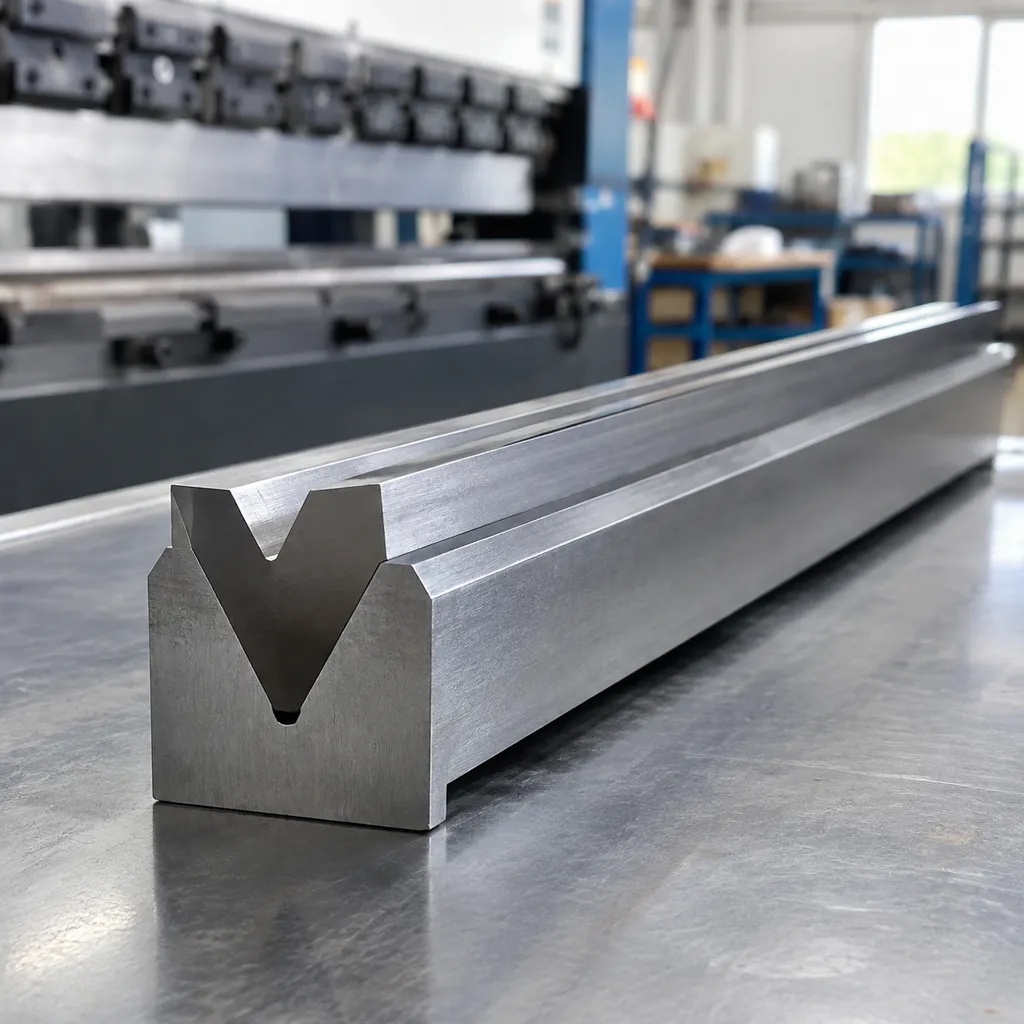
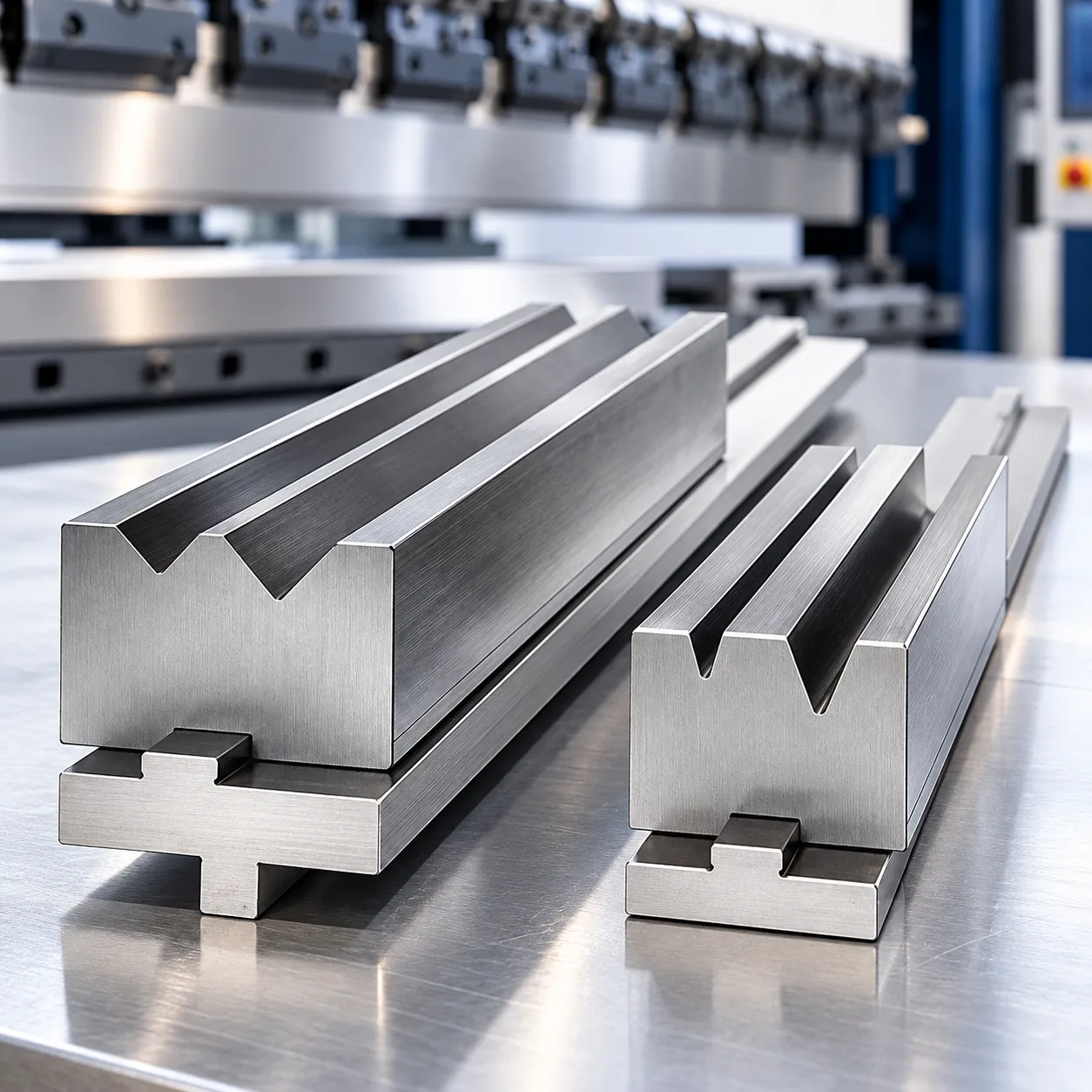
High-Efficiency Dual V-Opening Lower Tooling
Cut Setup Times with 180-Degree Die Rotation
Traditional single-V setups force operators to swap heavy lower dies whenever material gauges change. Our 2-way bottom die design transforms that workflow:
- Instant Gauge Switching: Rotate the die 180 degrees directly on the bed to access a second V-opening in seconds.
- Reduced Crane & Forklift Dependency: Eliminate the need for auxiliary lifting equipment when shifting between thin and medium-gauge materials.
- Minimized Idle Time: Keep your CNC press brake running continuously during mixed-part batch processing.
Air Bending and Bottoming Versatility from 0.8 mm to 6.0 mm
| Sheet Thickness Range | Typical Dual V Combinations | Primary Bending Methods | Compatible Materials |
|---|---|---|---|
| 0.8 mm – 1.5 mm | V6 / V10 or V8 / V12 | Precision Air Bending, Bottoming | Mild Steel, Aluminum, Cold Rolled |
| 1.5 mm – 3.0 mm | V12 / V16 or V12 / V20 | Air Bending, Coining | Mild Steel, Stainless Steel (304/316) |
| 3.0 mm – 6.0 mm | V16 / V25 or V20 / V32 | Standard Air Bending | High-Strength Alloys, Hot Rolled Steel |
European and Universal Machine Bed Interchangeability
We engineer our 2V Press Brake Dies to align seamlessly with global manufacturing standards:
- Standard Promecam & European Style Mounts: Equipped with a standard 12 mm x 20 mm or 13 mm tang, fitting seamlessly into conventional and quick-clamping lower tool holders.
- Universal Bed Clamping: Fully adaptable to major press brake brands worldwide without custom modifications or costly adapter plates.
- Self-Centering Precision: Engineered tang dimensions seat true against the machine centerline, drastically cutting down manual alignment procedures during tool installation.
2V Press Brake Dies Technical Specifications and Metallurgy
We forge our 2V Press Brake Dies from high-grade 42CrMo alloy steel, delivering the mechanical strength needed to eliminate fracturing under continuous heavy cycles. Every tool undergoes through-quenching and tempering to achieve a robust core, followed by localized high-frequency induction hardening on the high-wear shoulder zones.
This metallurgical treatment gives you a tough, shock-absorbing tool core paired with ultra-hard working surfaces that prevent deformation, galling, and premature wear during aggressive air bending operations.
Core Metallurgical and Mechanical Parameters
- Base Core Material: 42CrMo high-tensile chrome-moly alloy steel (quenched & tempered).
- Core Hardness: 28–32 HRC for optimal structural ductility under dynamic load.
- Shoulder Hardness: 56–60 HRC via precision high-frequency induction hardening (depth 2–4 mm).
- Machining Precision: CNC precision ground surfaces within ±0.01 mm across working centerlines.
- Straightness Tolerance: Controlled within ±0.02 mm per meter for true parallel bends.
| Tooling Parameter | Specification Value | Production Benefit |
|---|---|---|
| Material Grade | 42CrMo (AISI 4140 equivalent) | High yield strength prevents die body snapping |
| Wear Zone Hardness | 56–60 HRC | Resists friction grooves when running abrasive sheet |
| Grinding Tolerance | ±0.01 mm | Consistent bend angles across segmented setups |
| Standard V Angles | 85°, 88°, 90° | Accommodates springback in mild steel and stainless |
Load Capacity and Tonnage Ratings per Meter
Our precision-ground double-V blocks handle high concentrated loads without yield deformation. To safeguard your tooling setup and maintain bending accuracy, always match material thickness with the safe tonnage limits outlined in our press brake v die chart and tonnage guide.
- Small Openings (V6 – V12): Rated up to 800 kN/m (80 T/m) for precise thin-gauge sheet work.
- Medium Openings (V14 – V25): Rated up to 1000 kN/m (100 T/m) for general fabrication.
- Large Openings (V26 – V50): Rated up to 1200–1600 kN/m (120–160 T/m) for heavy plate bending.
Bed Clamping and Machine Compatibility for 2V Dies

We engineer our 2V Press Brake Dies to match the world's most common clamping standards, ensuring your operators can swap, seat, and align tools with zero fuss. Whether you run a modern CNC setup or an older mechanical press, mounting precision remains solid across the full bed length.
European and Promecam Style Self-Centering Base Tangs
Most fab shops rely on the European/Promecam system, and our tooling integrates directly into these holders:
- Standard 12.7 mm to 13 mm tangs: Fits straight into universal lower holders and clamping rails.
- Self-centering seating: The precision-machined shoulder guides the die straight onto the holder centerline as the clamping bars tighten down.
- Quick reversal: Operators can loosen the manual set screws, lift, rotate the block 180 degrees to switch V-openings, and retighten in under a minute.
If you run varied sheet gauges throughout the day, pairing these with versatile press brake bottom dies gives you the fastest turnaround between thin and medium plate jobs.
American Conventional Center-Slot Tang Configurations
For North American shops running conventional mechanical or hydraulic machines, we grind solid 0.500" wide tangs to fit traditional bed slots:
- Direct-drop mounting: Slides right into standard slotted beds without requiring expensive intermediate adapters.
- Set-screw locking: Heavy side set-screws lock into the tang without distorting the working groove.
- Heavy-gauge stability: The wide-base American tang supports high-tonnage runs when air bending plate up to 6.0 mm.
| Machine Clamping Style | Standard Tang Size | Alignment Method | Best Suited For |
|---|---|---|---|
| European / Promecam | 12.7 mm – 13.0 mm | Self-centering side bar / set-screws | High-mix jobs, fast 180° die flips |
| American Conventional | 0.500" (12.7 mm) slot tang | Side set-screws into bed slot | Heavy-gauge forming, traditional beds |
| Wila / Trumpf Style | Adapter base required | Hydraulic pin clamping / pneumatic push | Automated setups, high-precision CNC |
Wila and Trumpf Hydraulic Bottom Clamping Adaptations
Shops utilizing Wila New Standard or Trumpf-style hydraulic holders can run our 2V press brake dies using precision-ground base adapters.
- Hydraulic pin engagement: Adapter rails lock directly into the hydraulic bed track for button-push clamping.
- Pneumatic lift-and-roll: Smooth interchange lets operators slide heavy, segmented 2V tools into position without scratching the bed surfaces.
- Consistent seat height: Precision adapter tolerance preserves your machine's programmed open height and shut height settings.
Centerline Alignment Verification with Top Punches
Uneven bends often come down to bad punch-and-die alignment. We make dial-in simple by maintaining an identical working centerline across both V-grooves on every 2V die:
- Lower the punch: Bring your upper tooling down until the punch tip rests lightly inside the selected V-groove under minimal tonnage.
- Float the die: Keep the bed clamp tension finger-tight so the die self-aligns with the punch center.
- Check contact: Look for uniform light shut-off along both die shoulders across the entire bed length.
- Torque the clamps: Lock your clamping bars or engage hydraulic pressure while the punch holds the die centered.
- Flip without re-aligning: When rotating the die to use the secondary V-opening, the identical centerline offset keeps your X-axis backgauge and Y-axis punch targets true without recalibrating your CNC controller.
Length Options and Segmented 2V Press Brake Dies
Standard Full Lengths for Continuous Profile Forming
Long, uninterrupted sheet runs require extreme straightness and structural stability. Our standard solid lengths eliminate section seams, preventing visible witness lines on long components.
- Standard Solid Stock: Available in common lengths including 415 mm, 500 mm, and continuous 835 mm sections.
- Maximized Deflection Resistance: Solid blocks maintain rigid support under high tonnage loads, preventing center-bed deflection during heavy-gauge forming.
- Consistent Part Linearity: Ensures straight, deflection-free bends for channels, long fascia panels, and structural trims.
Precision Sectional Cut Schemes for Box and Pan Bending
For deep four-sided boxes, pans, and parts with pre-bent return flanges, our segmented double V die press brake sets offer total clearance flexibility. Operators can quickly drop in or remove individual segments to accommodate varied part widths without tool interference.
Our standard segmented sets typically total 835 mm and include:
Standard Cuts: 10 mm, 15 mm, 20 mm, 40 mm, 50 mm, 100 mm, 200 mm, and 300 mm.
Horned End Sections: 100 mm cut-away left and right horn pieces for tight corner and return-flange clearance.
If you are weighing sectional arrangements against solid setups for specific workpieces, review our press brake die selection guide for precise bending to verify profile clearance and load ratings.
Seamless End-to-End Compounding Without Shimming
Misalignment between adjacent tooling sections ruins bend angles and marks workpieces. We solve this by precision grinding every segmented sheet metal bending die in matched sets under single-setup machining operations.
- Matched Working Heights: Critical shoulder and base tang heights are ground within a tight ±0.01 mm tolerance.
- Zero Shimming Needed: Dies align automatically end-to-end along the bed without requiring tedious shimming or manual leveling.
- Continuous V-Centerline: The V-groove track stays dead true across compound tooling runs, preventing step marks and angular variance on parts spanning multiple segments.
Tool Life, Wear Resistance, and Structural Integrity of 2V Press Brake Dies
Engineered Durability and Overload Protection
- Galling-Free Shoulder Radii: Precision-machined, smooth shoulder entry zones lower friction, cut down tonnage resistance, and prevent material galling on delicate sheet metal. Practicing simple press brake die maintenance tips for longer tool life keeps these polished radii running without scoring parts.
- Anti-Cracking 42CrMo Alloy Matrix: Our solid core absorbs high-impact shock and side loads during deep-bend air forming. The tempered substrate flexes safely under peak dynamic stress without chipping or catastrophically splitting under heavy overloads.
- Deep Induction Hardening: Working V-shoulders undergo targeted induction hardening to reach 56–60 HRC, locking in wear resistance against high-tensile materials while preserving core toughness.
- Permanent Laser Identification: Each 2-way bottom die features clear, permanent laser markings showing the exact V-width, angle, and load capacity. Checking our European press brake die rating guide for tonnage safety allows operators to match tool limits directly to press parameters and avoid overload errors.
V-Opening Selection and Air Bending Tonnage Limits
Matching sheet thickness to the right groove size protects both your machine and your tooling. When setting up our 2V press brake dies, using the correct ratio ensures sharp bend angles, prevents tool deformation, and keeps forming tonnage within safe operating thresholds.
Rule of Thumb for V-Opening Selection
For standard air bending, we calculate the ideal V-opening based on material thickness ($T$):
- Thin gauge sheet (T le 2.5 mm): Use V = 6 × T to 8 × T for sharp radii and tighter flanges.
- Medium plate (3.0 mm le T le 6.0 mm): Use V = 8 × T to balance tonnage load and prevent cracking along the bend line.
- Stainless steel: Increase to V = 10 × T to counter higher yield strength and heavy springback.
- Aluminum alloys: Consult our press brake die selection for aluminum guide to adjust groove sizes and prevent exterior surface cracking.
Air Bending Reference and Safe Tonnage Load Chart
The following reference chart details common material thicknesses, recommended V-openings, minimum flange limits, and average forming tonnages per meter:
| Material Thickness ($T$) | Recommended V-Groove ($V$) | Minimum Flange ($b_{min}$) | Mild Steel (450 MPa) | Stainless 304 (700 MPa) | Aluminum (200 MPa) |
|---|---|---|---|---|---|
| 1.0 mm | 8 mm | 5.5 mm | 80 kN/m (8 t/m) | 120 kN/m (12 t/m) | 40 kN/m (4 t/m) |
| 1.5 mm | 12 mm | 8.5 mm | 110 kN/m (11 t/m) | 165 kN/m (16.5 t/m) | 55 kN/m (5.5 t/m) |
| 2.0 mm | 16 mm | 11.0 mm | 150 kN/m (15 t/m) | 225 kN/m (22.5 t/m) | 75 kN/m (7.5 t/m) |
| 3.0 mm | 24 mm | 17.0 mm | 230 kN/m (23 t/m) | 345 kN/m (34.5 t/m) | 115 kN/m (11.5 t/m) |
| 4.0 mm | 32 mm | 22.5 mm | 300 kN/m (30 t/m) | 450 kN/m (45 t/m) | 150 kN/m (15 t/m) |
| 6.0 mm | 50 mm | 35.0 mm | 450 kN/m (45 t/m) | 675 kN/m (67.5 t/m) | 225 kN/m (22.5 t/m) |
Minimum Flange Length Limits
A flange must bridge at least 70% of the V-groove opening to seat securely on both shoulder radii during the bend cycle.
- Standard Formula: b_{min} approx 0.7 × V
- Shorter Flanges: If the part flange drops below 0.7 × V, the sheet slips directly into the opening, throwing off angle accuracy and risking tool edge damage. In those scenarios, rotate to the smaller opening on our dual-groove die to support the part without exceeding safe press brake load capacities.
Custom 2V Press Brake Dies Design and Engineering
Standard profiles do not always match complex bend sequences. We engineer and manufacture custom 2V press brake dies tailored to specific part geometries, uncommon sheet gauges, and demanding production runs. Whether your job calls for oddball dimension combinations or non-standard opening spreads, our CNC press brake bottom tooling delivers consistent accuracy straight out of the box.
Non-Standard Asymmetrical and Mixed Acute-Angle Combinations
Off-the-shelf dies rarely pair an acute pre-bend groove with a standard 90-degree opening on the same block. We build custom dual V die tooling that solves this bottleneck:
Mixed-Angle Configurations: Combine an acute 30° or 60° groove on one side with an 85° or 88° opening on the other to minimize tool flips across multistep jobs.
Offset & Asymmetric Openings: Match narrow and wide V-grooves (such as a 6 mm groove opposite a 25 mm groove) without sacrificing balance or centerline alignment.
Special Relief Profiles: Add side reliefs or modified web clearances to prevent flange collision on return bends.
Customized Shoulder Modifications for Mark-Free Bending
Shoulder drag causes visible die lines on sensitive parts. We modify the V-groove shoulders on our sheet metal bending die profiles to control friction and preserve cosmetic surfaces:
Enlarged Entry Radii: Ground to smooth, sweeping transitions that reduce contact pressure and prevent galling on aluminum or pre-painted stock.
Specialized Coatings: Friction-reducing surface treatments cut down galling during high-speed runs.
Scratch Prevention Options: When zero surface marking is required, explore our non-marking press dies for scratch-free metal forming to run polished stainless or decorative panels without secondary finishing.
Rapid CAD/CAM Approval and Fast Turnaround
Custom tooling should speed up your workflow, not create lead-time delays:
Direct Engineering Support: Send your part drawings (DXF, DWG, or STEP), and we generate 2D/3D profile layouts factoring in your machine tonnage, backgauge clearance, and base tang style.
Approval Within 24 Hours: Receive verified CAD drawings with tonnage limits and cross-section specs for quick sign-off.
Precision CNC Machining: Produced from quenched 42CrMo alloy on precision CNC grinders to hold exact shoulder radii and depth tolerances before induction hardening.
2V Press Brake Dies Frequently Asked Questions
Why Choose a 2V Die Over Single-V or Multi-V Blocks?
A 2-way bottom die gives you the fastest changeover between two primary sheet metal gauges. You just rotate the die 180 degrees rather than lifting a completely different tool into the bed. Compared to bulky, heavy multi-V dies that require cranes or special roller setups, our dual V die tooling stays manageable for daily operator handling while preventing the bed clutter of multiple single-V blocks.
Can 2V Dies Mount Directly onto American Conventional Holders?
Standard European style bottom dies feature a narrow 13 mm tang, meaning they cannot drop directly into typical American 0.5-inch wide bed slots without an interface. To run these tools on American machines, we provide self-centering bottom die press brake adapters, or we machine the base tang to fit conventional center-slot configurations directly. If you manage a mixed fleet, exploring our press brake die replacement for American and European styles ensures total alignment across all beds.
Should You Choose Segmented or Solid Continuous Lengths?
The choice depends on whether your shop bends standard panels or four-sided boxes:
| Tooling Type | Best Application | Key Advantage |
|---|---|---|
| Segmented Dies | Box, pan, and deep-flange forming | Easy handling; configure exact lengths to clear side returns. |
| Solid Lengths | Long, unbroken sheet metal bends (2 m to 4 m+) | Maximum structural rigidity and zero seam marks across the bend line. |
How Do You Maintain Induction-Hardened V Shoulders to Avoid Premature Wear?
We harden our critical V-groove wear zones with high-frequency induction up to 55–60 HRC, but abrasive mill scale can still degrade precision surfaces over time:
Wipe Down Grooves Daily: Clean out carbon flakes and laser slag before setting the workpiece.
Apply Dry Lubrication: Use a light spray-on dry lubricant to reduce friction without attracting dust.
Inspect Top Punch Compatibility: Avoid undersized punch tips that coin the bottom of the V-channel and exceed recommended air bending tonnage limits.
What Thickness of Stainless Steel Can an 88-Degree 2V Die Handle Safely?
Because stainless steel requires 50% to 60% more tonnage than mild steel, we recommend opening the V-ratio to 10x or 12x the sheet thickness rather than the standard 8x ratio:
V16 Opening: Safely air bends up to 1.5 mm (16 ga) stainless steel.
V24 Opening: Safely handles up to 2.0 mm to 2.5 mm stainless steel.
V32 Opening: Safely air bends up to 3.0 mm stainless sheet.
Always check your machine’s load limits per meter to prevent structural overloads when working with heavy-gauge austenitic stainless grades.