

Formula details
Product Details
Overview
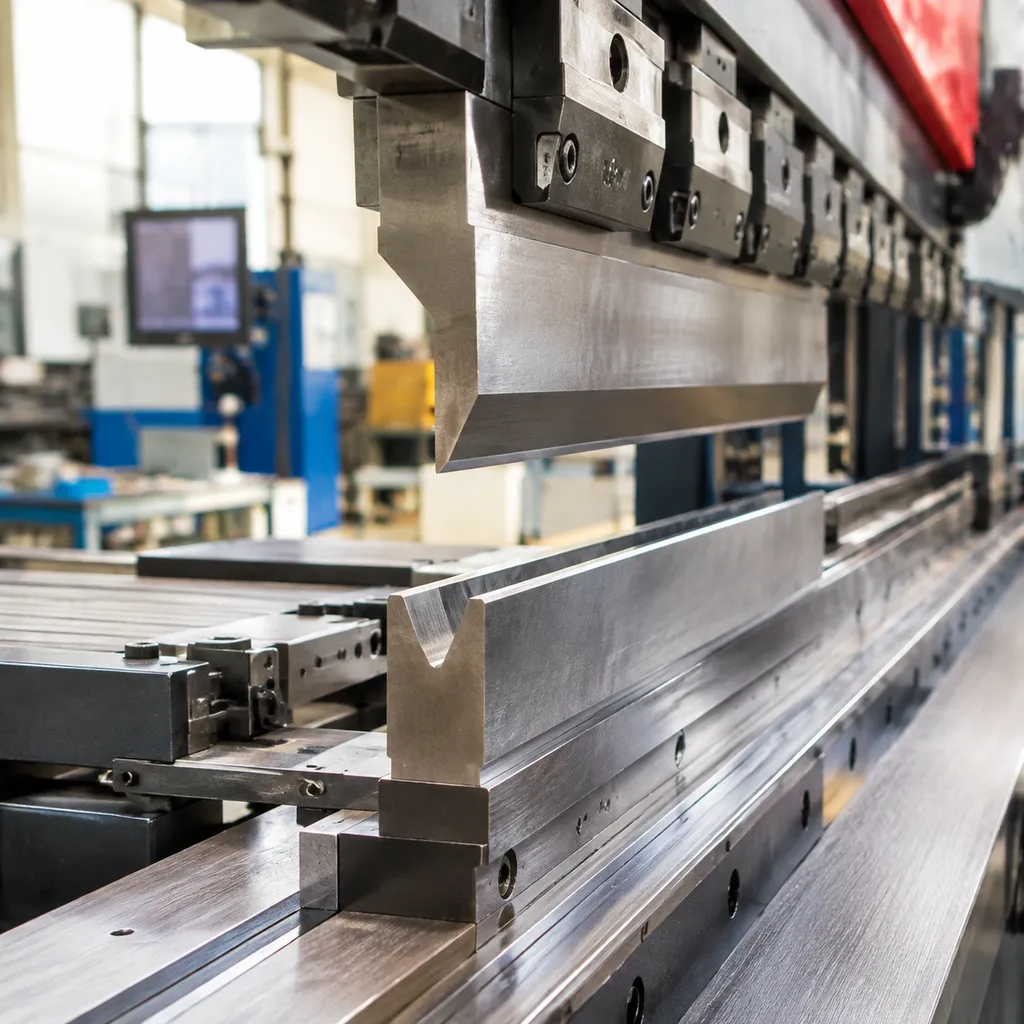
European Style Press Brake Tooling: Clamping Interface and Tang Standards
Promecam and Amada Style Tang Specifications
The European standard clamping interface uses a targeted tang-and-shoulder geometry designed for rapid vertical and horizontal tool installation. Our punches and dies lock securely into mechanical, hydraulic, or pneumatic clamping systems, ensuring full self-seating under initial clamping pressure.
- Standard Tang Width: 8.4 mm with precision safety retention grooves.
- Shoulder Contact: Precision-ground load-bearing faces that transfer vertical tonnage directly into the upper beam without stress concentrations.
- Safety Integration: Spring-loaded safety click buttons or fixed safety pins allow safe, rapid horizontal loading and eliminate drop hazards during setup changes.
| Interface Feature | Standard Specification | Fabrication Benefit |
|---|---|---|
| Tang Profile | Promecam / Amada Standard (8.4 mm) | Universal fit on standard European style intermediate clamping beams |
| Shoulder Heights | 12.7 mm / 20.0 mm reference shoulders | Repeatable tool height reference across all tooling segments |
| Safety Retention | Safety pins / Quick-click buttons | Prevents punch detachment before clamp lock engagement |
| Sectional Tolerance | ±0.01 mm to ±0.02 mm height matching | Seamless multi-segment bending without shimming or step marks |
Modular Sectional Alignment for Multi-Tool Setups
Setting up staged bending across long beds requires strict dimensional consistency. We grind every punch and die to tight working-height tolerances (±0.01 mm). When you combine multiple segmented pieces—such as 100 mm, 50 mm, or split sets—our tooling maintains uninterrupted centerline alignment and uniform bending angles across the entire length of your workpiece.
Tool Steels & Metallurgy for European Style Press Brake Tooling
Standard & High-Wear Alloy Grades
- 42CrMo (AISI 4140): Our primary alloy steel for standard precision bending. It delivers excellent structural integrity, fatigue resistance, and impact strength under high tonnage.
- Cr12MoV (AISI D2): An optional high-carbon, high-chromium tool steel designed for heavy-duty fabrication and abrasive sheet processing, offering extreme wear resistance.
- Specialty Options: We also supply grades such as T8A and 55SiCr for specialized bending profiles.
| Steel Grade | Core Hardness | Working Edge Hardness | Primary Applications |
|---|---|---|---|
| 42CrMo | HRC 28–32 | HRC 47 ± 2 | Universal CNC sheet metal bending, box forming, medium-to-heavy fabrication |
| Cr12MoV | HRC 30–34 | HRC 48–52 | Abrasive materials, high-production stainless steel, extended wear runs |
Heat Treatment & Precision Grinding
To ensure maximum tool life without the risk of brittle fracture under shock loads, our tooling undergoes a two-stage thermal process:
- Full-Body Quench & Temper: The entire tool body is heat-treated to achieve a uniform core hardness of HRC 28–32. This absorbs heavy bending forces and prevents the body from cracking or permanently deforming.
- CNC Induction Hardening: High-frequency induction hardening is applied directly to the working tip radius and die shoulder entry radii, achieving a localized hardness of HRC 47 ± 2.
- Precision Grinding Standards: All critical load-bearing surfaces, tangs, and contact radiuses are CNC precision ground to a working height tolerance within ±0.01 mm to ±0.02 mm. This micro-level accuracy guarantees seamless alignment when setting up segmented sections or pairing punches with our precision press brake V die tooling across the entire bed.
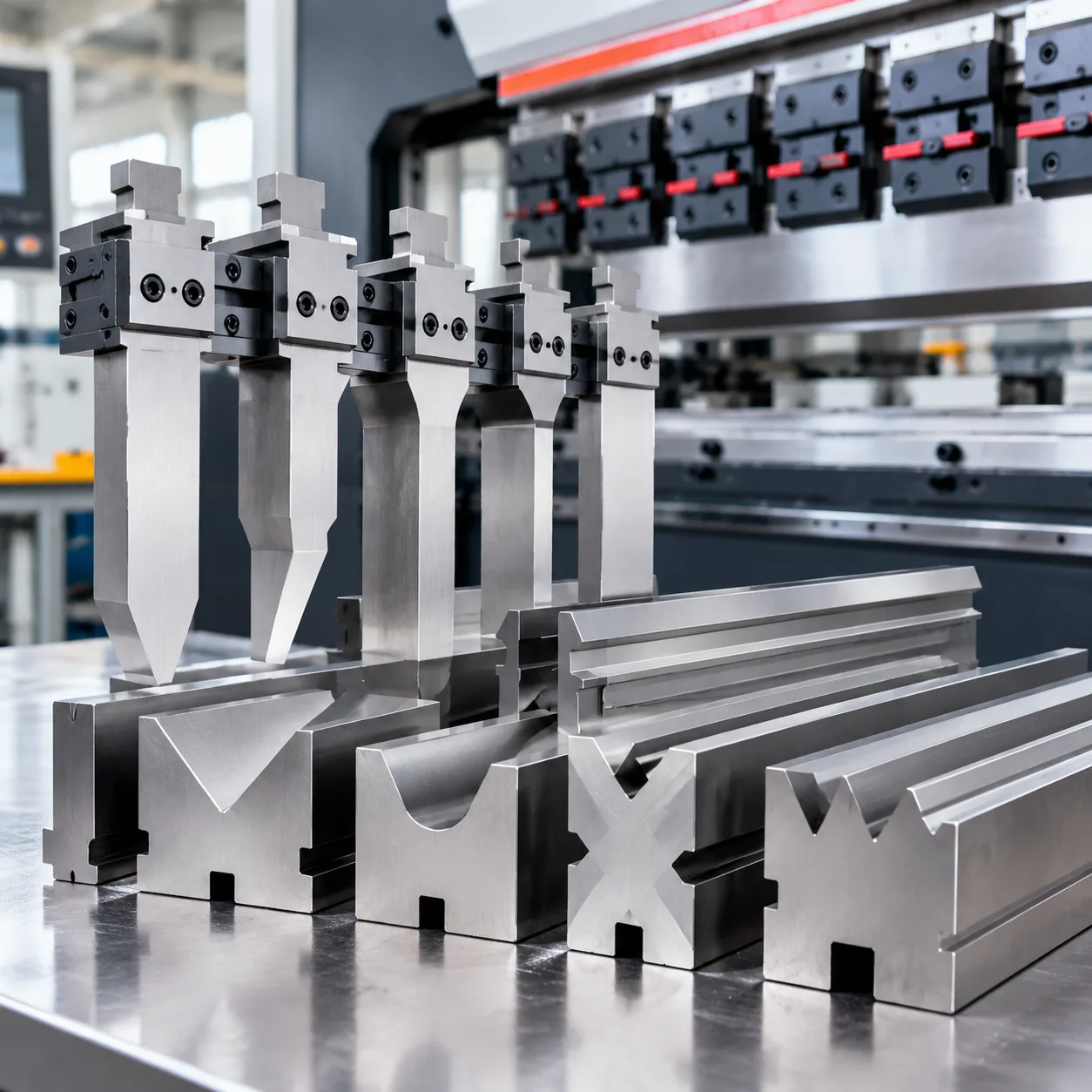
European Press Brake Punch Profiles and Selection
Standard Straight Punches (88° and 90°)
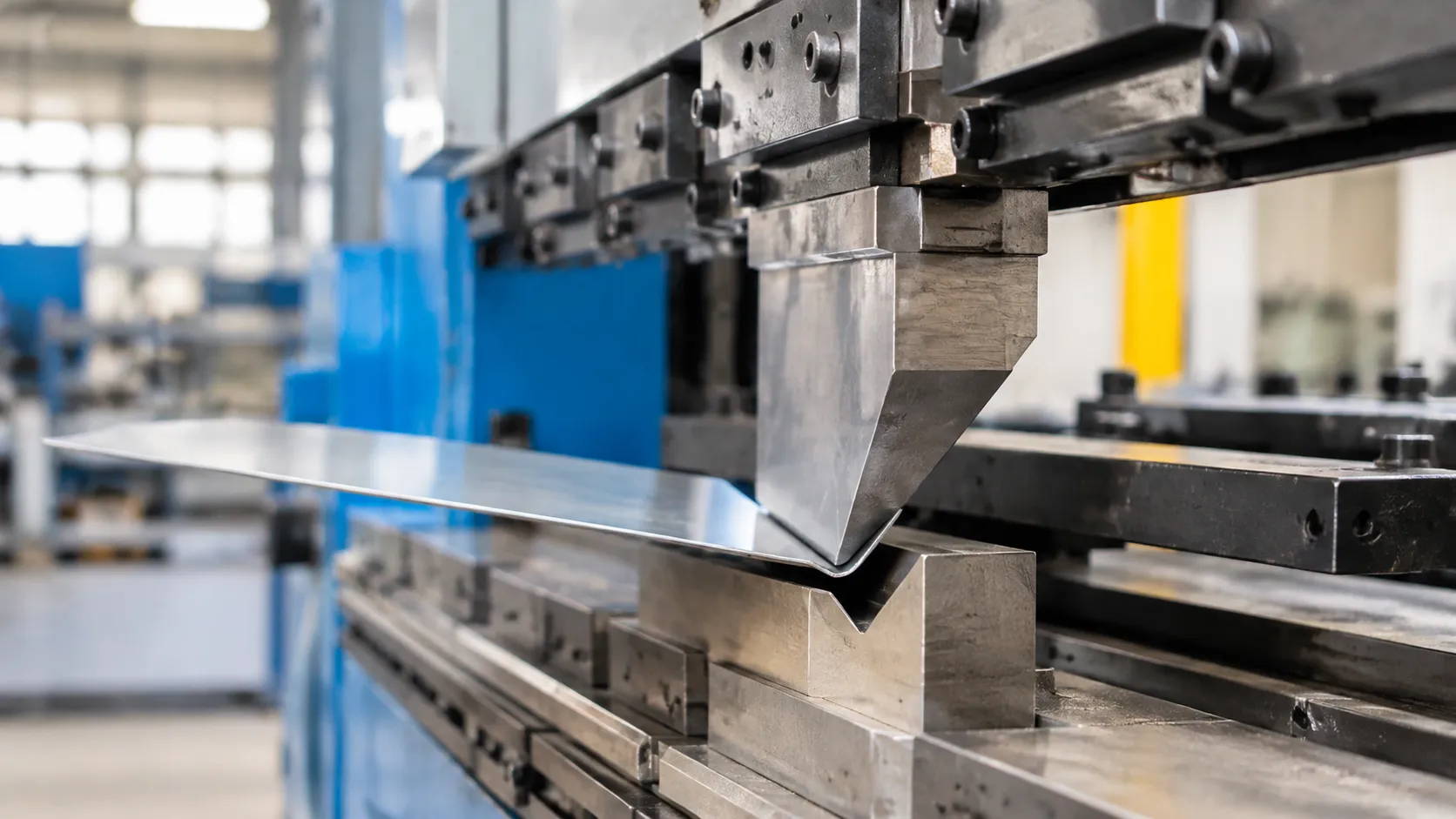
Standard straight punches serve as the core workhorse for everyday 88° and 90° air bending, shallow channels, and box forming. Designed with symmetrical profiles, they deliver maximum vertical rigidity under high tonnage, making them the primary choice for standard sheet metal parts without complex return lips.
Gooseneck Punches for Return Flange Clearance
When forming deep channels, narrow profiles, or complex enclosures, standard punches collide with the returning sheet. Our European standard gooseneck punches feature a deep relief pocket that provides clearance for secondary return bends up to 90° or acute returns. They keep parts moving without secondary setups.
Acute and Sash Punches (30°, 35°, and 60°)
For narrow profiles, tight air bends, and the first stage of two-step hemming operations, acute punches provide the necessary angular clearance.
30° & 35° Acute Punches: Allow for springback overbending in high-tensile sheets and serve as the pre-bend tool for tear-drop and flat hems.
Sash Punches: Feature narrow, relieved necks engineered specifically for window framing, architectural trim, and tight channel sections.
Hemming Compatibility: Pair these directly with our dedicated hemming punches for precise sheet metal forming to complete rapid two-stage hem production.
Heavy-Duty Radius Punches (R3.0 to R20.0 mm)
Bending high-strength structural steel or heavy plate requires distributed stress to prevent material cracking along the bend line. Our heavy-duty radius punches feature large tip radiuses from R3.0 mm up to R20.0 mm, precision-ground from high-yield 42CrMo to withstand heavy tonnage without edge deformation.
Punch Profile Selection Guide
| Punch Type | Typical Angles | Primary Application | Key Advantage |
|---|---|---|---|
| Straight Punch | 88°, 90° | General air bending, box forming | Maximum vertical load capacity |
| Gooseneck Punch | 86°, 88°, 90° | Deep U-channels, return flanges | Deep relief pocket prevents collision |
| Acute / Sash Punch | 30°, 35°, 60° | High-springback materials, pre-hemming | Narrow access and extreme angular reach |
| Radius Punch | 80°, 85°, 90° | Heavy plate, structural brackets (R3–R20) | Prevents outer-fiber sheet cracking |
European Die Types and V-Opening Configurations
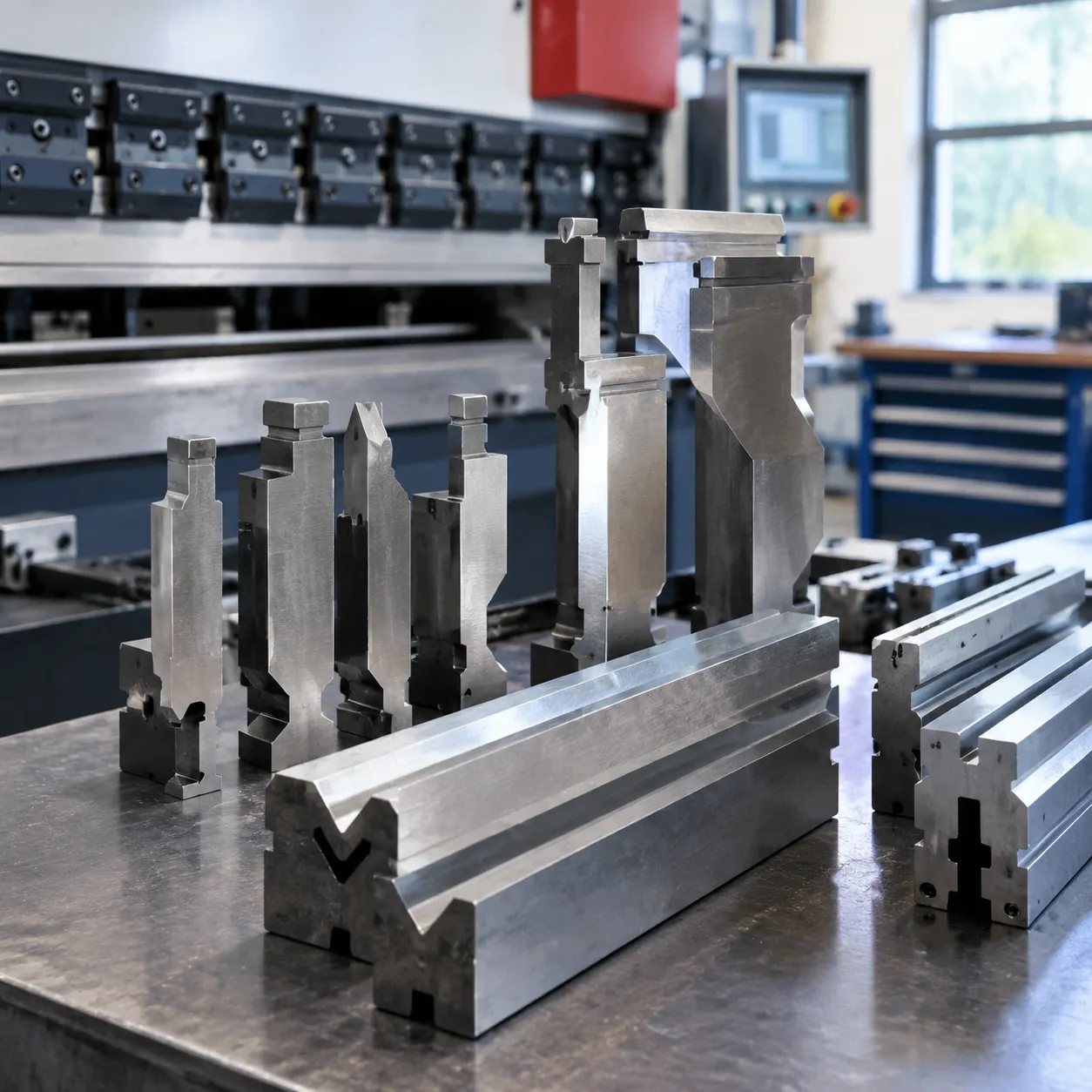
Matching the correct lower die geometry to your sheet thickness ensures consistent bend angles, precise radius control, and clean finishes. We manufacture European style press brake tooling dies from high-grade 42CrMo alloy steel, precision ground to ±0.01 mm tolerances with localized CNC induction hardening on high-wear radii.
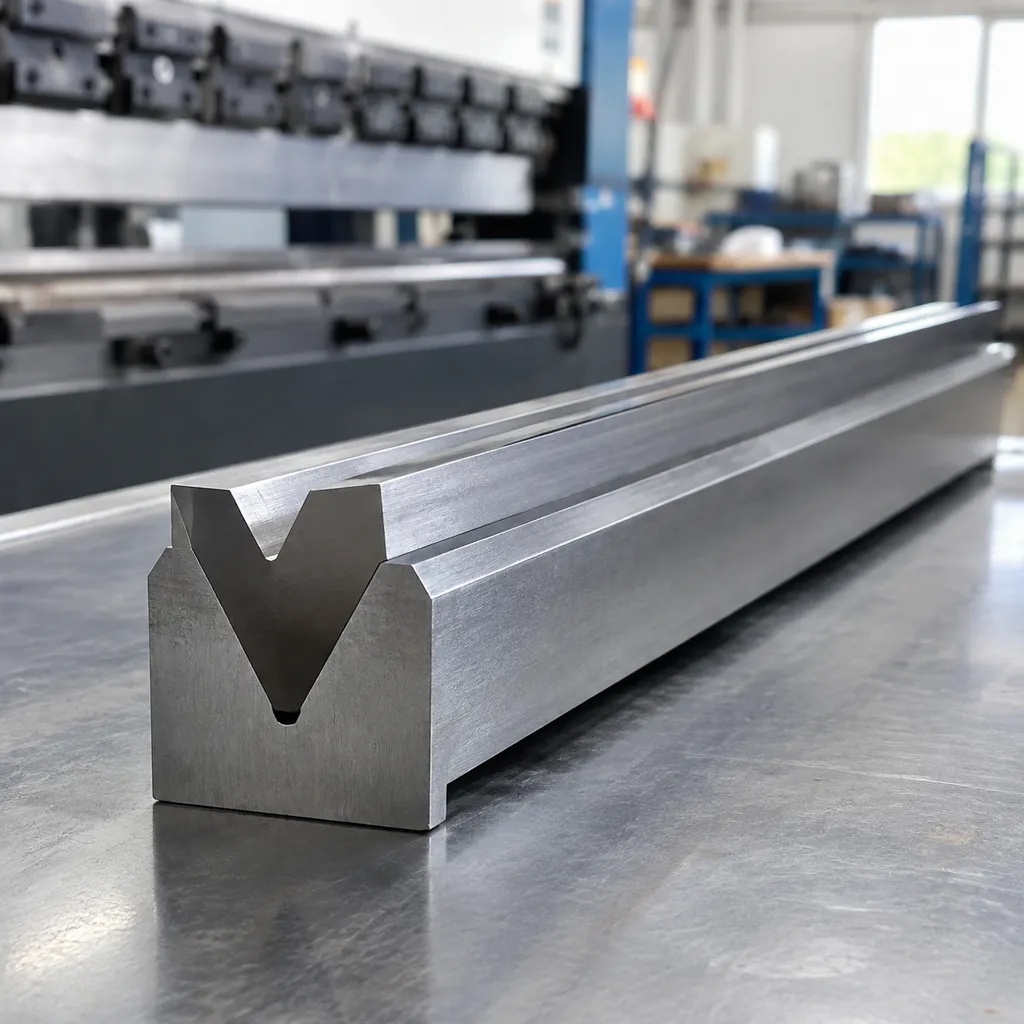
Single-V (1V) Self-Centering Dies
- Design: Dedicated single V-channel with standard European 12.7 mm / 20 mm mounting shoulders.
- Application: High-precision CNC air bending.
- Advantage: Self-centering shoulder seating locks directly into Euro-style bottom holders, maintaining strict tool centerline alignment across single and segmented setups.
Double-V (2V) Reversible Dies
- Design: Dual opposing V-openings on a single compact tool body.
- Application: Multi-gauge sheet metal bending.
- Advantage: Flip the tool 180° to switch between standard material thicknesses. Reviewing press brake die types explained for better metal bending helps identify the exact V-opening ratios needed for quick-change setups.
Multi-V Die Blocks
- Design: Solid 4-way and multi-opening square block configurations.
- Application: Heavy plate fabrication, structural steel, and variable-thickness bending.
- Advantage: Handles high tonnage loads with multiple V-sizes machined into a single monolithic block, eliminating frequent die swapping during heavy-duty runs.
Spring-Loaded and Pneumatic Hemming Die Sets
- Design: Integrated 2-in-1 acute pre-bend and flattening combination dies.
- Application: Fabrication of safety edges, decorative hems, and reinforced panel edges.
- Advantage: Combines the initial 30°/35° acute bend and the final flattening stroke into a single continuous station, removing secondary handling steps.
Rola-V and Markless Bending Dies
- Design: Hardened rotating steel roller inserts integrated into the die shoulders.
- Application: Mirror-finish stainless steel, pre-painted metal, and aerospace-grade aluminum.
- Advantage: Utilizing press brake dies with rollers for mark-free bending replaces sheet sliding friction with rolling contact, eliminating die lines, scratches, and post-bend polishing labor.
Standard Tooling Lengths and Segmented Split Sets
Monolithic Stock Lengths (835 mm & 415 mm)
For continuous, straight bending jobs across long parts, solid sections provide maximum rigidity and fast installation:
- 835 mm (Full Length): The primary industry standard for high-tonnage full-bed bending.
- 415 mm (Half Length): Ideal for shorter part runs, lighter handling, or filling specific open spans on the bed.
Standard 835 mm Segmented Box-Bending Breakdown
Forming enclosed trays and deep boxes requires leaving clearance for pre-bent return flanges. Our segmented press brake punch set configurations allow operators to assemble almost any target bend length in 5 mm increments.
| Segment Size (mm) | Quantity | Purpose / Application |
|---|---|---|
| 100 mm (Left Horn) | 1 | Deep box clearance on the left side |
| 100 mm (Right Horn) | 1 | Deep box clearance on the right side |
| 100 mm (Straight) | 1 | General span building |
| 50 mm | 1 | Intermediate spacing |
| 40 mm | 1 | Fine span adjustment |
| 20 mm | 1 | Fine span adjustment |
| 15 mm | 1 | Precise box width tuning |
| 10 mm | 1 | Micro width tuning |
| Total Set Length | 835 mm | Full modular sectional set |
To confirm profile clearances across different machine setups, check our press brake die size chart and dimensions guide.
End-Matched Precision Grinding for Zero-Step Transitions
A common frustration with low-grade segmented punches and dies is the visible step mark left on parts where two segments butt together. We eliminate this issue through precision CNC end-matched grinding:
- Tolerances within ±0.01 mm: Working heights and centerlines are ground uniformly across the entire batch.
- Seamless Tool Alignment: Individual pieces from our segmented sets can be combined in any order along the bed without height discrepancies or uneven tonnage loading.
- Interchangeable Spares: If an operator damages a single 15 mm or 50 mm piece, a replacement segment drops straight into the setup without needing to re-grind the rest of the set.
Machine Compatibility and Press Brake Clamping Systems
Tooling misalignments and loose clamping cause uneven bend angles and fast edge wear. We build our European style press brake tooling to match industry-standard receivers without modification, seating firmly across OEM upper beams and lower beds.
[ Press Brake Ram / Upper Beam ]
│
┌─────────────┴─────────────┐
│ Mechanical / Quick Clamp │ ◄── Clamping Plate
└─────────────┬─────────────┘
│
[ Safety Tang/Pin ]
▼
[ European Style Punch ]
OEM Machine Compatibility
Our Euro style punches and dies fit mechanical, hydraulic, and pneumatic clamping systems across leading press brake brands:
- Direct Fit: Fully compatible with Amada tooling systems, Promecam, Durma, Yawei, and Accurpress.
- Adapted Systems: Readily mounts to Bystronic tooling setups and LVD machines using standard European conversion intermediate plates.
Clamping Interface Configurations
We machine our tangs to precise tolerances to support two primary clamping setups:
- Manual Mechanical Clamping: Uses heavy-duty clamp plates that seat into the precision safety groove. This locks the punch tang securely against the upper beam shoulder, preventing horizontal walk or drop during installation.
- Hydraulic and Pneumatic Quick Clamps: Designed for fast, vertical front-loading. The integrated safety click pins snap directly into automated hydraulic or pneumatic clamping bars, cutting setup changeovers down to seconds while maintaining exact center alignment under full load.
Custom European Tooling Design and OEM Manufacturing
When standard catalog profiles cause flange collisions or fail to meet tight bend radii, our engineering team develops engineered-to-order European style press brake tooling built directly around your part drawings. Through our specialized custom press brake tooling manufacturing services, we transform complex bending challenges into reliable production setups.
- 2D/3D CAD Profile Analysis & Simulation: We run collision detection on your step files to verify punch neck relief, return flange clearance, and die shoulder entry before machining begins.
- Tonnage Safety & Springback Calculations: We calculate exact bending forces against machine ratings and adjust punch tip angles to compensate for material yield strength and springback.
- CNC Machining & Targeted Hardening: Tools are milled from premium 42CrMo alloy steel, full-body quenched, and localized induction hardened along working tips to HRC 47 ± 2 for extended service life.
- CMM Quality Inspection: Every custom European punch and die segment undergoes CMM dimensional inspection to verify working heights and profiles within ±0.01 mm tolerances for seamless modular alignment.
European Style Press Brake Tooling Ordering and RFQ Checklist

Key Parameters to Provide
To ensure seamless compatibility and accurate bending performance, provide these primary job parameters:
Material Grade & Tensile Strength (σᵦ): Mild steel (e.g., Q235, A36), stainless steel (304/316), or aluminum alloys require different tonnage ratings and tip radii.
Sheet Thickness (t) & Inner Bend Radius (Rᵢ): Determines the proper V-die opening width (typically V = 6 × t to 8 × t) and punch nose profile.
Target Bend Angle (α): Critical for calculating springback compensation and acute angle relief. Refer to our press brake die angles guide for springback selection to verify standard vs. acute die options.
Minimum Flange Length (bₘᵢₙ): Ensures the workpiece will not slip into the V-groove before reaching the bend threshold.
Machine Mounting Interface: Confirm whether your brake uses standard Promecam-style manual mechanical clamps, quick-change hydraulic systems, or pneumatic adapters.
Required Technical Parameter | Why It Matters | Standard Default / Rule of Thumb |
|---|---|---|
Material Tensile Strength | Helps prevent exceeding tool load capacity (kN/m) | Mild steel: ~450 MPa; stainless steel: ~700 MPa |
Sheet Thickness (t) | Determines V-opening width and punch tip radius | Bending load increases approximately with the square of sheet thickness under otherwise equal conditions |
Bend Angle & Target Radius | Helps prevent tool collisions and accounts for springback | 88°/90° for standard bends; 30°/35° for acute bends |
Minimum Flange Height | Helps prevent the sheet from slipping into the V-groove during forming | Typically bₘᵢₙ ≈ 0.7 × V |
Tool Length / Split Configuration | Determines clearance for four-sided box forming | 835 mm solid, 415 mm, or segmented tool sets |
Multi-Station Tool Layout Planning
If you run progressive, multi-bend setups across a single bed, provide the complete bend sequence. We configure matched common-height punch and die sets with consistent shut heights so your operators can step through complex parts without adjusting the machine stroke or recalibrating backgauges between bends. Choosing the right female press brake V-die for precise sheet metal bending alongside matching punches guarantees consistent bend lines across every station.
Frequently Asked Questions About European Style Press Brake Tooling
What is the difference between European (Promecam) and American style tooling?
European style press brake tooling utilizes a standardized narrow tang profile with integrated safety grooves or quick-release buttons, centered directly under the load axis. American style tooling relies on a wider top tang clamped with standard set screws from the side. European punches and dies deliver superior self-centering repeatability, tighter height alignment tolerances (within ±0.01 mm to ±0.02 mm), and faster modular setups for complex sheet metal bending.
Can I run European style tooling on an American standard press brake?
Yes. You can install upper clamp adapters and lower die holders that convert standard American clamping bars to accept Euro style press brake tooling. If your shop operates mixed equipment lines, our press brake die replacement for American and European styles enables seamless profile matching, consistent shut heights, and complete tooling interchangeability across different press brake brands.
How does induction hardening depth affect tool life and fracture resistance?
A tool hardened all the way through becomes brittle and risks catastrophic failure under high-tonnage point loads. We balance structural integrity by full-body quenching and tempering our 42CrMo tooling to a tough core hardness of HRC 28–32, then apply localized CNC induction hardening to the working tips and contact shoulders up to HRC 47 ± 2. This combination eliminates tip deformation while absorbing continuous shock loads during heavy-duty forming.
What are the standard split dimensions in an 835 mm European segmented punch set?
Segmented tooling sets let operators configure specific lengths for four-sided box forming, deep return flanges, and narrow channels. A standard 835 mm segmented punch set is precision ground as a matched batch to prevent stepped seams across joints:
| Segment Length (mm) | Standard Quantity | Purpose / Feature |
|---|---|---|
| 100 mm (Left Horn) | 1 pc | Box side clearance |
| 100 mm (Right Horn) | 1 pc | Box side clearance |
| 100 mm (Straight) | 1 pc | Main straight run |
| 50 mm | 1 pc | Mid-range adjustment |
| 40 mm | 1 pc | Fine spacing |
| 20 mm | 2 pcs | Fine spacing |
| 15 mm | 1 pc | Micro spacing |
| 10 mm | 1 pc | Micro spacing |